Scottish Fossils Fill The Gap In The Evolution Record

Balanerpeton Woodi

350 million years ago, Scotland was part of a much bigger land mass and lay slightly south of the equator.

When the Scottish summer feels little different from the Scottish winter, it is time to ponder Scotland’s journey over millions of years from the equator to its present position.

On its way north, Scotland brought with it the fossils of small tetrapods, ancestors of every land creature of present times, including man.

Romer’s Gap

But until the Scottish fossils were discovered, there was a gap in the record known as Romer’s Gap, named some ninety years ago after American palaeontologist Alfred Sherwood Romer.

Specifically, there was no fossil evidence of life on land in the fifteen-million-year gap that stretched from 345 to 360 million years ago in the early Carboniferous period.

There was plenty of evidence of life in the sea from 360-million years ago and earlier.

And there was evidence of life on land from 345-million years ago and later – but nothing in between.

Because this gap is the very period when animals moved from the sea to the land, it was a niggling mystery that there was no evidence of life in that fifteen-million-year period.

Enter Self-Taught Palaeontologist Stan Wood

And that’s how things were until a self-taught Edinburgh palaeontologist named Stan Wood began looking in the Borders area in Scotland. He searched for fifteen years before he found what is now recognised as the oldest land-based animal fossils in the world.

From 2008-2011, he uncovered fossil animal skeletons, along with millipedes, scorpions and plants in sites in Scotland.

You can see some of his discoveries at the Fossil Hunters: Unearthing the Mystery of Life on Land exhibition at the National Museum Of Scotland in Edinburgh.

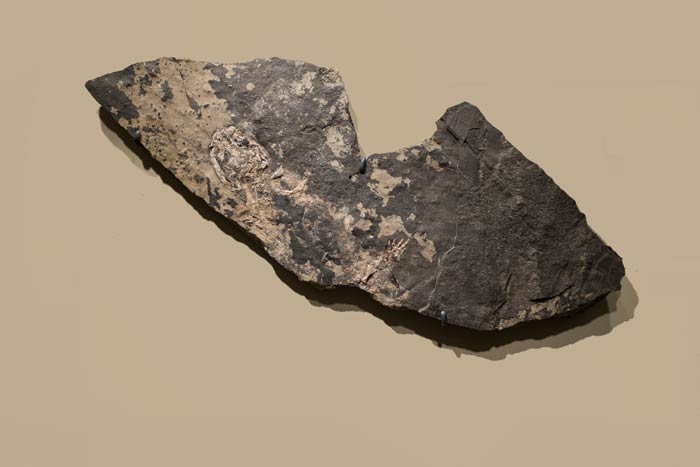
The photo at the beginning of this article is of a fossil discovered by Stan Wood. It is Balanerpeton Woodi. It looked like a salamander and it was about a foot long. Here is a close-up photo of one of its hind feet. You can see it in the top photo as well, near the middle of the slab of rock.
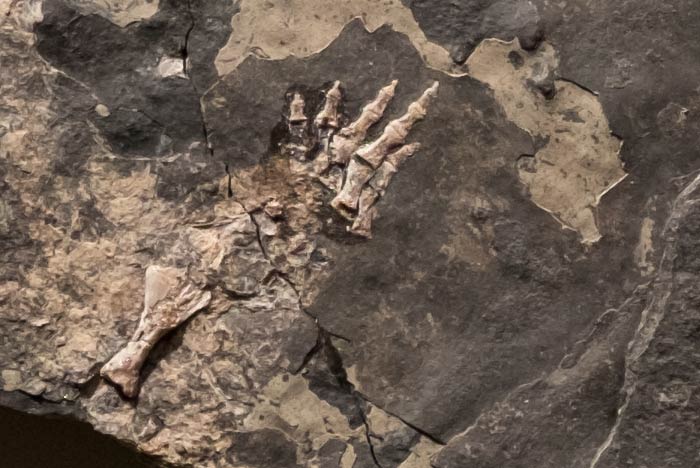
A close up of the bones of the foot of Balanerpeton Woodi

And here is a close-up of its head showing the flattened salamander-like shape. You can even see the top of its spinal column and the shoulder blade girdle.
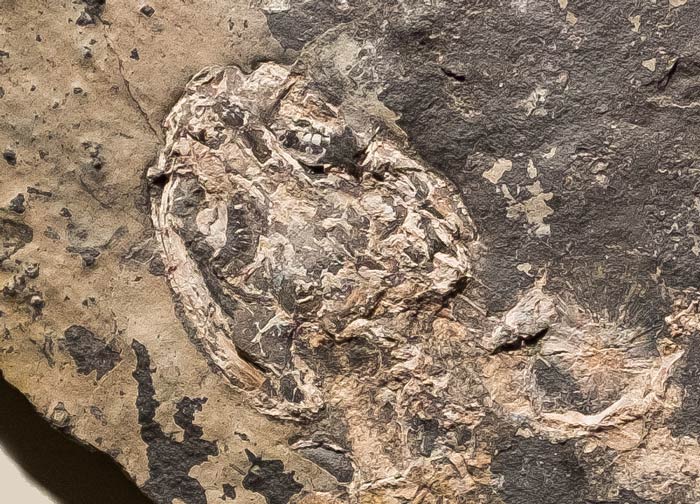
head-of-balanerpeton-woodi

Stan’s Fossils and Edinburgh Museums

Stan donated his fossil discoveries to Edinburgh Museums and there are lots of fossils to see at the exhibition, which runs until 14th August and it is well curated. Go see it if you can. After that, the exhibition will be touring the UK.

Project Tweed

Stan Wood’s discoveries have led on to Project Tweed, involving teams from the Universities of Cambridge, Leicester and Southampton, the British Geological Survey and National Museums of Scotland.

They are working through the material at a microscopic level, investigating everything from plant spores to micro-skeletons to build up a picture of life during Romer’s Gap.

Stan Wood achieved an international reputation as a palaeontologist. He was also the owner of Mr Wood’s Fossils at Cowgatehead at the top of the Grassmarket in Edinburgh. The shop is still there – owned and run by the former manager, Matt Dale.

Matt Dale

Matt took over as manager in 1998. He had been working with fossils in museums in Glasgow following a geology degree and museum studies post-graduate course. Then with Stan’s health failing, Matt bought the business in 2006 and continued following Stan’s death in 2012.

Matt says you’ll find him in the shop most days – unless he is at trade shows in France and the USA, or out in the field looking for fossils.


mr woods fossil shop in edinburgh filling romer's gap

If you like this post, why not take a look at our ecard service featuring original photos like these. Find out more about Quillcards here.

What It’s Like Inside The Beak Of A Pelican

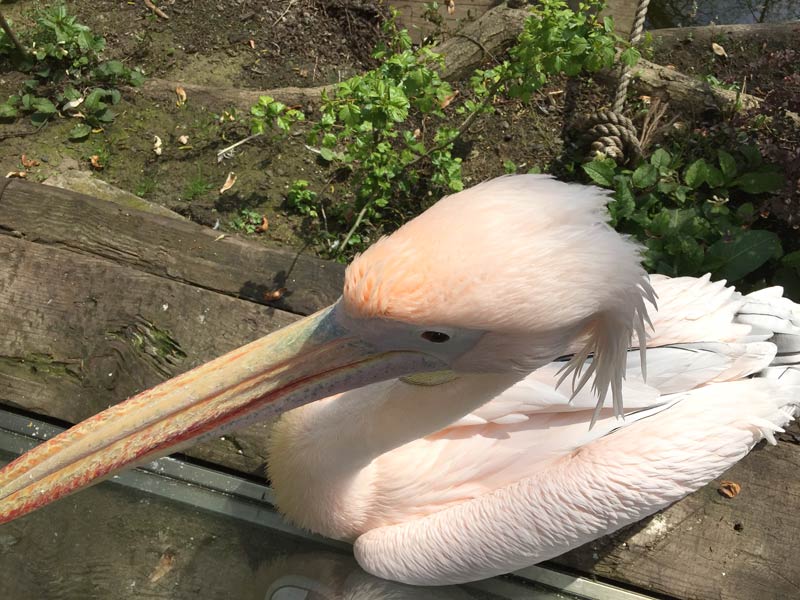
three pelicans

pelican with beak close up

Inside The Beak Of A Pelican

At the zoo a month ago, we watched the pelicans. It’s obvious that they are very gregarious. As soon as one of them found something interesting to investigate on land, the others would follow and congregate and huddle close to one another.

The pelicans were so friendly that two of them reached up to say hello to us.

And Tamara and I had the experience of having our hands inside a pelican’s beak.

When the pelican closed its beak on my hand, the upper beak felt like being tapped gently with a thin piece of lightweight wood. It was a pleasant experience being investigated delicately by a large bird.

When the pelican closed its beak around my hand, the edge of the beak rasped against my hand as though with very tiny teeth. They were not sharp – just a faint rasp as they closed around my hand.

It was easy to understand that the tiny teeth are for draining water from its throat pouch when the pelican folds its wings, dives into the water, and rises to the surface with fish in its beak.

Because the lower beak is stretchy and translucent, light shines through it and illuminates the inside. Tamara noticed this, and soon we both experienced seeing all the way down the pelican’s throat into its gullet.

Inside the beak of a pelican is like a highway illuminated by yellow light.


Here’s Dixon Lanier Merritt’s limerick that, with several variations over the years, often springs to mind when discussing or thinking about pelicans:

A wonderful bird is the pelican,
His bill will hold more than his belican,
He can take in his beak
Enough food for a week,
But I’m damned if I see how the helican.

Smit Marks – A Practical, Quick, And Simple Way To Identify Sheep

When they are half a field away, ewes know their lambs and lambs know their mothers by their bleats. But if you are a farmer rather than a sheep, then you need another practical, quick, and simple way to identify your sheep.

When sheep are fenced in a field, then the only sheep that need quick identification are strays that manage to escape the field. That happens a lot with some breeds, whose only purpose in life is said to be a desire to push themselves through any opening that presents itself.

Of course, it’s a different story on open, unfenced ground where flocks can mix freely – such as up on the hills of Northern England. Up there it’s the whole flock that can become mixed in with other flocks.

In former times, knowing which sheep belonged to who was important also on Common land. Common land was land that was owned by the village as a community. The village made communal decisions about planting and grazing, including when sheep were let out to graze. And when that happened, sheep from different flocks mixed freely.

Then the Enclosure Acts of the 18th and 19th centuries fenced off the Commons and passed the ownership from the local community to one farmer. Some called it highway robbery; some called it the march of progress.

But whether for strays or whole flocks, how was a farmer to know which were his sheep? From close up he would know them by their lug marks – distinctive cuts to the lug of their ears. But from far away, the farmer or the shepherd needed a different method.

Smit Marks

If you have seen sheep in the lowland fields and on the hills in the UK you may have noticed the paint marks on their fleeces. They are smit marks and farmers have been using them for hundreds of years to identify who sheep belong to.

A daub of paint – perhaps two marks of red or one of black – nearer the haunch or the shoulder. From these a farmer would know which were his sheep and which belonged to his neighbour.

The paint was a mixture of a pigment to give the colour and grease or whale oil to make the mixture stick.

The pigment might be powdered iron ore or graphite or powdered stone. Farmers used pigments rather than natural dyes because they would retain their colour over the year and not be bleached away by the sun.

Of course, once a sheep was sheered the process had to be repeated. This shorn sheep could be asking what happened to its smit marks…

A Guide To Smit Marks

Smit marks were complex. There were crosses and dots and stripes of colour on the back, the neck, the haunches and on the near side and the far side of the sheep.

And which was the ‘far’ side? Well, if you imagine a sheep standing sideways to you with the head to your right, that is the far side.

With all that complexity it is no wonder that in 1817 Joseph Walker published the first manual of smit marks. He published the manual for his home area of Martindale and the surrounding valleys in the Lake District in the north-west of England.

His guide was so popular – so popular that over the next 80 years or so other farmers published guides to many other parts of the country.

The need for a guide is not surprising bearing in mind the number of sheep. Even today with much reduced numbers there are still around twenty million sheep in the UK.

The Present Day

In the 21st century, sheep are required by law to have digital tags implanted under the skin. Their main use is to identify a sheep when disease strikes and action needs to be taken quickly.

Flocks are transported long distances for mating and to sell at auction. And the Lake District is just a few hours away by wagon from the south coast nowadays.

The result is that disease can spread rapidly all over the country. This happened in the terrible foot-and-mouth disease epidemic of 2001 in the UK.

Foot-and-mouth disease affects pigs, cattle, deer, and other animals, and in the 2001 epidemic around ten million sheep and cattle were slaughtered and their carcasses burnt in an effort to halt the disease.

But even with implanted tags, farmers today use traditional smit marks to know at a distance which sheep belong to them and which to their neighbours.

Chemical Dyes

It’s mostly chemical dyes that are used nowadays, and as you can see from the photo at the beginning of this article, the chemical dye on these sheep is a nice shade of green.

But what about this Swaledale ewe with a large smit mark in a lovely shade of ochre. The mark could easily be iron ore with its reddish colour. Perhaps it is.

So next time you are out in the countryside, remember the smit marks that trace their history back hundreds of years to a different England, a different UK.