Gannets on Bass Rock

Bass Rock in the Firth Of Forth sticks out of the water with sheer cliffs all around.

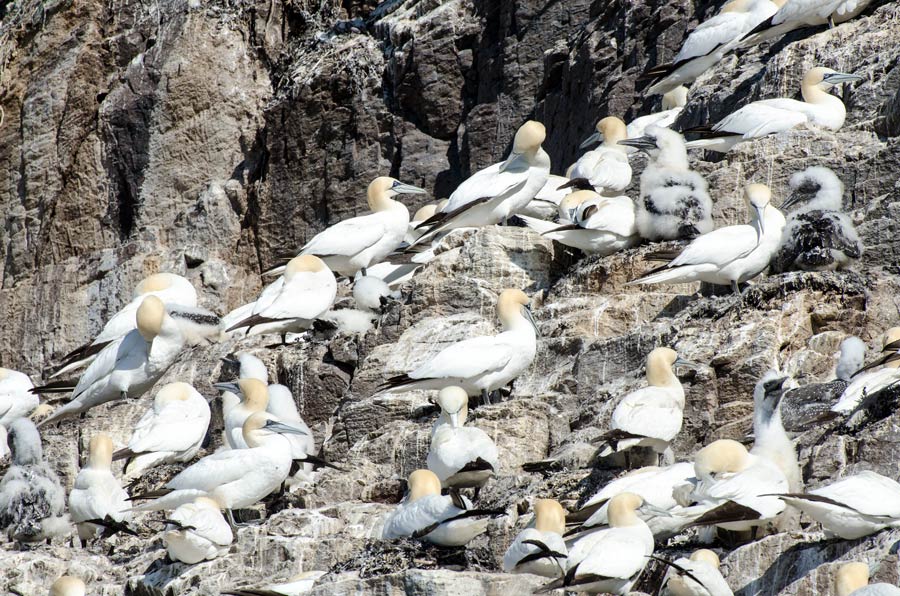
From a distance the top of the rock looks white. It’s white with the density of gannets that call it home during the breeding season.

At 150,000 birds, it’s the largest colony of Northern Gannets in the world. It has grown year on year but looking back to earlier in the 20th century there were no gannets.

The top of the rock was green – the green of meadows and planted fields. The produce from them helped to support a small population of lighthouse keepers and their families.

The lighthouse is still in use but since 1988 it has been run by remote control. The Commissioners of the Northern Lighthouse Board monitor it from their headquarters in Edinburgh.

With the human disturbance gone the gannets claimed the rock as their own. And once established, the breeding pairs return year after year.

Visiting in 2015

The Scottish Seabird Centre run trips to Bass Rock. Landings depend on the weather and you need to be fit.

I and eleven others were in an inflatable RIB, having just visited the Isle Of May.

On the way back to North Berwick we idled in the waters for a while. We didn’t land but we did see gannets. I was truly staggered with the sheer numbers overhead. It was amazing – one of those times when my head stops and I know I am enjoying something so deep that it clears the fog.

That’s when I took these shots.
Woof! Bearded Collies

Sitting on a grooming table at the Scottish Breeds Show, a Bearded Collie sat patiently, immobile even, while all around him dogs were being walked, groomed, tended to, displayed, exhibited, and judged.

Not only Bearded Collies, but also other Scottish breeds at the 31st General Championship Show of the Scottish Breeds Canine Club held at the Royal Highland Centre at Ingliston, near Edinburgh, on 28th March.

My wife Tamara thought it would be interesting to go see the show. And it was interesting. For example, dog exhibitors take a cage and a portable grooming table to the shows. That’s quite a lot of paraphernalia involved in exhibiting.

And everyone was forever brushing and grooming their dogs.

And pushing their dog’s back feet backwards and their front feet forwards so that they stood ‘just so’ when they were being judged.

And the judges felt down the length of the animals backs and haunches and opened their mouths and looked at their teeth – ‘My, what big teeth you have.’

They were all lined up and ready to be judged. They were all incredibly patient and calm, waiting for their turn to strut their stuff and run around the ring with their owners. The way their long fine hair sweeps behind them, Bearded Collies look like they are heading into a gale-force wind when they are just trotting at a comfortable pace.

The dog won best of breed at Crufts this year was in the top seven dogs at Crufts in all classes. Its owner Ms Waldron from Middlesex got first prize here, too..

Colinton

Colinton is a village outside Edinburgh. It can be reached by bus (#16 from the town centre) and then it’s a short walk to the parish church.

As a child, the author and poet Robert Louis Stevenson stayed in Colinton, where his grandfather was the Minister of the parish church.

The river known as The Water of Leith runs below the church, and Stevenson wrote a poem about the games he played near the water mill as a child. He reflects on how, when he and his friends are adults and return home, the mill wheel will still be turning.

Keepsake Mill

Over the borders, a sin without pardon,
Breaking the branches and crawling below,
Out through the breach in the wall of the garden,
Down by the banks of the river, we go.

Here is the mill with the humming of thunder,
Here is the weir with the wonder of foam,
Here is the sluice with the race running under
Marvellous places, though handy to home!

Sounds of the village grow stiller and stiller,
Stiller the note of the birds on the hill,
Dusty and dim are the eyes of the miller,
Deaf are his ears with the moil of the mill.

Years may go by, and the wheel in the river
Wheel as it wheels for us, children, to-day,
Wheel and keep roaring and foaming for ever
Long after all of the boys are away.

Home from the Indies and home from the ocean,
Heroes and soldiers we all shall come home;
Still we shall find the old mill wheel in motion,
Turning and churning that river to foam.

You with the bean that I gave when we quarrelled,
I with your marble of Saturday last,
Honoured and old and all gaily apparelled,
Here we shall meet and remember the past.

It’s a poem about growing up and returning to things and seeing them in a new way – appreciating that in its earthly wisdom, the mill has kept on turning.

Of course, in the 21st century the Earth is shifting under our feet with the prospect of environmental worries on a scale beyond that which we can rescue or redeem.

The church was designed by the architect Sidney Mitchell, an Edinburgh architect. The church was built in 1908 and replaced an earlier church that itself replaced a yet earlier one.

The man who gave me the information about the church told me that the design is neo-Byzantine.

Having spent some time in Finland, I was struck by the Nordic feel to the design – light and airy and down to earth rather than stratified and authoritarian. Well, egalitarian with perhaps the exception of the pulpit which is raised above the congregation.

There is a path that leads from the church to Collinton Dell, where I took this photo. It is a lovely feeling to be able to take a bus away from the city and reach the countryside so easily.

I saw a nuthatch and several long-tailed tits in the trees – and it’s nice to look forward to taking a walk here when the weather is warmer in the Spring.