Almscliff Crag – North Yorkshire

Originally published November 1, 2008

Almscliff Crag in North Yorkshire, England, is an outcrop or tor of gritstone, visible for many miles around. It is a site of special scientific interest – a protected site under the Wildlife and Countryside Act of 1981 and a venue for climbers who boulder on it and walkers who want to look around the area from a high vantage point.

Bouldering is a branch of climbing concentrating on difficult technical problems, often just a few feet off the ground. Gritstone is a hard rock and, not surprisingly, feels very gritty and rough to the touch, and provides very good friction for climbing.

For the climbers who come to do some bouldering, Almscliff is within easy reach of Harrogate, and quite near the road, so dragging a crash mat up from the car is not hard. A crash mat is a kind of portable mattress onto which a climber can jump down to avoid landing on hard or stony ground.

Yorkshire gritstone is also called millstone grit because it was used for making millstones for grinding wheat. Whilst millstone grit is a hard rock, the grit must surely have rubbed off and become mixed with the wheat. Certainly, from time to time a stone would have to be dressed, which involved cutting fresh furrows in the stone where they had worn down rubbing against the opposing stone.

Walking around the base of the outcrop on a bright October day, cow pats dotted the grass. We could imagine cows wandering around the base of the rocks high above the surrounding countryside.

Beatrix Potter and Herdwick Sheep

Beatrix Potter, the internationally known children’s story writer and illustrator, and creator of the character Peter Rabbit, was a keen supporter of the Herdwick breed of sheep and helped save it from extinction.
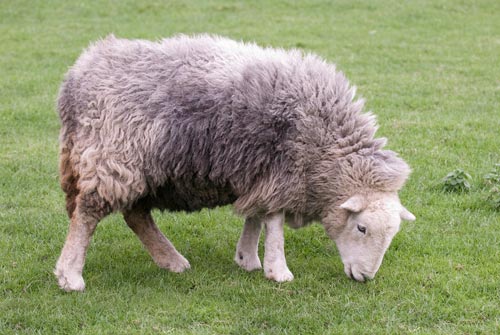
herdwick

This was part of her wider vision to preserve that part of England known as the Lake District. She wanted to preserve it from irresponsible development and ensure that so far as possible it would continue to be farmed in the way that had shaped its landscape over hundreds of years.

Part of what formed her vision is the contact she had with the founders of the National Trust, an independent charity formed in 1895 and dedicated to the preservation of the English countryside.

She and the Trust worked together, including farming some farms jointly to prevent them being broken up.

Beatrix Potter died in 1943 and at the time of her death she owned several farms in the Lake District totaling more that 4,000 acres (1,600 hectares), all of which she dedicated to be left to the National Trust following the death of her husband in 1945.

In 1951 an area of 885 square miles (2,230 square kilometres) was dedicated as the The Lake District National Park, ensuring it would be preserved from development.

National Parks in Great Britain are controlled and funded by the UK government. The farms that Beatrix Potter owned lies within the Lake District National Park and therefore have the double protection of being within the Lake District National Park and also owned by the National Trust.

Beatrix Potter’s farms comprise less than one percent of the Lake District National Park but her vision and that of the National Trust were instrumental in moulding the attitudes that resulted in the creation of the National Parks.

She bought Troutbeck Park Farm in the 1920s and built up a flock of over 1,000 Herdwick sheep, which she did in part because she felt they should be preserved as a breed because they were indigenous to the Lakeland fells with a history going back hundreds of years.

Herdwicks were under threat because they are slow growing sheep which give birth to fewer lambs than lowland sheep and therefore struggled on the balance sheets of working farmers against the advantages of other breeds.

Following her death the farms she owned and her Herdwick flocks were endowed to the National Trust with conditions attached to the continuation of the Herdwick breed.

The outbreaks of Foot and Mouth disease in England in recent years have again put strain on the viablility of the breed. This has made the conditions attaching to Beatrix Potter’s endowment to the National Trust an important factor in maintaining Herdwicks as a breed.

Herdwicks have magnificent coats with a lovely mix of gray, white, and brown wool. They are described as being hefted to the hill on which they are raised, which means that they know their home and will not stray from it.

And while Herdwicks are local to the Lake District, I took this photograph of a Herdwick sheep at a model farm in Yorkshire that specializes in maintaining a mixed flock of original English breeds.

You can send distinctive ecards featuring our photographs by Joining Quillcards.
Photographing Musical Instruments

I spent this morning photographing musical instruments. I wasn’t primarily interested in capturing what is sometimes referred to as a record image of the instrument, which is an image that captures the best possible view of the subject to show the viewer what the thing looks like in reality.

Rather, what I wanted to do was to capture something that I would like to see as an image. And that ‘something’ is the riddle of photography.

It’s a bit like archery – there’s a kind of summing up of what is the right thing to do, and then a click and let go.

But unlike archery, the photographer has to make a mental translation of the image from the 3D image he can see in the viewfinder to the 2D image as it will appear on the page.

Still, you can’t just go on thinking and thinking – your hands get tired and your mind gets tired, so there is a tension in the coming together of the thoughts and the vision and the click of the shutter.

And it has to be like that – you can’t go on beating your brow and agonizing over taking a photograph – click and let go.

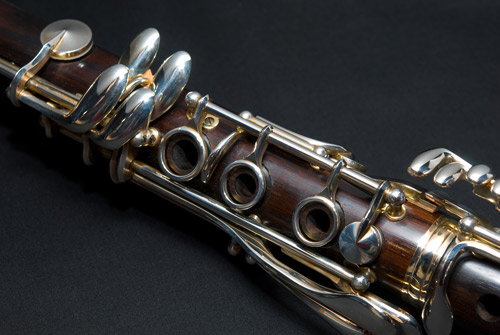
This clarinet is a good example of the ‘problem’, and these are the running thoughts I had as I was photographing it.


    How much of the clarinet do I want to show?

    If I photograph the whole length of the instrument, it is going to make a photograph of a long, skinny object, so most of the frame will be devoid of anything at all?

    Should I have it running from top left or top right? What difference will that make to the way a viewer feels about the shot?

    If I shoot it against a dark background, will that capture the luxuriousness of the instrument, which is what I want?

clarinet