Osage Orange

Walking along the path in the Botanic Garden that runs more or less parallel to Trumpington Road, we came across dozens and dozens of what looked like yellow-green balls beneath two trees. They looked like versions of yellow tennis balls, only much bigger. The biggest we probably about 20cm (8inches) in diameter.
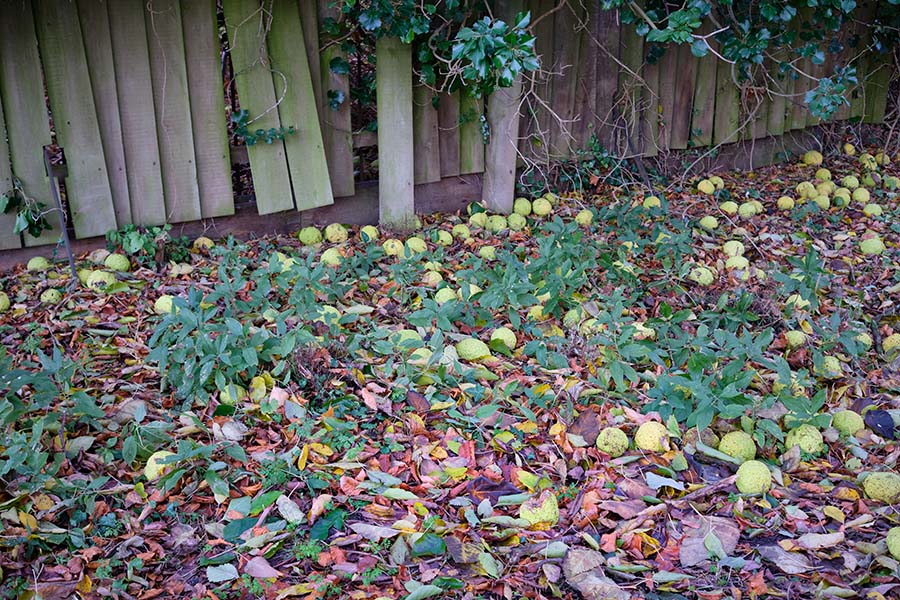
How hadn’t we seen them before when they were on the trees? How could we have failed to see them?

Mark pulled one apart and we could see they didn’t have a peel or a shell. Rather they were self-contained versions of something like a cauliflower, with the stalks reaching into the middle of the ball, and the surface tightly packed.

Maclura pomifera, commonly known as the Osage orange, horse apple, hedge, or hedge apple tree, is a small deciduous tree with these fruiting bodies. The fruit are inedible to humans and more or less inedible to animals save for black-tailed deer in Texas and fox squirrels in the Midwest. The belief is that they were once the food of a species of animal that is now long extinct.

Their range is in a fairly narrow area of the South West United States.

Leaves in Late November

In the Botanic Garden, near the Hills Road entrance, the Copper Beech has lost almost all of its leaves, as has the Wild Service tree.

A few trees have kept their leaves – the Italian Alder and three young Liquidambar Orientalis (Oriental sweetgum). The leaves on the Liquidambar are a mix of fresh green and yellow leaves. The Caucasian Wingnuts are in leaf with lots of dark green leaves.

The Platicarya looks like it did in the summer, and while there are of leaves on the ground and some of the smaller branches have lost leaf, overall it looks in full leaf. Close up, the leaves themselves look just a bit more veined in contrasting green and yellow than they did in summer.

The gardeners have chopped down the Gunnera leaves and piled them in stooks by the stream. The leaves look fresh and green. I remember last year how they matted down to a deep purple-blue soggy mass.

Squirrels and Mast Years

Over a period of about ten days in September, I visited the Cambridge University Botanic Garden three times. On the first two visits I saw maybe five or six squirrels but on the third visit I saw around fifty young squirrels. Why so many squirrels, so suddenly?

I asked CUGB, and the wildlife experts wrote that in their opinion the reason was that:

Last year was a mast year for oaks. Mast years happen in intervals of round 7-10 years and are years when oaks produce masses of acorns and this is synchronised- so all the oaks in an area will do the same thing. This provides an abundance of food for species like squirrels who then overwinter very well and then are able to breed really well the following year. Now’s the time that lots of young ones are becoming independent and are out and about more. Hence lots of squirrels. When its not a mast year, there are fewer acorns and this is a way that plants can keep their herbivores in check. See this article in the Woodland Trust site, what is a mast year?