Poetic Timing
Three days after Pablo Neruda was hospitalized with cancer in his native country of Chile in the autumn of 1973 after having been very ill for some weeks before, he died of heart failure on September 23rd at the age of 69.
However, it wasn’t in just any month that Neruda’s final days took place: On September 11th less than two weeks before he died, a career military man named Augusto Pinochet spearheaded a coup d’etat to overthrow the government of Neruda’s friend, Chile’s first socialist president named Salvador Allende.
Although Allende had run unsuccessfully for the presidency three times before he was finally elected in 1970, he had a respected political career that had endured for forty years during which time he served as a senator, deputy, and cabinet minister.
Moreover, Allende was also a physician, a respected pathologist whose ground-breaking epidemiological work during the 1930s helped establish the field of social medicine in Latin America.
What mattered the most to the United States who engineered Pinochet’s coup d’etat, however, was the fact that Allende was the first Marxist socialist to be a democratically elected president of a state in the Americas.
Brave Mourners
Even as the news swept through the world that the legendary poet, diplomat, political activist, and intellectual free spirit was gone, Pinochet refused to give his permission to transform Neruda’s funeral into a public ceremony. In response, thousands of grieving Chileans took to the streets.
Pinochet could not prevent their actions as they bravely disobeyed curfews and crammed the streets to attend the poet’s funeral.
In this way, Neruda’s funeral served as the catalyst for the first public protest in Chile against Pinochet’s military dictatorship.
Shunning the ‘Practical’
Born in the town of Parral in Chile on July 12, 1904, Pablo Neruda began life as Neftali Ricardo Reyes Basoalto.
His mother, a teacher, died soon after his birth. Afterwards he grew up with his father, a railway employee who wanted his son to have a ‘practical’ occupation.
Hoping that he could keep his poetry from his father by assuming another name and because he happened to be living in a time when it was stylish to adopt a pen name, Neftali assumed his pen name of Pablo Neruda when he was only a teenager.
Roots
Neftali fashioned his pen name from two sources: from the Czech writer and poet named Jan Neruda, and it is thought that his first name was inspired by the French poet Paul Verlaine which he translated into the Spanish ‘Pablo’.
The poet continued to be known by variations of his real name, however, until he legally changed his birth name to his pen name in 1946.
Worldwide Influences
Neruda’s writing was influenced by French, Russian, and Latin American writers.
However, he declared that the writer who inspired him the most was the American poet Walt Whitman.
The Exceptional Poet
When he was only in his twenties, Neruda became famous for a collection of his Spanish-language poems that spoke of melancholy, love, and eroticism.
Written in 1924, the title of this collection translated from the Spanish is Twenty Love Poems and A Song of Despair.
Not Lost in Translation
On ‘la Rive Gauche’ (the Left Bank of the River Seine) in Paris during the 1920s, an American free thinker named Sylvia Beach opened Shakespeare and Company, a bookstore that she turned into a famous gathering place for Paris’ literary expatriate elite.
Among others, Ernest Hemingway, George Bernard Shaw, Gertrude Stein, and Ezra Pound came to her store for their doses of English literature and literary conversation.
Shakespeare and Company still exists today, an alternative reincarnation of the original. Besides the (sometimes musty) shelves with its creative collection of books that are crammed inside the store, this Parisian landmark also displays racks of used books outside on its sidewalk to tempt strolling passersby.
And so it happened that when David and I visited the store last year, he spotted a French translation of this same Twenty Love Poems and A Song of Despair that had endeared Neruda to the Spanish-speaking public when he was young – and so David took this photograph:
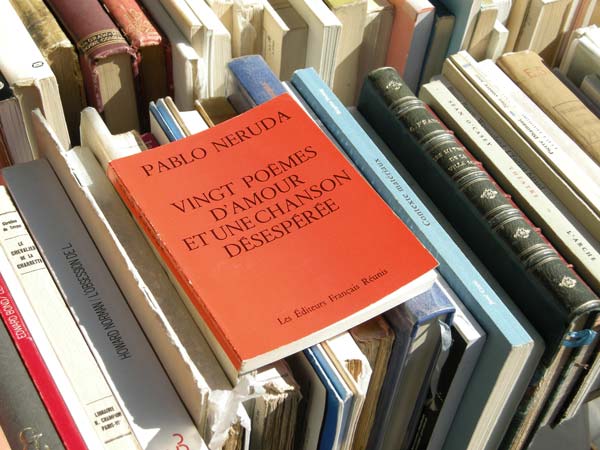
This photograph is available as a Quillcards ecard.
Poetic Leanings
Here is an excerpt from one of Neruda’s poems in this celebrated collection captured in this photograph:
From Twenty Love Poems: 7
Leaning into the evenings
Leaning into the evenings I throw my sad nets
to your ocean eyes.
There my loneliness stretches and burns in the tallest
bonfire,
arms twisting like a drowning man’s.
….
The night birds peck at the first stars
that twinkle like my soul as I love you.
Night gallops on her shadowy mare
scattering blue wheat stalks over the fields.
(translated from the Spanish by Mark Eisner)
Diplomatic Assignments
Along with his writing, Neruda was engaged in other work through the government of Chile who bestowed upon him a number of honorary consulships in Burma, Sri Lanka, Java, Singapore, Argentina, Spain, France, and Mexico between 1927 to 1943.
During that period, he continued with his poetry. This included writing enigmatic surrealist poems, historical epics, and undisguised political manifestos, all of which are present in his 1933 collection called Residencia en la tierra.
Mourning Lorca
The cruelty that political conflict can wreak was heightened for Neruda three years later during the summer of 1936 when his cherished friend Frederico Garcia Lorca was executed.
One of the most critically acclaimed Spanish poets and playwrights of the twentieth century, Lorca was killed soon after he wrote the last of his trilogy of plays that included Blood Wedding, Yerma, and The House of Bernarda Alba.
Arrested by nationalist supporters of General Franscisco Franco and murdered without a trial, in death Lorca became an early martyr of the Spanish Civil War.
Lorca’s leftist leanings and his supposed homosexuality had sealed his fate at the hands of the country’s fascists.
Buried in a mass grave, Lorca’s great works were officially banned in Spain until 1971.
The Poet as Political Activist
Lorca’s brutal death, the ongoing Spanish Civil War, plus the poverty that Neruda witnessed in his native Chile had a profound effect on him.
It also propelled him to help 2,000 Spanish Republican refugees dislocated by the Spanish Civil War to relocate to Chile.
Following this, Neruda served as the Chilean consul to Mexico in 1940.
Poems that he wrote during that time in Mexico were included in Tercera Residencia. Although the book was published in 1947, he had actually begun writing parts of it in Spain before his appointment as consul to Mexico.
Explaining Things
Included in Tercera Residencia is Neruda’s poem called I Explain Some Things.
In this poem excerpted here, he addresses his dear, murdered friend Frederico (that is, Frederico Garcia Lorca):
I Explain Some Things
You will ask: And where are the lilacs?
And the metaphysics laced with poppies?
. . . .
Frederico, you remember,
from under the earth,
do you remember my house with balconies on which
the light of June drowned flowers in your mouth?
. . . .
Traitor
generals:
behold my dead house,
behold Spain destroyed:
. . .
Come and see the blood in the streets, . .
(translated from the Spanish by Mark Eisner)
Consciousness Raising
In the early 1940s preceding the publication of this poem and others in Tercera Residencia, several events had impressed upon Neruda the need for unity among peoples: the German attack against the Soviets in 1941; the extension of war throughout the world; a visit to Guatemala in 1941; and a subsequent visit to Cuba in 1942.
Then in 1945, the poet was elected to Chile’s Senate and he also joined the Communist Party.
Fleeing to Argentina
Three years later, the Chilean President Gabriel Gonzalez Videla began to openly persecute labor unions, the Communist Party, and also Neruda.
Neruda responded by going into hiding, ultimately fleeing to Argentina by 1949.
Celebrating Latin America
The year after he was forced to take flight to Argentina, Neruda published Canto General (“General Song”), his tenth book of poems.
An epic piece of writing containing 15 sections, 231 poems, and more than 15,000 lines, Canto General displays Neruda’s heightened appreciation of humanity that he had gained during the early 1940s.
In the collection, he paid homage to political heroes, indigenous leaders, and historical battles.
In addtion, Canto General bore out Neruda’s assertion that Walt Whitman inspired him the most. Described as a ‘Whitmanesque catalog’, it also contains Neruda’s detailed observations about South America’s natural beauty.
Honoring Peru’s Macchu Picchu
After visiting Macchu Picchu in Peru, for example, Neruda wrote the series of poems included in Canto General called The Heights of Macchu Picchu.
It was in those poems that he celebrated the region’s austere beauty.
Macchu Picchu, often called ‘The Lost City of the Incas’, has remained one of the most familiar symbols of the Inca Empire.
Taking Multi-National Corporations to Task
Canto General contains another poem called The United Fruit Co, a poem through which Neruda makes tongue-in-cheek observations about how multi-national corporations at that time had the upper hand over politicians.
It was this that enabled those huge associations to claim for themselves what ‘Jehovah’ [God] had actually intended for mankind to receive, Neruda further claimed.
Here is how Neruda expresses this in this excerpt from his poem:
The United Fruit Co.
When the trumpt sounded, everything
on earth was prepared
and Jehovah distributed the world
to Cola-Cola Inc., Anaconda,
Ford Motors, and other entities:
The Fruit Company Inc.
reserved the juciest for itself,
the central coast of my land,
the sweet waist of America.
It re-baptized the lands
“Banana Republics”
… .
(translated from the Spanish by Jack Hirschman)
The United Fruit Company
Neruda was specifically referring in his poem to the United Fruit Company (UFC), a major US corporation of the time that traded in vegetables and tropical fruit (mainly bananas and pineapple). The food that the company traded in was grown in Third World plantations for sale in the USA and Europe.
By the mid-20th century when Neruda wrote The United Fruit Co., UFC controlled huge swathes of land and transportation systems in Central America, Columbia, Ecuador, and the West Indies. Although it competed with another company named Standard Fruit Company for command in the banana trade around the world, in certain regions it did hold a monopoly.
UFC ran into bad financial times, eventually merging with AMK in 1970 to become the United Brands Company, and in 1984 that brand was transformed into the present-day Chiquita Brands International.
Banana Republics
Several Latin American countries were deeply impacted by UFC in their economic and political development. At the time, critics like Neruda accused UFC of exploitation through neocolonialism, describing the conglomerate as embodying the stereotype of what happens when a multinational coroporation has too much influence on the internal politics of so-called ‘banana republics’.
Coined by the American author O. Henry in 1904, the term ‘banana republics’ became a perjorative one to describe a politically unstable country that is dependent on limited agriculture (like bananas) and ruled by a small, corrupt, and wealthy clique of people.
Such a political reality was one that Neruda thoroughly despised.
Reflecting On Insomnia
Neruda’s worries about his native country of Chile continued. This is illustrated in this excerpt from his poem called Insomnia which was written in 1964, fourteen years after he had composed The United Fruit Co.:
Insomnia
In the middle of the night I ask myself,
what will happen to Chile?
What will become of my poor, dark country?
From loving this long, thin ship so much,
these stones, these little farms,
the durable rose of the coast
. . . .
(Translated from the Spanish by Alastair Reid)
The ‘Long, Thin Ship’
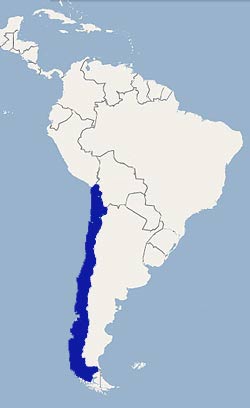
Neruda’s graphic characterization in Insomnia where he compared Chile to a ‘long, thin ship’ mirrors what Chile physically looks like, as you can see here.
A Presidential Candidate
Six years after Insomnia was written, Neruda was nominated as the candidate for the Chilean presidency in 1970.
However, in the end he gave his support to Salvator Allende.
Allende went on to win the election, and later that year he became the first democratically elected socialist head of state.
Not too long after he became president, Allende appointed Neruda as the Chilean ambassador to France. After serving at this post from 1970-1972, however, the poet returned from France in ill health.
Winning the Nobel Prize for Literature
It was during that period in 1971 that Neruda received the Nobel Prize for Literature, the same year by chance that the ban on his martyred friend Lorca’s works was finally lifted in Spain.
Neruda had actually sought to win the Nobel Prize for years. However, some of the Nobel Prize committee members were reluctant to award him the prize.
Why was this so? Because like so many leftist intellectuals of his generation, Neruda had supported the Soviet Union of Joseph Stalin because it had had a hand in the defeat of Nazi Germany during WWII.
In the end, however, his Swedish translator named Artur Lundkvist persuaded the Nobel Prize committee members to change their minds about Neruda.
Neruda was the 72nd annual recipient of the Nobel Prize for Literature .
To give you an idea of the caliber of his fellow Nobel laureates for literature, Neruda followed Samuel Beckett and Alexandr Solzhenitsyn who received the awards in 1969 and 1970 respectively.
What Love Has to Do With It
Going full circle from the poet’s Nobel prize that he won towards the end of his life back to his first triumphant collection of poems called Twenty Love Poems and A Song of Despair (that brought him his first taste of fame in his early twenties), here is another excerpt from what I think is one of his most beautiful poems from that collection:
From Twenty Love Poems: 14
Every day you play with the light of the universe.
Subtle visitor, you arrive in the flower and the water.
. . . .
You are like nobody since I love you.
Let me spread you out among yellow garlands.
. . . .
My words rained over you, stroking you.
A long time I have loved the sunned mother-of-pearl of
your body.
I go so far as to think that you own the universe.
I will bring you happy flowers from the mountains, bluebells,
dark hazels, and rustic baskets of kisses.
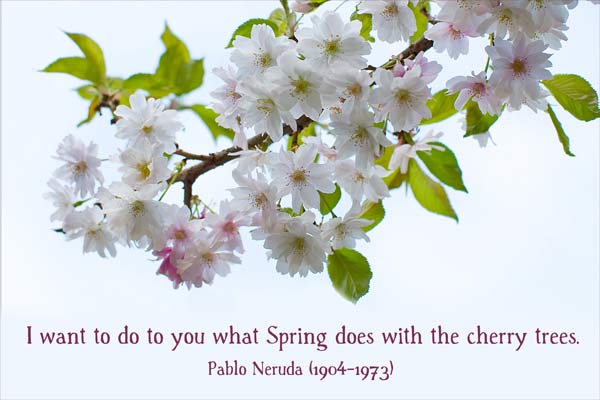
I want to do with you what Spring does with the cherry trees.
(Translated from the Spanish by W.S. Merwin)
I paired the last line of this poem with a photograph that David took of cherry blossom here in England, and together we created this image for one of our ecards:
This image is available as a Quillcards ecard.
‘Poetry Is Like Bread’
What did Neruda think about this genre of poetry that was his lifeblood?
According to a wonderful book edited by Mark Eisner called The Essential Neruda Selected Poems, Neruda characterized poetry as follows:
On our Earth, before writing was invented, before the printing press was invented, poetry flourished. That is why we know that poetry is like bread; it should be shared by all, by scholars and by peasants, by all our vast, incredible, extraordinary family of humanity.
Last Words
In addition, towards the end of the acceptance speech that Neruda made when he received the Nobel Prize for Literature only two years before his death in 1973, Neruda had this to say about his life and his art:
I come from a dark region, from a land separated from all others by the steep contours of its geography.
I was the most forlorn of poets and my poetry was provincial, oppressed, and rainy.
But always I had put my trust in man. I never lost hope.
It is perhaps because of this that I have reached as far as I now have – with my poetry and also with my banner.
____________________________________________________________
References
Book:
‘The Essential Neruda Selected Poems’ edited by Mark Eisner, a co-publication of City Lights Books and Fundacion Pablo Neruda, 2004.
Websites:
Nobelprize.org
Wikipedia
Who2
Sarah Browning
Paper:
‘Commentary: Salvador Allende and the birth of Latin American social medicine’ by Howard Waitzkin, International Journal of Epidemiology, Oxford University Press, 2005.