The Lowdown On Photographs And Aspect Ratios

We shoot most of the photographs for our ecards using digital SLR cameras. A few of our photographs are, however, shot on film and then scanned.

Whichever method we use to capture the photographs though, the aspect ratio of the images we use for our ecards – that is the length of the long side of the image compared to the length of the short side of the image – is 3:2.

Some people may think that the aspect ratio of an image changes with the size of the photograph.

The fact is though, that if the image is scaled up or down, the aspect ratio doesn’t change. The ratio of the length of the two adjoining sides is the same no matter how big or small the photograph is.

Photographs For This Blog
It’s a different story with the photographs we take for this blog. Here we crop the images in different ways to illustrate a story and to suit the layout of the article. Sometimes we also set the text so that it flows around the cropped photographs as in this article about tea.

Nature Photographs Suit A Panoramic Format
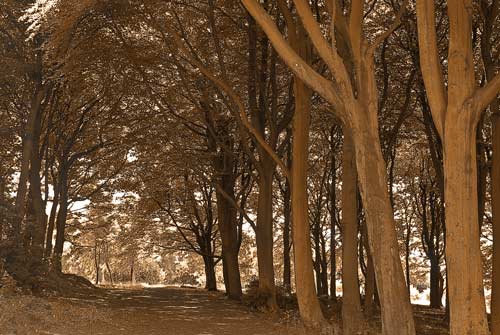
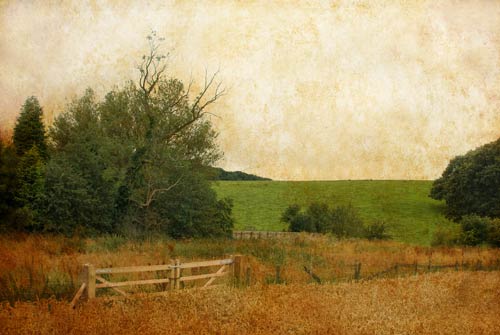
Images of trees and fields suit a wide format because the interesting parts of the image lay more or less in a horizontal line and a panoramic photograph mimics the way we generally look at the landscape.

South Yorkshire Landscape

Orientation
One thing that causes confusion is the use of the word landscape when talking about photographs. That is because as well as refering to trees and fields, etc., it is also used to describe which way up a photograph is oriented.

It is easier to show than to describe.

Both of these blue rectangles have the same 3:2 aspect ratio but one is in portrait orientation and the other in landscape orientation. Of course, the principle works whatever the aspect ratio.

Also, if I were to turn a panoramic image that was in landscape orientation on its side I would get a bookmark.

Same Aspect Ratio - Different Orientation
Same Aspect Ratio – Different Orientation

Large Elements In Photographs
Panoramic images works can also ‘work’ where there is a large element in the photograph, such as a country house set in a landscape. Here is an example of an image that is an amalgam of six images merged in Photoshop. It shows a country hall in South Yorkshire, England set in its surroundings.

The house and its grounds are now owned by the local authority for the benefit of everyone, though it was once a privately owned house in which one family lived.

Cannon Hall - South Yorkshire
Cannon Hall – South Yorkshire

The existence of these country mansions makes me think of the fact that in a more equal society the house would never have been built nor the trees planted. On the other hand, everyone can now enjoy the house and grounds because of the inequality that went before.

Portraits
Long, narrow, panoramic images can look great for landscapes but would look a bit unusual if used, for example, for a studio portrait. Having said that, a panoramic shot that shows the person and also includes some of the background can look good, as Arnold Newman’s 1946 portrait of the composer Igor Stravinsky shows.

Newman posed Stravinsky with his arm resting on his grand piano. Stravinsky is at one end of the photograph and the bulk of the photograph is taken up with the shape of the piano. It is a great example of the panoramic format working well for a portrait.

It’s an unusual portrait because the composer’s head and shoulders occupy only a six per cent of the total area of the photograph. Nonetheless it is a powerful photographic portrait.

Back To The Aspect Ratio We Use For Our Ecards
As I said at the beginning of this article, for our ecards we use the 3:2 image format. It is not just chance that we do so, and in fact the 3:2 aspect ratio has been the most popular format throughout the history of photography.

There is a very good reason why 3:2 is the most popular image format. It is a very good compromise – being neither too long and narrow nor too square – and therefore it suits a variety of subjects.

Aspect Ratios - From Square To Panoramic
Aspect Ratios – From Square To Panoramic

The Dominance Of The Three To Two Aspect Ratio
But though it seems to be a good all-round compromise, how precisely did 3:2 become the dominant ratio for film and digital cameras worldwide?

The History Of Film
There is no absolute reason that film had to be in this format, and throughout the history of film there have been many film formats other than this.

None however has been as popular as the 35mm film that has been used by countless millions of people worldwide since the early Kodak and Leica cameras gave people the portability and ease of use they wanted.

In Thomas Edison’s Laboratory
The reason that the format became the most popular may simply be that the earliest roll film made for the new ‘compact’ cameras was in 3:2 format and the momentum grew from that.

That film was made in the 1890s by William Dickson in Thomas Edison’s laboratory.

What Dickson did to make the ‘new’ film for still photography was simply to cut lengthwise down the 70mm movie film stock supplied to him by the Eastman Kodak Company. Then as they say, the rest is history.

Putting It In The Frame
Of course, film is cut into rolls to fit in the camera, so it is the really the size and shape of the metal frame or mask that sits in front of the roll of film in the camera that determines the actual frame size and shape of the photographic negative.

Without that frame or mask, a roll of film is just that – a roll – and the individual frames can be any size at all, so long as the lens will focus a sharp image on it.

After a few false starts and a bit of haggling, the size of the frame or mask was settled on by Eastman Kodak at 36 x 24mm -which is of course the 3:2 aspect ratio because 36 is one and a half times 24mm.

And it is the shape of the frame that is really what we are talking about when we speak about the aspect ratio of the individual photograph recorded on a roll of film.

So for the best part of a century the film that you or I would buy from the store – whether made by Kodak, Fuji, Agfa, Ilford, or any of the other brand names that were once common but of which many no longer exist – would be 35mm film made to fit cameras that produced images in a 3:2 image format.

35mm Film From Kodak And Fuji

The Transition To Digital
Kodak, Nikon, and Canon were among the earliest manufacturers of digital cameras for the mass market. They already made film cameras so it was probably a matter of simple economics for them to make digital cameras that used the parts they already used in their film cameras.

Or perhaps they simply decided to stick with the 3:2 aspect ratio that people had become used to.

This aspect ratio is used in the dSLR (digital Single Lens Reflex) cameras we use and have used here at Quillcards – the Nikon D700, the Nikon D60, and the Nikon D200.

And that is why the photographs for the Quillcards ecards are in the proportions they are. That and the fact that the 3:2 aspect ratio is still a good compromise and suitable for all kinds of subjects.

Compact Point and Shoot Cameras
As digital cameras matured, camera manufacturers recognised that they were free to make camera sensors in any aspect ratio they wanted. As a result, the manufacturers of many compact point and shoot digital cameras have opted for a slightly squarer 4:3 format.

Some manufacturers even offer a range of formats within the same camera. Of course, what that really means is that when the format is changed, the frame masks off part of the sensor.

The compact camera that I use as a digital ‘notebook’ is the Panasonic LX3. It has a standard rectangular 3:2 format sensor but it also has a mask operated by a switch that changes the format to 4:3 or 16:9. It also has a custom setting in its menus that enables 1:1 or square format.

Cropping The Image
Of course once any photograph has been taken it is always possible to crop it to a different format. I took this with a Nikon D200 camera so the original image was 3:2. I isolated the model’s face in Photoshop and cropped it to the 1:1 square format image you can see here.

Square Format Portrait

Where Is All This Leading?
As you may have heard, a large number of Polaroid images were sold at auction by Sotherby’s in New York a few days ago under an order of the court following the bankruptcy of the Polaroid Corporation.

Among those sold were Polaroids of and taken by some famous photographers and artists such as Ansel Adams, Yousuf Karsh, William Wegman, Robert Frank, Andy Warhol, and Chuck Close.

If you are not familiar with the work of Chuck Close, he is a painter who paints very large photo-realistic paintings. In the case of the Polaroids though, he made a montage of his own face built up from a number of Polaroid photos.

Polaroid photos have a very recognizable shape. They are more or less square, but set within a frame that has extra depth at the bottom – all of which gives the shot a particularly attractive ‘finished’ look.

With the sale of the Polaroid Corporation to PME, the future of Polaroid as a brand is uncertain but if you are interested in Polaroid products, the Impossible Project is a good place to look for them.

From Polaroid To Poladroid
Now there is an application that enables anyone to take a digital image and make it into a Polaroid lookalike. The software can be downloaded from the Poladroid website.

I shot this photograph in India on the banks of the river Ganges at Varanasi. I shot a normal 3:2 image with a Nikon D60 and Nikon 35mm AF-S lens. Then I put the image through the Poladroid application, and this is the result.

Three Men And A Boat

Sarnath, The Deer Park In India Where Buddha First Taught

Stupa At Sarnath

Buddha’s Religious Teachings
Having adopted the life of a religious master from the age of 35 until his death in 486 B.C. at the age of 80, Buddha taught the ‘noble truths’ that the craving for pleasure and the avoidance of pain leads to existence and suffering.

To get out of this cycle, Buddha stressed, one must strive to take a middle path between indulgence and denial. He preached that to attain that desired path, one should strive to behave with correct views, intentions, speech, action, livelihood, effort, mindfulness, and concentration.

Buddha As The ‘Lord Of The Deer’
There are a number of different claims about where the name of Sarnath for this deer park was derived, with one of them explaining that one of Buddha’s titles is ‘Saranganath’, which means ‘Lord of the Deer’.

As the story goes, Buddha as an enlightened being took the form of a deer and offered his life to a king to take the place of the doe that the king was planning to kill. The king in turn was so moved that he created the park now known as Sarnath as a sanctuary for deer.

Sarnath
The park and the town that has grown up around it is situated 8 miles (13Km) north of the city of Varanasi in the State of Uttar Pradesh in India.

It is reached by road from Varanasi by crossing the Varuna river and traveling along the aptly named Guatam Buddha Rajpath road.

A Peaceful And Pleasant Place
After trying to deal with the constant clamor of staggering traffic in Varanasi, we were delighted to find that the road out to Sarnath becomes peaceful and pleasant.

Buddhist Monks At Sarnath

We traveled past dusty scattered houses set on quiet lanes lined with attractive trees.

It was an enormous contrast to the city that lay only a short distance behind us.

The town of Sarnath is small and dominated by a number of temples and by the parked coaches that have delivered pilgrims here from all over the world.

There is also a very good museum devoted to Buddhist artifacts and of course there is the Deer Park where the Buddha taught.

Once inside the neatly trimmed and tranquil park, we saw many Buddhist pilgrims like these robed monks.

The Dhamek Stupa In The Deer Park
Dotted with the remains of buildings among close-cropped grassed areas, the remains of the Dhamek stupa dominates everything in the deer park.

This stupa was built about 1,500 years ago to replace the earlier stupa built by Ashoka almost 750 years before that.

The Influence of Ashoka At Sarnath
Ashoka was the emperor during the Mauryan dynasty who ruled almost all of the Indian subcontinent from 269 BC to 232 BC.

It was he who spread Buddhism all over the country and it was he who built the original stupa at Sarnath.

Pilgrims At This Holy Buddhist Site
The original stupa and its replacement commemorate the Buddha’s life and deeds and contains part of his remains.

Today it is visited by Buddhists from all over the world.

They come to listen to stories about the Buddha’s life, to sermons from this holy site which marks the place where the stream of his teaching first circulated, and just to be in contact with the place where the Buddha taught.

We saw many groups of such pilgrims exploring this area, like these men and women dressed in white who are walking around the base of the stupa.

Pilgrims Walking Around The Stupa At Sarnath

Other Visitors Absorbing The Tranquility Of The Park
We also observed other visitors dressed in everyday clothing who were similarly soaking up the atmosphere about the Dhamek stupa that day.

As you can see, they are sitting with umbrellas to shield themselves from the hot rays of the sun that day:

Sarnath Visitors

Remains From Earlier Times
Although Sarnath is now visited by many pilgrims and other visitors these days, the park actually lay forgotten until 1883 when a British Archaeological Society team led by Sir Alexander Cunnigham, J.D. Beglar and Dr. Rajendralal Mitra meticulously excavated the site and rediscovered the Ashokan stupa beneath the Damekh stupa.

This modern, carved stone inscription stands near the stupa and reads:

“According to an inscription dated 1062 A.D. recovered from the site its old name was Dharma Chakra Stupa. It is perhaps commemorating the spot where Lord Buddha preached his first sermon. In search of the relic casket Alexander Cunningham bored a vertical shaft through its center down to the foundation level and at a depth of 91.4cm [3 feet] he found a slab with the inscription “Ye Dharma Hetu Prabhava Hetu…” written in the Brahmi script of 6th -7th A.D.

Inscription Near The Damekh Stupa

Further below he traced out a stupa made of Mauryan bricks. However, the present diameter of this solid cylindrical tower is 28.5 meters [94 feet] at the base and 33.35 meters [110 feet] in height. Its total height is 42.60 meters [140 feet] including the foundation.

The structure consists of a circular stone drum up to a height of 11.2 meters [37 feet] from the ground above which rises the cylindrical mass of brickwork about 6.0 meters [20 feet] above the base eight niches are provided in eight directions which must have contained images of the Buddha, below them runs a broad course of beautifully carved stones having geometric designs, swastika, leaf and floral patterns combined with birds and human figures.”

Building Details
Here is a detail of the carving decorating one of the buildings in the park. Close inspection showed that the stonework was covered in small patches of gold leaf arranged in patterns.

We learned that some of the gold leaf laid on the stonework is very old, dating back to the earliest buildings in the park that pre-date the stupa itself.

Sarnath Temple Carvings

During our visit, we also saw groups of women rebuilding some of the brick walls of the ancient ruins in the park. All through the park, low walls indicate the outlines of the many buildings that filled the park at one time.

Women Rebuilding Walls At Sarnath

Deer In Sarnath Today
There is a small fenced off area at one side of the park where a group of deer were eating long, red Delhi carrots that a good number of people were feeding them at the time.

The Boy Seller
We had seen those carrots for sale on stalls and stands throughout India.

This time in Sarnath, I noticed several young boys hawking bags of these carrots which had been cut into thin, manageable strips.

I noticed that the deer were chomping down the vegetables with great relish. So I decided this time to buy a bag to feed the deer.

Cross-Cultural Sharing
I went back to the fence and started feeding the animals.

However, I saw a group of middle-aged women who were watching me and other people feeding the deer out of the corner of my eye.

They were shyly smiling at us as they also admired the animals.

Suddenly it occurred to me to share the red Delhi carrots with these visitors. So I turned and motioned to them, since I wasn’t sure they would understand English.

I got a great reception to my pantomime, and soon several sets of hands were politely thrust in my direction to receive the vegetables.

That Circle of Life
As I handed out the carrots, I received something in return – namely a row of sincerely warm smiles, meaningful eye contact with the women in question, and gentle pats of gratitude on my shoulders and arms as well.

And so it occurred to me that everyone in our little group benefited that day under the heat of the midday sun: From the boy who sold me the carrots; to myself who had the pleasure of sharing them with the women; to the women who seemed moved by interacting with me as a guest in their land – and ultimately to the gentle deer, those lovely animals who accepted the food so gratefully from all of us and made our spirits rise at the sight of their beauty.

Deer At Sarnath

The Luminous Daffodils Of William Wordsworth

Vivid Childhood Experiences
The Irish poet Seamus Heaney wrote in his essay on William Wordsworth that Wordsworth as a child “imagined he heard the moorlands breathing down his neck” and “he rowed in panic when he thought a cliff was pursuing him across moonlit water.”

Wordsworth And His Sister Go Out For A Walk
Perhaps this intensity of imagination similarly stoked his creative juices when he and his sister came across a long stretch of beautiful daffodils in bloom when they went out for a walk one day in April 1802.

Creating ‘I Wandered Lonely As A Cloud’
Why is this probably so? Because apparently it was that memory which led to his writing in 1804 his poem entitled I Wandered Lonely As A Cloud.

One Lone Daffodil
Here is one ‘relative’ of those daffodils photographed for a Quillcards Flower Ecard 208 years later this spring by David here in the north of England:

The Daffodil In The Park - Available As A Quillcards Ecard

I Wandered Lonely As A Cloud
A masterpiece on the glory of daffodils, Wordsworth’s poem was first published in 1807 three years after he wrote it:

I Wandered Lonely As A Cloud
by William Wordsworth

I wandered lonely as a cloud
That floats on high o’er vales and hills,
When all at once I saw a crowd,
A host, of golden daffodils,
Beside the lake, beneath the trees
Fluttering and dancing in the breeze.

Continuous as the stars that shine
And twinkle on the Milky Way,
They stretched in never-ending line
Along the margin of a bay:
Ten thousand saw I at a glance
Tossing their heads in sprightly dance.

The waves beside them danced, but they
Out-did the sparkling waves in glee: –
A poet could not but be gay
In such a jocund company:
I gazed -and gazed -but little thought
What wealth the show to me had brought.

For oft, when on my couch I lie
In vacant or in pensive mood,
They flash upon that inward eye
Which is the bliss of solitude;
And then my heart with pleasure fills
And dances with the daffodils.

‘The Spontaneous Overflow Of Emotions’
Much has been written about Wordsworth and his art, of course.

In this classic poem, Wordsworth set his hat on the common daffodil that grows in abundance in England to convey his idea that poetry is “the spontaneous overflow of emotions” and that the subjective experience and the emotions that we feel in such circumstances are crucially important.

Hail To Those Hosts of Golden Daffodils
His poem is set firmly in the English consciousness, which is why every spring when the daffodils make their splash I and many other people think of his “host of golden daffodils” as we admire their luminous beauty set in peaceful country settings.

We have changed the look of ecard communications.
Take A Look At Our Ecards