Originally published February 1, 2009 by Tamara Colloff-Bennett
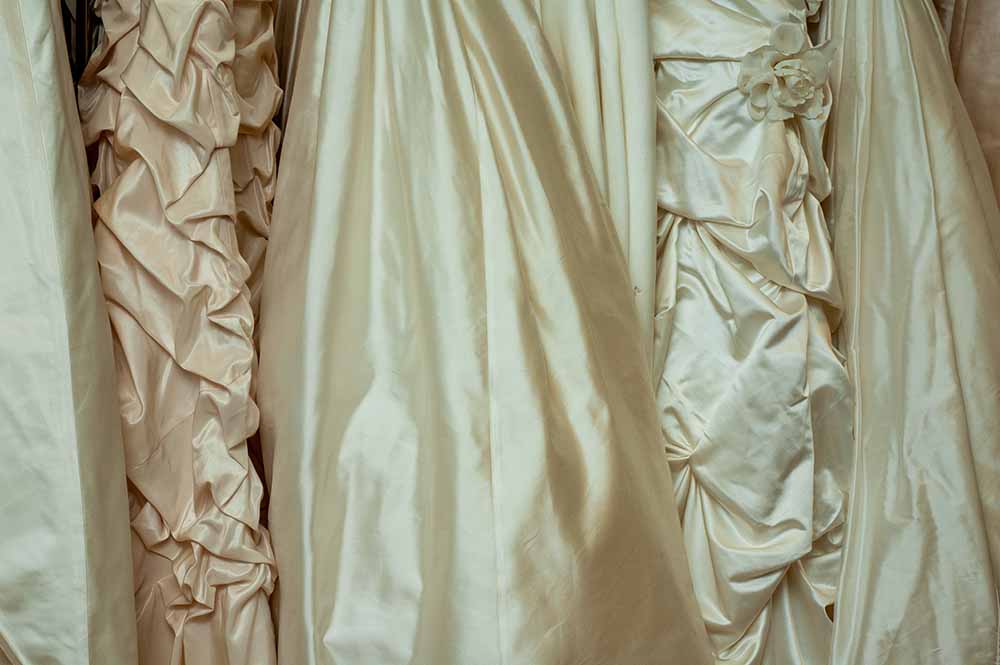
An ornate white dress is what most people in the West associate with weddings. This isn’t surprising since white is universally regarded as the color of purity, and weddings are all about celebrating and cementing a monogamous, loving relationship.
However, the tradition of wearing white wedding dresses in fact only started in the mid-19th century when Queen Victoria of England wore a white wedding gown when she married her consort Albert in 1840.
Before then, in previous centuries in the West, other colours were chosen for wedding gowns. For example, before Queen Victoria popularised white, brides may well have been thinking of the proverb, “Marry in blue, lover be true.”
Because Christianity generally portrayed the Virgin Mary in blue, purity was also associated with this colour just as it is these days with white.
And outside of the West, a range of colours has always dominated the wedding day. For example, in ancient Rome, brides wore blue to symbolise love, modesty, and fidelity. And in ancient Israel a blue border on a wedding dress symbolised those same virtues.
In other countries, red is popular. It is the colour that brides wear in China.
Some brides also wore red in the United States during the Revolutionary War in the 18th century to symbolise the independence the Colonists were fighting for. And to pay tribute to the dead, some American brides during the Civil War wore purple because it represents honour and courage.
In Korea, brides have two types of dresses to choose from, including a simple lime-green gown called a wonsam. It is embroidered with flowers and butterflies and worn over the hanbok, the doll-like traditional wedding dress made of patterned silk. The other type of dress that brides wear in Korea is the more elaborate gown called a hwarrot, or “flower robe.”
Because it is the colour of nature, Moroccan brides there wear green gowns thinking it brings good luck. They might also wear yellow instead of green because yellow is said to scare away the evil eye.
During the 16th century, Roman Catholic brides in Spain wore black gowns and lacy mantillas to show their devotion to their spouse until death.
In Japan, women wear two colours; a white, silk kimono lined with red that symbolises happiness and a new beginning. While women in Japan begin their wedding wearing a white kimono lined with red, they often wear gowns of silver or gold as the special event progresses.
Originally published February 3, 2009 by Tamara Colloff-Bennett
Mandarin ducks breed in densely wooded areas near shallow lakes, marshes or ponds. They roost high in trees and nest in tree hollows found near bodies of water in eastern Siberia in Russia, China, and Japan. During the winter, they migrate to southern China and Japan.
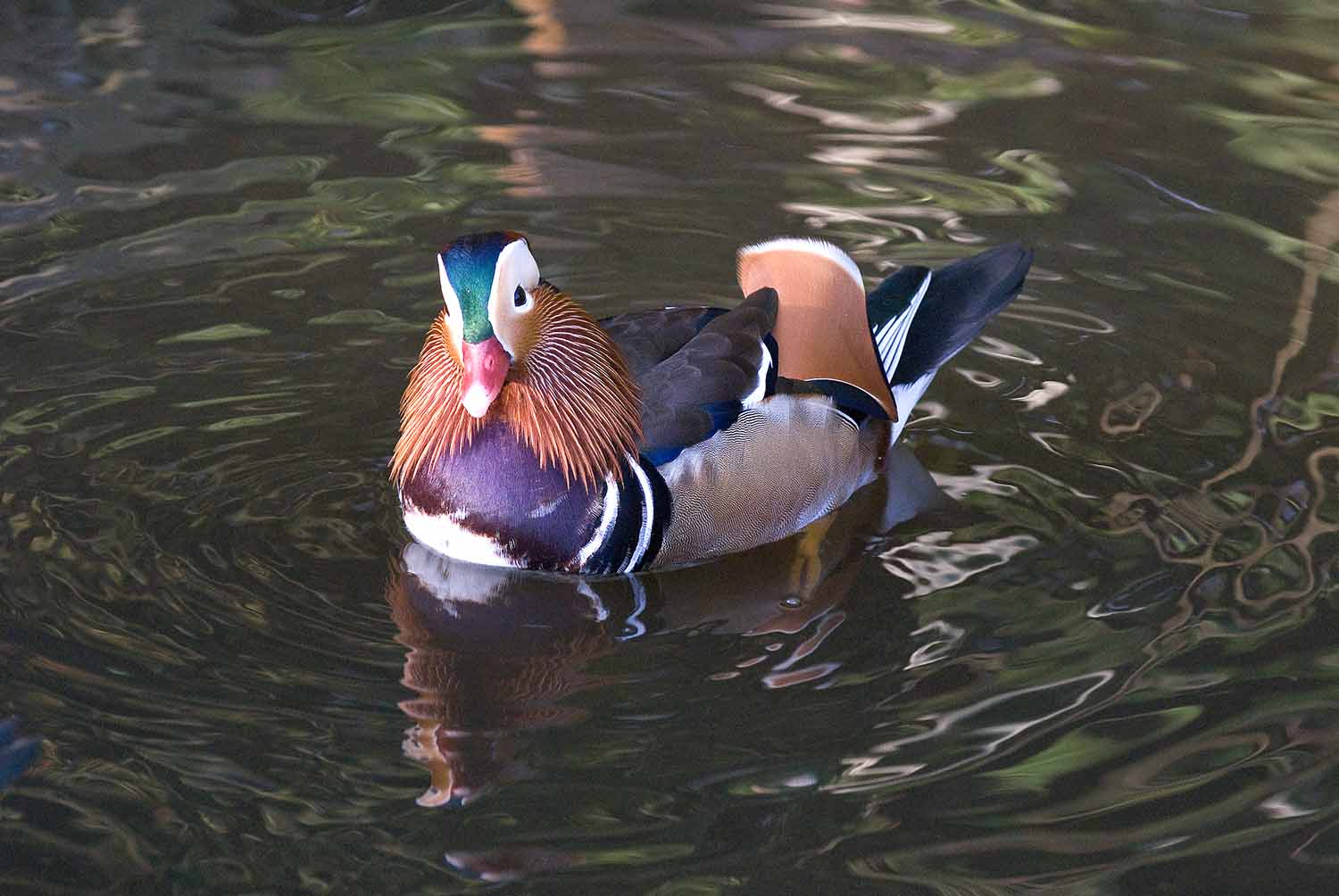
The male or drake mandarin like the one pictured here has very colourful markings.
The female mandarin looks very different with feathers that are a mixture of pale colors and speckles of greys, browns, and whites. Her coloring serves as important camoflage against predators during the mating season.
Their American Relative
The mandarin duck is a close relative of the North American wood duck.
In fact, the two species are the only two members of the genus ‘Aix’ — the Mandarin being ‘Aix galericulata’ and the Wood Duck being ‘Aix sponsa’.
Monogamous and Admired in the Far East
Thought to be monogamous, mandarin ducks have been revered in Far Eastern culture since at least the fifth century. Praised for their ornate beauty, they are often found in art, poetry, and other forms of Oriental literature as a symbol of marital fidelity and emblematic of conjugal affection and fidelity.
Related Chinese and Japanese Proverbs and Traditions The Chinese language use the proverb translated as “two mandarin ducks playing in water” as a metaphor for a loving couple. The Mandarin Duck symbol is also used in Chinese weddings since they symbolize wedded bliss.
Similarly in Japan in the past, pairs of mandarin ducks were often presented as wedding gifts to Japanese newly-weds.
An Homage from Hiroshige
An example of the depiction of mandarin ducks in Asian art can be found in one of the kacho-e (i.e., prints depicting birds and flowers) masterpieces created by the esteemed Japanese artist Utagawa Hiroshige who lived 1797 to 1858.
Translated from the Japanese, Hiroshige characterizes what happens in a tumultuous setting in nature between the otherwise normally bonded and loyal mandarin ducks:
A Mandarin Duck on a Snowy Bank The morning tempest sees even mandarin ducks go separate ways.
An ancient Japanese folktale that contrasts greed and cruelty against kindness and love, The Tale of the Mandarin Ducks is a timeless legend about a powerful lord who separates a pair of loving mandarin ducks because he wants to have the male drake’s brilliant plumage to show off in his manor.
The drake almost dies of grief for his mate who is alone and foresaken on her nest, but two of the lord’s servants who respect and love animals and nature bring the creatures back together.
Although the servants find true love in one another through their virtuous deed, they put their lives at risk by helping out the beautiful mandarin duck.
All ends happily in the end, however, as the grateful bird and his mate manage to successfully save them.
A beautiful version of this legend for children was published in the 1990s. Using the same title and retold by Katherine Paterson in English, it also features color illustrations by Leo and Diane Dillon created in the style of eighteenth-century Japanese woodcuts.
Worrying Population Decline
The current reality and fate of the mandarin duck is not nearly as heartwarming as the end of that timeless fable, however.
This is because according to recent research reported by the UK’s Wildfowl and Wetlands Trust (WWT), numbers of mandarin ducks in their native Far East have declined from their former great numbers due to habitat destruction (mainly logging) and over-hunting to the present-day small wild populations of mandarin ducks which are under government protection in China, Japan, and Russia.
Including a feral, free-flying population of 7,000 birds in the UK, estimates put the total world-wide population of wild mandarin ducks today at around 80,000 birds.
First written and published February 1, 2009 by Tamara Colloff-Bennett
The rabbit Peter, the hedgehog Mrs. Tiggy-Winkle, the frog Mr. Jeremy Fisher, the cat Simpkin, the duck Jemima Puddle-duck, the mice Tom Thumb and Hunca Munca, the red squirrel Nutkin, the tortoise Ptolemy, the guinea pig Tuppenny: Children and adults alike have been enchanted by these and other animal characters that Beatrix Potter created for her children’s picture books.
Beatrix’s Love of Guinea Pigs
A lesser-known fact about Beatrix is that she was also a fan of guinea pigs.
At about the age of 24 in her booklet of illustrated verse entitled Our Dear Relations, she featured a family of them eating dinner, in typical Beatrix Potter fashion complete with a guinea pig Mom sitting at the head of the table ladling out the youngsters’ food.
Three years later in 1893 and at a point when she still didn’t own any guinea pigs herself, Beatrix borrowed a friend’s long-haired guinea pigs as models for a card, a long-haired ‘Abyssinian’ guinea pig breed like the one in the photograph here.
That same year she also drew a quartet of guinea pigs carrying garden tools, en route to fixing up their own garden.
Her affection for the animals continued when in 1903 she wrote her tale of Tuppenny.
Tuppenny and Gulliver’s Travels
When an American publisher from Philadelphia visited her in 1929, he persuaded her to produce another book which he would publish especially for her American public, that is a novel for older children which Beatrix would call The Fairy Caravan and in which she would star the guinea pig Tuppeny from her earlier tale.
Tuppenny is a short-haired guinea pig breed called an ‘agouti,’ and in this novel the author would show her political persuasions.
Just like satirist Jonathan Swift (1667-1745) set his book Gulliver’s Travels in a fantasy world but used the story to make fun of the snobbery of English society, Beatrix did the same with her town of Marmalade in which the Abyssinian cavies who have long hair and side whiskers look down on the common short-haired guinea pigs.
The Amiable Guinea Pig
An Abyssinian guinea pig served as the model of another illustration that appeared in Beatrix’s Appley Dapply’s Nursery Rhymes which she wrote in 1917.
Entitled ‘The Amiable Guinea-pig’, you can see an illustration of it a the V&A on line Collection section of the Victoria & Albert Museum in London.
The Author’s Early Years
Beatrix knew the world of privilege intimately. Born in 1866 and christened Helen Beatrix Potter, she grew up in a wealthy, strict Victorian English family with her father Rupert Potter, her mother Helen Leech, and her brother Bertram.
Where did Beatrix get the idea of making animals the stars of her stories?
The answer lies in the life that she led, her parents’ own artistic backgrounds and influences on her, and her strong love for her pets – many of whom became models for characters of her books.
In keeping with the norm for upper-class English families of the time, Beatrix was schooled at home and attended to by a legion of servants and a nanny.
Both of her parents liked to paint, and her father was an accomplished amateur photographer at a time when photography was a relatively new art. Along with photographing landscapes and the family, Rupert photographed sitters for Sir John Everett Millais, a leading British painter of the time.
The Potters encouraged their children to develop their artistic abilities, and Beatrix’s younger brother Bertram became an accomplished landscape painter as an adult.
With Beatrix, her parents arranged for a drawing teacher to come to the house.
Although Beatrix was six years older than her brother, they were very close. Except for cousins who would visit at times, they rarely met other children. Then at the age of six, Bertram was sent away to boarding school while Beatrix continued to be educated at home by her governesses.
The schoolroom which had been Beatrix’s and Betram’s world then became the sole province of Beatrix’s universe.
As she had done with her brother, it that schoolroom Beatrix kept a large number of pets: rabbits, mice, a bat, a frog, lizards, a terrapin, and a snake. Two rabbits were her particular favorites, one of whom was named Peter Piper who, as Peter Rabbit, would be the hero of her first book.
Alone as she studied, Beatrix started a secret journal in code some time thereafter when she was 14 years old. She used the journal to record details of her world that especially interested her, and through this she started developing her style as a storyteller.
Fortunately for Beatrix, her parents who enjoyed going on vacation rented a place in the countryside every summer. They took along the entire household, including the children’s pets.
Beatrix was very influenced by these journeys to the countryside, and in later years they would come to serve as the settings for many of her stories.
The Tale of Peter Rabbit
Beatrix Potter’s great talent in art combined with her keen eye for observation about animals and her whimsical, gentle touch for storyline has made her a favorite author throughout the world.
That story came about through Beatrix’s associations with her last governess named Annie Carter who was only three years her senior.
After forming a close bond through studies, when Annie left Beatrix’s home to marry, the two remained good friends. As the years went by, Annie had five children with her husband Edwin Moore.
Then in 1893 when Beatrix and her rabbit Peter Piper were on holiday in Scotland and she wanted to cheer up Annie’s eldest son Noel who had been suffering from a long illness, she couldn’t think of what to write him.
So she decided to tell him, as she put it, “a story about four little rabbits whose names were – Flopsy, Mopsy, Cottontail and Peter.”
The children loved Beatrix’s stories, like another one that she sent to Noel’s four-year-old younger brother Eric in which she wrote, “My dear Eric, Once upon a time there was a frog called Mr. Jeremy Fisher, and he lived in a little house on the bank of a river…”.
As the years went by and Beatrix was successful in selling her animal drawings for greeting cards and illustrating popular rhymes, fairy tales, and stories, she decided to try her hand at making her own illustrated book.
To that end, in 1900 she borrowed her letter back from Noel about the four rabbits and copied it to create a black and white book. She added some new parts, drew 41 new illustrations, named the book “The Tale of Peter Rabbit,” and had 250 copies printed in time for Christmas 1901.
Beatrix Potter’s Popularity Today
“The Tale of Peter Rabbit” can now be read in 30 different languages in addition to its original English-language version.
Were she alive today, Beatrix would probably be very taken aback to learn that the sales of her book are now placed at approximately 45 million copies.
Along with all of her other well-loved books, stories, and nursery rhymes, that book has become one of the best-selling books ever and has made Beatrix Potter one of the most widely-read children’s authors of all times.