A Sweet View
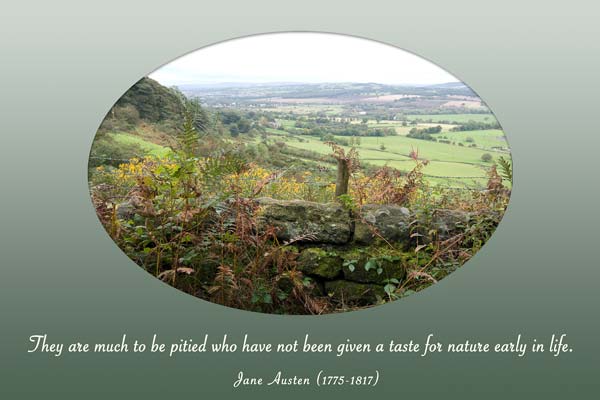
It was a sweet view – sweet to the eye and the mind. English verdure, English culture, English comfort, seen under a sun bright, without being oppressive.
– from ‘Emma’, Jane Austen’s novel published in 1815
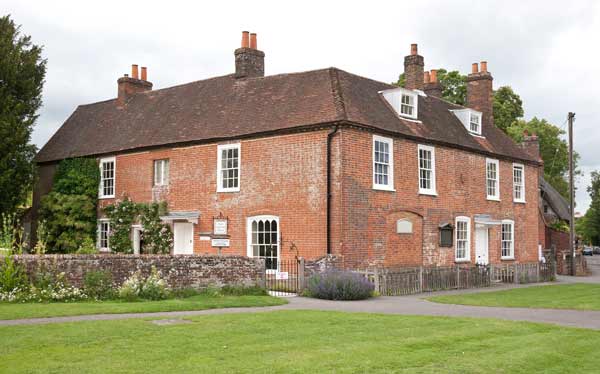
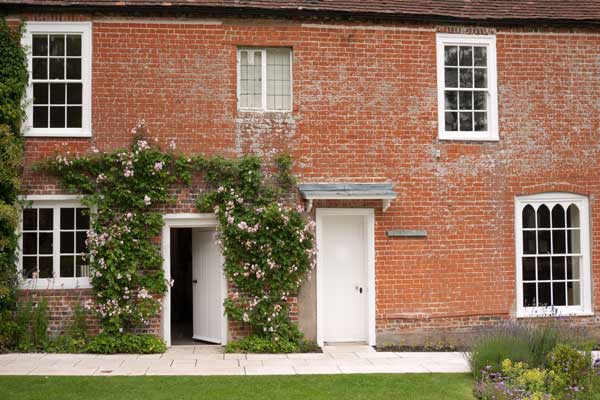
Jane Austen had lived for six years in this redbrick 18th century house called Chawton Cottage when she had her character Emma air these observations about the estate belonging to the character Mr. Knightley in her novel Emma.
My husband David took this photo when we visited Jane Austen’s House Museum in Chawton, Hampshire in southern England last summer. So I hope you enjoy this dose of summer as you read this in the depth of winter!
It is often said that authors write best about the realities that they know, and so I think that Jane might well have been referring to her own home located in the quiet English countryside when she wrote this description in Emma.
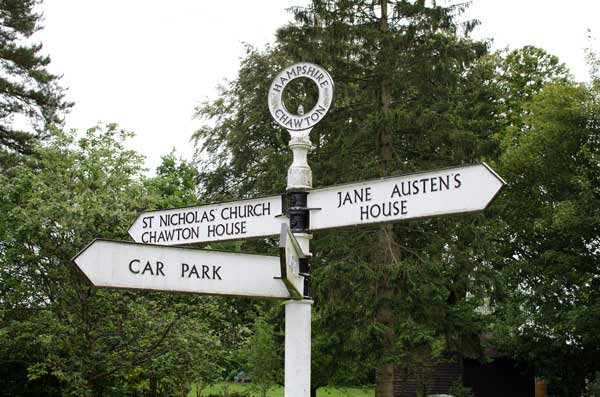
Called Chawton Cottage during Jane’s lifetime, Jane moved to the village of Chawton in the summer of 1809 when she was 34 years old.
The Arduous Path To Chawton
Four years before she arrived to live in relative peace at Chawton that summer, however, Jane and her family experienced first hand what dependency on a male head of a household meant in her era when her father Reverend George Austen died at the age of 74 in January 1805.
The family was living in Bath at the time. After her father died, however, the family had to leave Bath and Jane moved two more times with her mother and sister, each time to lodgings that were less expensive than the last.
Following this they stayed in several other locations including Clifton, Adlestrop, Stoneleigh, Kent, and Southampton, and small seaside places.
I would think that the cumulative effect of this dislocation also added to Jane’s sensitivity as an author since she learned first hand what it was like to live in ‘reduced circumstances’, as the euphemism of the time termed it.
Unsettling Times
Biographers have claimed that during this destabilizing period of her life when she and her family moved about (getting rid of all of their furniture as well along the way), Jane seemed unable to write.
She must have dealt with her writing block to some degree, however, because as Elizabeth Proudman explains in her booklet called The Essential Guide to Finding Jane Austen in Chawton, the novelist “always carried with her the manuscripts of three unpublished novels, Elinor and Marianne, First Impressions, and Susan.”
Refuge At Last
Finally in July 1809 which was four-and-a-half years after her father died, the Austens moved into Chawton Cottage.
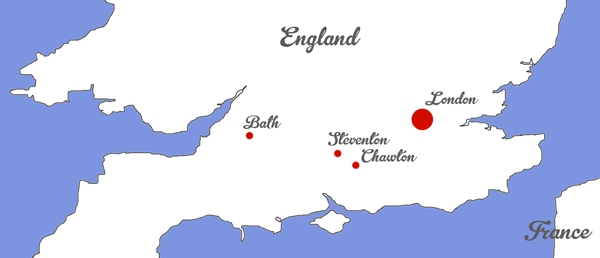
Jane had effectively moved back home because the small village of Chawton is in the same county of Hampshire as the village of Steventon where Jane spent the first 25 years of her life. Her family only left the county in 1800 to move to Bath because her father wanted to retire there.
After traipsing about to different locations, the family finally went back to a neighboring part of the county that they had first left years earlier.
You can see this illustrated (and nifty!) map that my husband David made:
A Sharp Observer Who Did Not ‘Marry Well’
During Jane Austen’s lifetime, women’s social standing and economic security were intricately bound up with the men that they married.
So because she focused so centrally on this pressure to ‘marry well’ in her classic novels, I find it ironic that both Jane and her sister Cassandra themselves never married, either ‘well’ or otherwise.
However, perhaps precisely because she never tied the knot, Jane gained objectivity on such an important social element in her times that might have been impossible otherwise.
Pride and Prejudice‘s Famous Beginning
Surely Jane’s circumstances influenced her writing, as you can see reflected in this very famous beginning of her classic novel Pride and Prejudice which was published when she had lived in Chawton for four years:
It is a truth universally acknowledged, that a single man in possession of a good fortune must be in want of a wife. However little known the feelings or views of such a man may be on his first entering a neighbourhood, this truth is so well fixed in the minds of the surrounding families, that he is considered as the rightful property of some one or other of their daughters.
The Quill, The Inkwell, The Desk!
When we visiting Chawton, I found it exciting to be in Jane’s physical space, to be in the room where she wrote her ingenious novels.
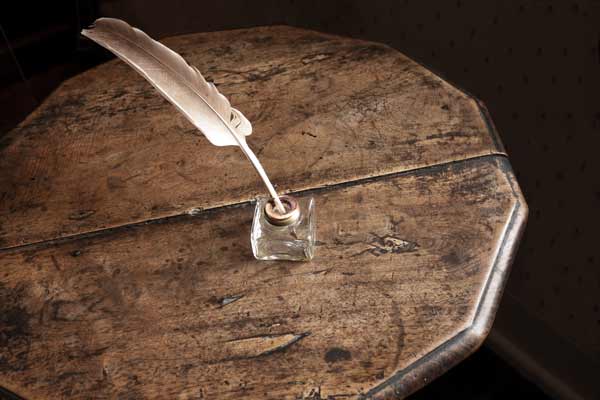
For example, here is Jane’s writing table that she used in Chawton – including the quill and inkwell that she used to write all of her wonderful novels.
A Room With A View
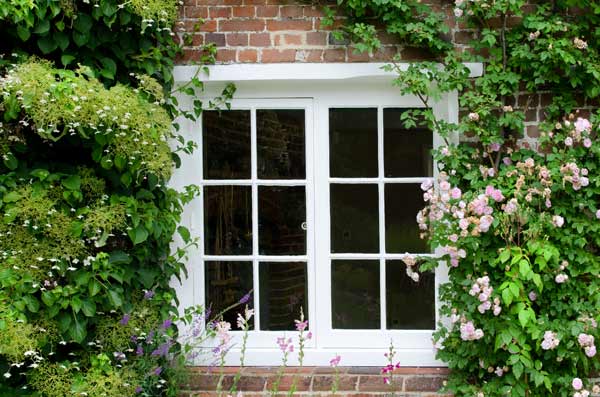
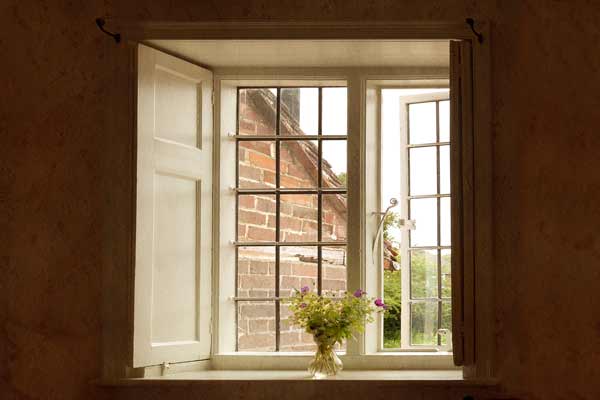
And from where Jane’s chair and this little table were located in the room, she could look outside through this window:
A Gentleman’s Daughter
Like her heroine Elizabeth Bennet in her novel Pride and Prejudice, the woman who wrote her classics on that desk and looked out that window in Chawton was a gentleman’s daughter.
Her father George Austen was descended from a family of woollen manufacturers who had risen to the lower ranks of the landed gentry.
However, she wasn’t always assured this status since her father’s branch of the family went through difficult times when her father was a boy.
That was why it was his wealthy uncle Francis Austen who paid for his education. Then when when he was 16, George received a scholarship to Oxford to study for ordination.
A Lady’s Daughter
George continued his association with Oxford when he became engaged to Cassandra Leigh.
Branches of her Leigh family had academic connections with Oxford and included all classes of gentry.
And in terms of status, this intelligent woman was descended from a Lord Mayor of London during the reign of Elizabeth I.
The Austen Crew
This importance of family loomed large in Jane’s life.
As I read on the site of the Jane Austen Society of Australia (JASA), Claire Tomalin reflected in her biography Jane Austen: A Life that the author “lived with a perpetual awareness of cousinage extending over many counties and even beyond England.”
And along with this very large extended family, her nuclear family included eight children with Jane herself being the seventh born.
Here is the line-up of the Austen siblings – all of whom along with her mother outlived Jane: Her six brothers were James (b.1765), George (1766), Edward (1767), Henry (1771), Francis, or Frank (1774), and Charles (1779).
Her one sister named Cassandra (after their mother) was born in 1773, and Jane herself was born in 1775.
Reflections Of Reality?
As far as how her one sister figured in her life, Cassandra was Jane’s closest friend throughout the author’s lifetime.
Could it be that the sisters Elizabeth and Jane Bennet who are the main characters in Pride and Prejudice and who also are very close in fact echo the author’s real-life relationship with her own sister Cassandra?
Life In The Austen Family
Not surprisingly considering her parents’ backgrounds, another biographer of Austen named Park Honan pointed out that life in the Austen home was lived in “an open, amused, easy intellectual atmosphere.”
Perhaps this accounts for the fact according to Le Faye’s A Family Record that Jane “never again lived anywhere beyond the bounds of her immediate family environment” after returning from school in 1786.
Little Brother Saves The Day
The Chawton Cottage to where Jane and other family members went to live after their wanderings was a residence owned by none other than Jane’s third brother Edward.
How did her sibling have such means?
What happened was that when he was about 16 years old, Edward was adopted by Thomas and Catherine Knight of Godmersham Park in Kent who were wealthy and childless relatives of the Austens.
The Knights’ stipulation was that Edward would have to take the family name of Knight.
Arranging all of this was a practical way of ensuring that the inheritance would remain in the family, and gradually Edward was entrusted to the affectionate care of these relatives.
Edward Austen Knight eventually took over management of the estates at Godmersham and Chawton in 1797. He lived at Godmersham, and let the Great House (as it was called) at Chawton to gentlemen tenants.
By 1809 he offered the house in the village – i.e., Chawton Cottage – to his mother, Cassandra, and Jane.
Coping With The Reality Of Life In Georgian Times
Why would supposedly loving parents put one of their children up for adoption? I have wondered about this since I read this fact years ago about Edward.
In other words, even though it turns out that it was a generous gesture on the part of wealthy relatives as I have just explained – I still find the situation a bit unusual.
That’s why I was happy to read an explanation for this as put forth by Michael Giffin in his article called The people in Jane Austen’s life – The quintessential Georgian parents: George & Cassandra Austen featured in the JASA site.
An author, editor, and Anglican priest, Giffin in his article on the JASA site claims that too many biographers, historians, and critics fail to look at the Austen family in the context of the Georgian times in which they lived – which he summarized as follows:
…the Georgians… lived in the shadow of the Reformation, Civil War, Restoration, and Glorious Revolution. Their way of life was dominated by an unregulated capitalism …. Agrarian change threatened their economic security…. Their social life was determined by property and patronage…. Every class was restless and insecure and under threat.
Giffin further points out the following with particular reference to Edward’s adoption by the Knights, and the effect that this ultimately had on Jane’s life considering that her father had died:
…the adoptive and biological parents of Edward Austen had a series of socially-constructed and genetic expectations… for their mutual benefit,…. One by-product was an environment that supported Jane during her most brilliant and productive years… Austen’s life… would have been rendered much more difficult without the support of her brother….
The History of Chawton Cottage
As Elizabeth Proudman details in her pamphlet called The Essential Guide To Finding Jane Austen In Chawton, Chawton Cottage was built in around 1700. It then served as an ale house beside the coach road near by for some years.
Following that, it was the home of the farm bailiff who worked for the Knights, the wealthy relatives who adopted Jane’s brother Edward.
Later when Edward took over management of Godmersham and Chawton, he improved the house for his mother and sisters.
Designed With The Family In Mind
Because the house is so close to what was considered a busy road in that Georgian era, Edward had a window in the front closed and he had another Gothic one looking into the garden:
Then Edward added three bedrooms at the back. This was also to accommodate the Austens’ good friend Martha Lloyd who lived with the family.
Cassandra Lives On Alone
After Jane died in 1817 and her mother died in 1827, her sister Cassandra lived alone at the cottage until 1845.
When Cassandra died, the house was partitioned to accommodate living space for three families.
A Tribute To A WWII Casualty
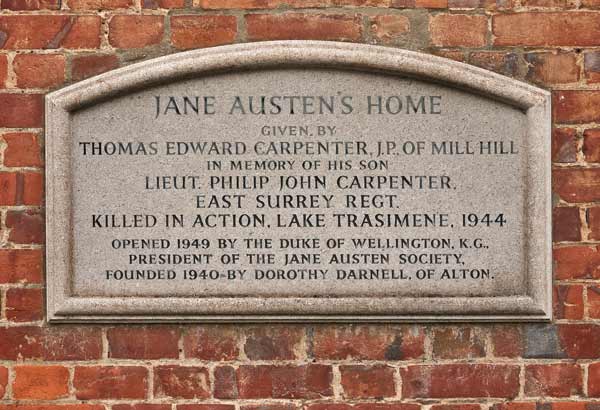
As you can see in this stone plaque that is on the front wall of the house, Thomas Edward Carpenter bought Chawton Cottage to be a museum in memory of his son Lieutenant Philip John Carpenter.
Philip served with the East Surrey Regiment, and he was killed during WWII in action in 1944 in Lake Trasimene in Italy.
You can see a portrait of Philip on the stairs in the house.
Praise, Jane Style
Chawton Cottage became Jane Austen’s House Museum in 1949, the same year the Jane Austen Memorial Trust was founded.
I wonder what Jane and her family would think about this.
However, historians do believe Jane was delighted with Chawton Cottage as evidenced from this little ditty ‘tribute’ of sorts that she wrote to her brother James to tell him how she felt about the place:
Our Chawton Home, how much we find
Already in it to our mind;
And how convinced that when complete
It will all other houses Beat
That ever have been made or mended,
With rooms concise or rooms distended.
Concealed Forever?
So here’s hoping that Jane herself would be content and happy to see how her and her family’s life has been preserved in this lovely museum of a home.
Beyond that, however, we do know for certain that an amazing wealth and blossoming of the imagination took place in Chawton Cottage.
For this was the place where Jane revised earlier manuscript novels Sense and Sensibility, Pride and Prejudice, and Northanger Abbey, and where she also wrote Mansfield Park, Emma, and Persuasion.
Still, I like to think for the sake of her and her family’s privacy that Chawton Cottage holds many other secrets beyond what we can see today from the remnants of her and her family’s lives in this quietly beautiful country cottage museum.
PART 1 OF THIS TWO-PART ARTICLE (Jane Austen in Bath) IS HERE.