Musee d’Orsay’s Clock Overlooking the River Seine

We’re changing the look of ecard communications.
Take A Look At Our Ecards.

The Train Station on the Banks of the Seine
For its Exposition Universelle of 1900, Paris hosted a record 50 million visitors who came to see its world’s fair. The fair was grand in size, featuring 76,000 exhibitors and covering 1.12 square kilometres (277 acres) of Paris.

A number of Paris’s most noted structures were built for the Exposition, including the train station called Gare d’Orsay which was located in the center of Paris on the banks of the Seine.

Its Second Life as the Musee D’Orsay
Gare d’Orsay eventually became the location to house Musee d’Orsay, a wonderful museum whose doors opened in 1986 with its collection that focuses on artistic creation in the Western world between 1848 and 1914.

The soaring, arched ceilings and the museum’s lighting design provide an airy, uplifting ambiance to see some 54,000 items from architects, photographers, sculptors, and French painters that are on display there.

The Café with the Huge Clock
When you want a break from all that beauty to rest your feet for a while, I recommend the café on the top floor of the museum.

What’s so striking about the cafe is the huge clock first used in the Gare d’Orsay which hits your field of vision as soon as you enter.

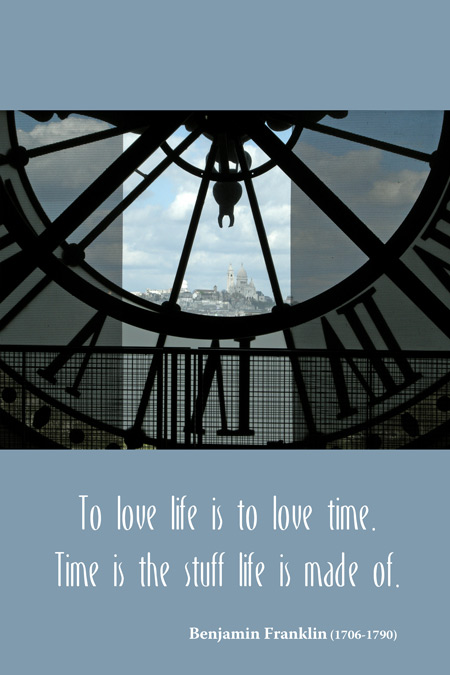
Peek between the clock’s large metal spokes that divide its hour demarcations and you can look out as David and I did beyond the River Seine towards the Sacre Coeur, the famous Roman Catholic basilica located at the summit of the butte Montmartre which is the highest point in Paris.

Here is one of our Quotations e-cards that features this scene:
 
clock
 
Impressive as that view is, the vista from street level of the River Seine is equally striking.

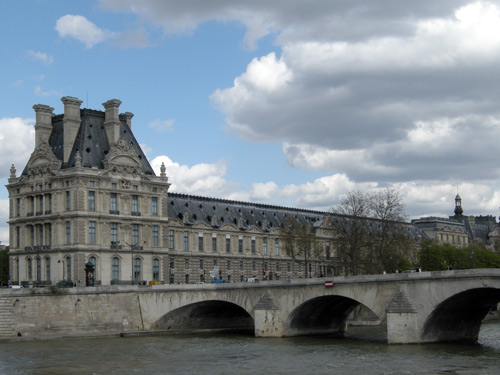
For example, here you can see the Pont Royal (the Royal Bridge) straddling the Seine, with buildings on the riverbank that are part of Louvre Museum:
 
seine

You can send distinctive ecards featuring our photographs by Joining Quillcards.

Mandarin Ducks: Monogamous, Revered Beauties

Their Breeding Grounds and Appearance
Mandarin ducks breed in densely wooded areas near shallow lakes, marshes or ponds. They roost high in trees and nest in tree hollows found near bodies of water in eastern Siberia in Russia, China, and Japan. During the winter, they migrate to southern China and Japan.
 
mandarin_duck
 
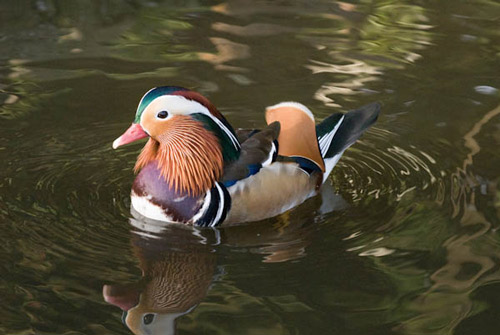
The male mandarin (also known as a ‘drake’ as all male ducks are called) like the one pictured here has very colorful markings.

The female mandarin looks very different with feathers that are a mixture of pale colors and speckles of greys, browns, and whites. Her coloring serves as important camoflage against predators during the mating season.

Their American Relative
The mandarin duck is a close relative of the North American wood duck.

In fact, the two species are the only two members of the genus ‘Aix’ — the Mandarin being ‘Aix galericulata’ and the Wood Duck being ‘Aix sponsa’.

Monogamous and Admired in the Far East
Thought to be monogamous, mandarin ducks have been revered in Far Eastern culture since at least the fifth century. Praised for their ornate beauty, they are often found in art, poetry, and other forms of Oriental literature as a symbol of marital fidelity and emblematic of conjugal affection and fidelity.

Related Chinese and Japanese Proverbs and Traditions
The Chinese language use the proverb translated as “two mandarin ducks playing in water” as a metaphor for a loving couple. The Mandarin Duck symbol is also used in Chinese weddings since they symbolize wedded bliss.

Similarly in Japan in the past, pairs of mandarin ducks were often presented as wedding gifts to Japanese newly-weds.

An Homage from Hiroshige
An example of the depiction of mandarin ducks in Asian art can be found in one of the kacho-e (i.e., prints depicting birds and flowers) masterpieces created by the esteemed Japanese artist Utagawa Hiroshige who lived 1797 to 1858.

Translated from the Japanese, Hiroshige characterizes what happens in a tumultuous setting in nature between the otherwise normally bonded and loyal mandarin ducks:

A Mandarin Duck on a Snowy Bank
The morning tempest
sees even mandarin ducks
go separate ways.

The Tale of the Mandarin Ducks
An ancient Japanese folktale that contrasts greed and cruelty against kindness and love, The Tale of the Mandarin Ducks is a timeless legend about a powerful lord who separates a pair of loving mandarin ducks because he wants to have the male drake’s brilliant plumage to show off in his manor.

The drake almost dies of grief for his mate who is alone and foresaken on her nest, but two of the lord’s servants who respect and love animals and nature bring the creatures back together.

Although the servants find true love in one another through their virtuous deed, they put their lives at risk by helping out the beautiful mandarin duck.

All ends happily in the end, however, as the grateful bird and his mate manage to successfully save them.

A beautiful version of this legend for children was published in the 1990s. Using the same title and retold by Katherine Paterson in English, it also features color illustrations by Leo and Diane Dillon created in the style of eighteenth-century Japanese woodcuts.

Worrying Population Decline
The current reality and fate of the mandarin duck is not nearly as heartwarming as the end of that timeless fable, however.

This is because according to recent research reported by the UK’s Wildfowl and Wetlands Trust (WWT), numbers of mandarin ducks in their native Far East have declined from their former great numbers due to habitat destruction (mainly logging) and over-hunting to the present-day small wild populations of mandarin ducks which are under government protection in China, Japan, and Russia.

Including a feral, free-flying population of 7,000 birds in the UK, estimates put the total world-wide population of wild mandarin ducks today at around 80,000 birds.

You can send distinctive ecards featuring our photographs by Joining Quillcards.
Wedding Dress Colours, Past and Present


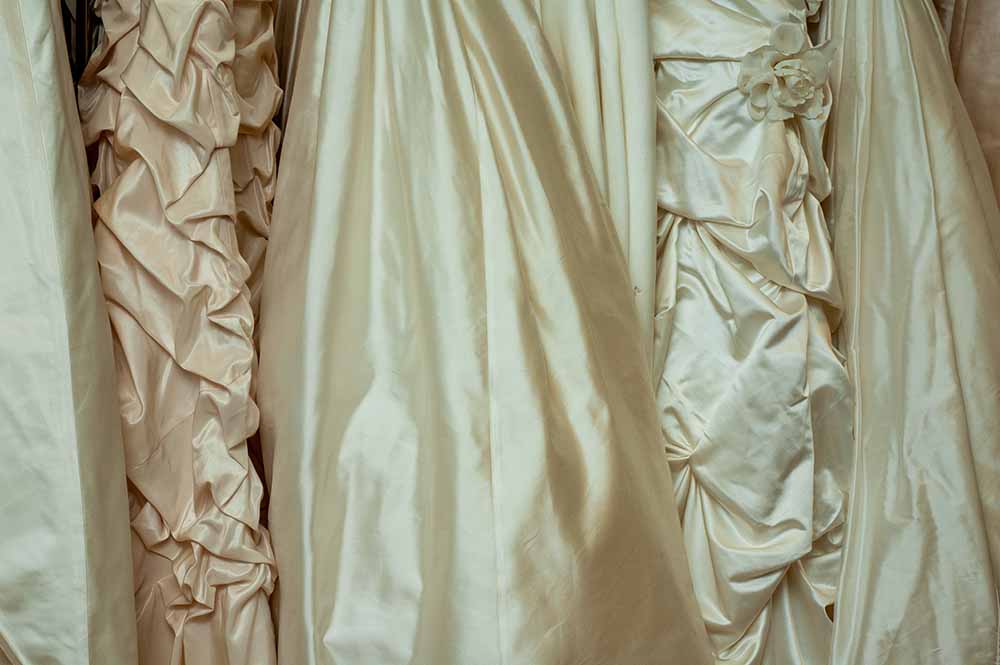
Like the photograph here of wedding dresses, an ornate, white dress is what most people in the West associate with weddings.

This isn’t surprising since white is universally regarded as the color of purity, and weddings are all about celebrating and cementing a monogamous, loving relationship.

However, this tradition of wearing white wedding dresses in fact only started in the mid-19th century when Queen Victoria of England wore a white wedding gown when she married her consort Albert in 1840.

Beyond the Pale

In reality, in previous centuries in the West, other colors were preferred for wedding gowns. Outside of the West, a range of colors besides white has always dominated the wedding day.

In ancient Rome, brides wore blue to symbolize love, modesty, and fidelity. Blue was also the border color of the bride’s dress in ancient Israel where it symbolized similar virtues. Because Christianity generally portrayed the Virgin Mary in blue, purity was also associated with this color just as it is these days with white.

Blue remained a popular colour for wedding gowns until Queen Victoria popularized wearing white. Perhaps the brides then were thinking of the proverb, “Marry in blue, lover be true.”

Opting for Red Instead

Regarded as the color of joy and luck, red is the color that brides wear in China.

Some brides also wore red in the United States during the Revolutionary War in the 18th century to symbolize the independence the Colonists desired.

In Korea, brides have two types of dresses to choose from, including a simple lime-green gown called a wonsam. It is embroidered with flowers and butterflies and worn over the hanbok, the doll-like traditional wedding dress that is made of patterned silk.

Where Green is Seen

Because it is the color of plants and Moroccans think it brings good luck, brides there wear green gowns.

The other type of dress that brides wear in Korea is the more elaborate gown called a hwarrot, or “flower robe.” Like the red wonsam, it is also worn over the hanbok (see last listing in ‘Red’ section above for more details).

The Reason Behind Bright Yellow

In Morocco, brides can choose to wear yellow instead of green. Yellow is worn to scare away the evil eye.

Other Colours

During the 16th century, Roman Catholic brides in Spain wore black gowns and lacy mantillas to show their devotion to their spouse until death.

To pay tribute to the dead, some American brides during the Civil War wore purple because it represents honor and courage.

In Japan, women wear two colors for the wedding ceremony: A white, silk kimono lined with red. This combination symbolizes happiness and a new beginning. While women in Japan begin their wedding wearing a white kimono lined with red, they often wear gowns of silver or gold as the special event progresses.