Discovering Cambridge

Despite its small size and probably because of the university and its nearness to London and to the rural East of England, there is a lot to Cambridge. Discovering Cambridge takes time.

See the two cities – the city of the university students and the city of the ordinary working man or woman. Listen to the accents, from the well-bred to the East End cockney. See the retired professor. See the visitors – tourists in their hundreds. It is all there.

See the ‘Backs’ – the area behind the colleges that is in the photo at the top of this article. Of course, not all of Cambridge is like that. How could it be? It has its share of poor housing and mean streets. But it also has a lot of very pretty streets and buildings.

Where Is Cambridge

Cambridge is a city in East Anglia, in the East of England. It is 49 miles from London as the crow flies and 50 minutes by the fastest train to the capital. It is on the southern edge of an area that was once fen until Dutch engineers drained them three hundred years ago.

A lot of the low-lying areas of eastern England, mainly in Lincolnshire, Cambridgeshire, and Norfolk, were once fen – low-lying and marshy area of land. Some were always under water and some flooded seasonally.

Because the water was so shallow, the inner parts of the fens could only be reached by flat-bottomed boats or punts. Its inaccessibility helped its reputation as a mysterious part of old England, cut off from the rest.

Most of the fens are now farmland and meadow, criss-crossed by drainage ditches that lead out eventually to the sea.

This is one of the prettiest views in Cambridge, on St. John’s Street with St. John’s College on the left. It has the prettiest russet-coloured brick. And it is quite different from the dark buff brick of most of the later buildings in Cambridge.

If you have a sense of the topography of England and of the trees that grow in the uplands and the lowlands, you will sense that Cambridge is low lying. You can tell it from the colour of the landscape and the way buildings have weathered. There is a dampness baked into the fabric of the area that is different from upland Britain.

And indeed Cambridge is low lying – just six metres (20 feet) above sea level.

And it is a small place – 120,000 people with another 18,000 students who come and go. And the buildings are low – no skyscrapers here.

And pretty. There are lots of old, pretty buildings, and the river Cam that wends in a gentle arc around the city.

Who has not heard of punting on the river at Cambridge?

And then there are the colleges – that collection of institutions that make up Cambridge University. The college buildings and the wealth of the colleges has helped Cambridge through times where other places have had their hearts ripped out and replaced with modern glass and steel.

Cambridge University

The university is very important to Cambridge. Without it there would be no biomedical research companies, no computer chip companies, etc. The relationship between the university and business is fundamental to the prosperity of the city.

And it is unusual in that it is in fact the umbrella organisation for 31 separate and autonomous colleges. There are 18,000 students from all over the world who study, each one at a particular college.

You get an inkling of the diversity of the students from the number of languages you can hear on the street. And with students come staff – 11,000 staff.

The colleges have their own rules and procedures (subject to the overarching university regulations), so you hear people talk of being at a particular college rather than being at Cambridge University.

Not all the colleges are ancient. Peterhouse was founded in 1284, Clare College in 1326, Gonville & Caius College in 1348, and Corpus Christi College in 1352. But many colleges were founded in the 1800s and Wolfson College was founded in 1965 and Robinson College in 1979.

City Status

I said it is a city, and you may wonder how it is a city when it is so small. After all, we usually mean places with populations of half a million or more.

What you might not know about the history of England is that a city is any settlement where there is a cathedral.

In the fifteen hundreds, King Henry VIII established the association between cathedral and city. He found cities in six dioceses, which were districts under the pastoral care of a bishop.

England has cathedrals in some relatively small cities. Take Chichester for example. It has a cathedral and it is therefore a city, and yet it has a population of less than 30,000.

But Cambridge does not have a cathedral and it is a city for a different reason. It was granted city status in 1951 by Royal Charter signed by King George VI. The grant was to correct the omission that it was the only ancient seat of learning in the kingdom that was not a city or royal borough. And it was also granted city status to reflect its commercial value to the nation.
Bicycles In Cambridge

This year is the two-hundredth anniversary of the invention of the bicycle.

Two hundred years ago in Mannheim in Germany, Karl Freiherr von Drais invented the ‘draisine’ – the forerunner of the bicycle.

It had two wheels, with the front able to be steered by handlebars. But it had no pedals, the rider instead ‘scooting’ the machine along the ground with his or her feet. It was really more of a standing affair than a sit-down experience, and with minimal suspension that might have been the better and wiser choice.

Then in the 1860s in France, came the vélocipède invented by Pierre Michaux and presented at the Paris International Exposition of 1867. It was an immediate success because its frame was sprung metal – giving it an early form of suspension. And unlike the draisine, it had pedals!

And from there to the Penny-Farthing and all kinds of experiments in perambulation based on two wheels. On on and on until we fast forward to today, and the topic if this article, which is bicycles in Cambridge.

How Many Bicycles In Cambridge

Tens of thousands of people use their bikes in Cambridge and its surroundings each day, and it is growing. Cambridge County Council monitor the number of cyclists crossing the River Cam.

And in April 2015 the number that crossed the river in an average 12 hours was 32,091 with a 69% increase in cycle traffic since 2005.

To put that into perspective, the population of Cambridge declared in the United Kingdom Census 2011 was 123,867. That included 24,488 students. The population in 2015 was, say 130,000. That means that according to the Council monitor, on any given 12-hour period in April 2015 approximately a quarter of the population was on a bicycle.

And what is remarkable is that because Cambridge grew up before that two-wheeled traffic grew so big, there are not very many cycle lanes. There is just not the room for them. There are some, but not enough to say that Cambridge is a city built for cyclists. Well, other than that it is flat.

Who Rides A Bicycle

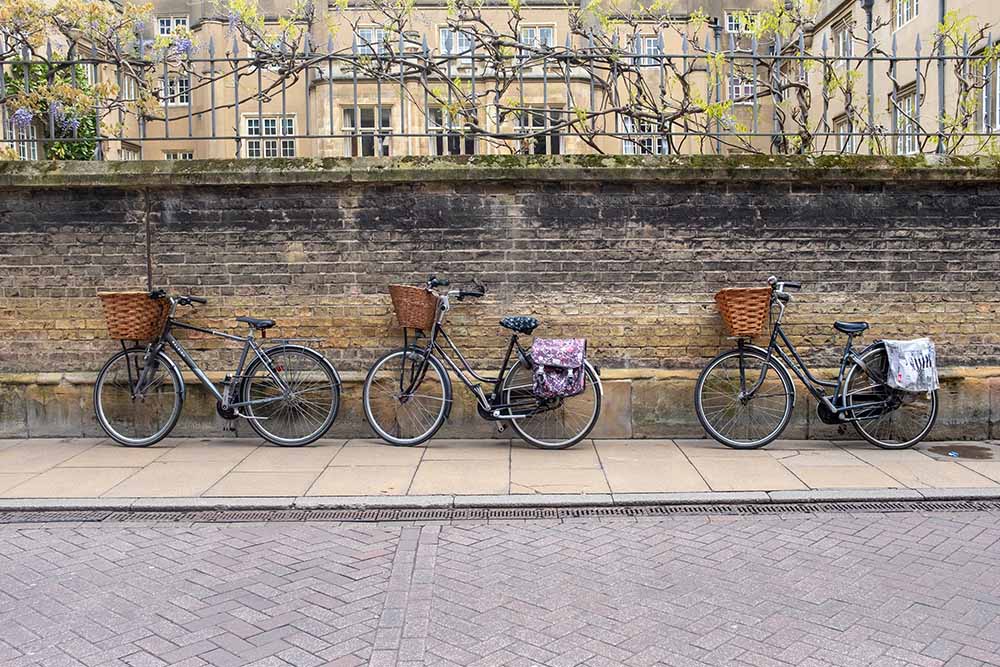
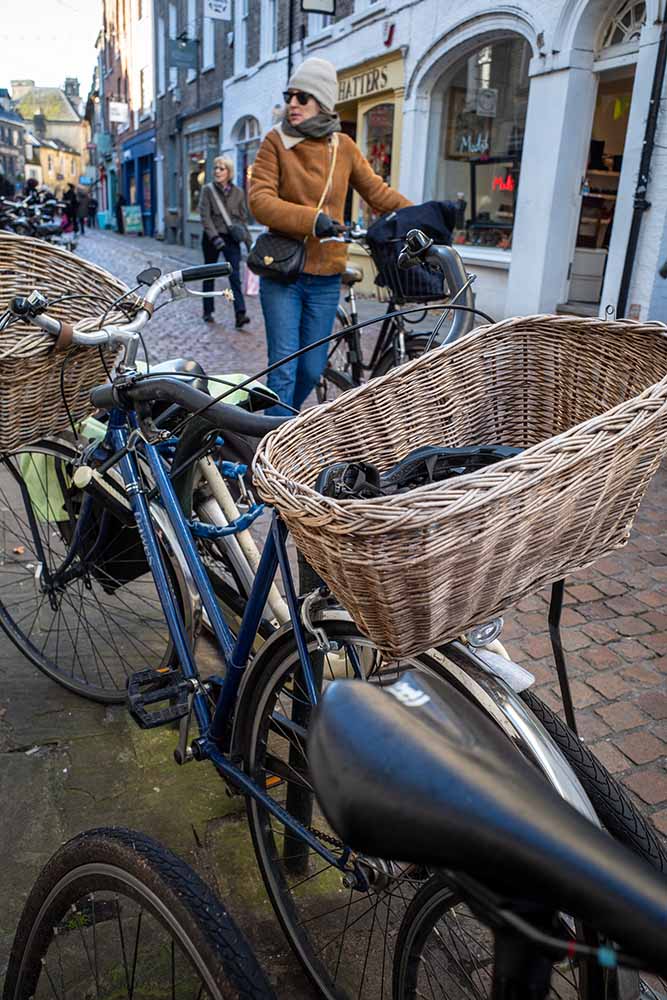
All around you see Cambridge dons on bicycles, students on bicycles, children on bicycles, fathers and mothers with children in tow in special carriages attached on bicycles, and old men and women perilously tottering and weaving along on bicycles.

In a word, everyone at every age rides a bike. And then there is the question of where to park these bicycles.

The Downside

I hesitate to write about the downside, but I must because it truly is a constant threat. Bicycles whizzing by. I tell you and I tell myself – watch out for those bicycles. And don’t ask a taxi driver what they think about bicycles 🙂

Ely In A Day

Ely is just a short train journey from Cambridge, where we live, so it is easy to do in a day.

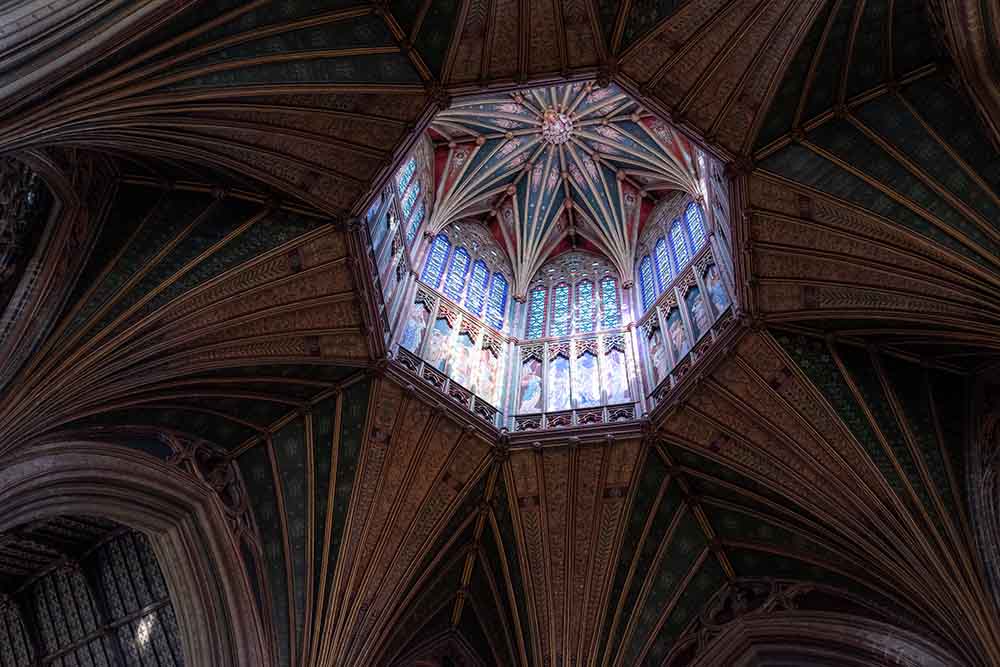
This is the lantern in the cathedral, and it’s just a quick shot on my phone. Next time I go I will set up something with my camera to get a better shot, but maybe even then I will not be able to capture the Wow! factor.

And it is a big Wow! Looking up and seeing the lantern set into the roof with the light streaming in, and the fact that the whole thing is made of wood and seems suspended on slender struts, makes it well worth seeing.

From Wikipedia

The central octagonal tower has eight internal archways that lead up to timber fan-vaulting that appears to allow the glazed timber lantern to balance on their struts.

The central lantern has panels showing pictures of musical angels, which can be opened, with access from the Octagon roof-space, so that choristers can sing from there.

That must be something – choirboys singing ‘up in the heavens’.

Getting There From The Station

There are a couple of roads to the cathedral that lead up from the railway station. I asked a nice woman which way to go and she said both ways were equidistant (what a lovely word) and she recommended that instead of either of these roads, that I walk up through the park.

Ely is set in the fens – a flat area of England that was under water until drained in the 1600s. A man I met near the cathedral mentioned that the cathedral is known as the battleship of the fens because of the way it sticks out on the horizon against the otherwise flat landscape.

Scottish Prisoners Drain The Fens

Oliver Cromwell’s house is now the tourist information office, and I picked up a book there about Scottish prisoners captured during the English Civil Wars being sent out to work to drain the fens. I’ve only just started it, but I googled around for more information and found that the Third English Civil War (1649–1651) was the last of the English Civil Wars, that had begun in 1642, between Parliamentarians and Royalists.

The war ended at the battle of Worcester when Cromwell’s New Model Army defeated the Royalists under Charles II.

Charles’ army of 16,000 who fought at Worcester included 14,000 Scots, so as the Royalist army was mostly Scottish, and as there was no major rising or support of the Royalists in England, historians have described the war as an Anglo-Scottish War rather than the last gasp of the English Civil War.

After Cromwell’s death there was total confusion that ended with the restoration of the monarchy in 1660.

And from time to time I wonder how it ever happened that the monarchy was restored. What prompted it?

An American Tribute To The Battle Of Worcester

In 1786, John Adams and Thomas Jefferson visited the battlefield at Worcester. John Adams wrote that he was deeply moved but disappointed at the locals’ lack of knowledge of the battle, and gave a lecture to the townspeople, noting:

‘The people in the neighborhood appeared so ignorant and careless at Worcester that I was provoked and asked ‘And do Englishmen so soon forget the ground where liberty was fought for? Tell your neighbors and your children that this is holy ground, much holier than that on which your churches stand. All England should come in pilgrimage to this hill, once a year.

Charles, Prince Of Wales Settles An Old Debt

Before the battle of Worcester, King Charles II bought uniforms for his army from the Worcester Clothiers Company. Having lost the battle and the war, he couldn’t pay the £453.3s bill. He escaped to France after the battle, and didn’t not return to England for nine years, until after the death of Oliver Cromwell in 1658.

Despite being restored to the throne, Charles II didn’t repay his debt and the debt remained unpaid until 2008 when Charles, Prince of Wales paid off the 357-year-old debt (without interest).