The London Eye By Day And Night

We’re changing the look of ecard communications.
Take A Look At Our Ecards.

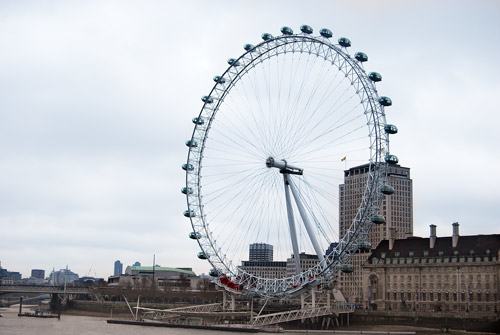
The London Eye, also known as the Millennium Wheel, came into service in March 2000. It is a Ferris wheel that sends more than 3 million tourists in a great circle around its circumference, each year.

By day the London Eye is not very attractive looking. It sits as a huge mechanical wheel tethered on the south bank of the Thames in the heart of London, within a short walk from Big Ben, Westminster Abbey, and the Houses of Parliament. It clashes with the architecture of the Tower of Big Ben, the Houses of Parliament, and Westminster Bridge.

The London Eye - Ecard

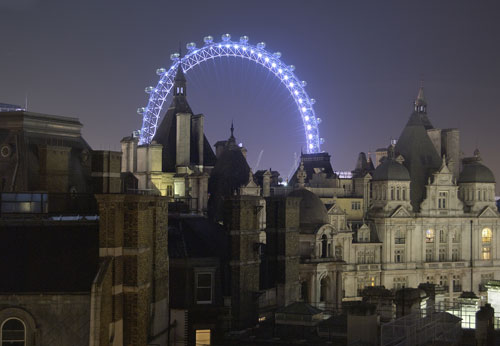
By night, illuminated with lilac floodlights, it looks altogether different.

london eye by night

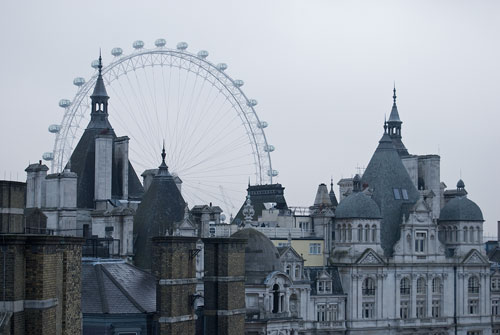
And in the morning, seen over the tops of buildings from the direction of Trafalgar Square, it still looks like something from a fairy tale land of ladies in high towers waiting for knights to rescue them.

london eye

Side Note
The name ‘Ferris wheel’ takes its name from that designed by George Washington Gale Ferris Jr. and erected as a landmark for the 1893 World’s Columbian Exposition in Chicago.

Beatrix Potter and Herdwick Sheep

Beatrix Potter, the internationally known children’s story writer and illustrator, and creator of the character Peter Rabbit, was a keen supporter of the Herdwick breed of sheep and helped save it from extinction.

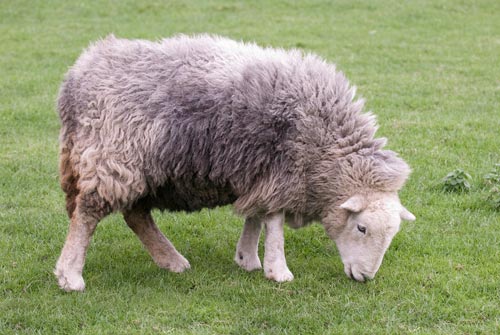
herdwick

This was part of her wider vision to preserve that part of England known as the Lake District. She wanted to preserve it from irresponsible development and ensure that so far as possible it would continue to be farmed in the way that had shaped its landscape over hundreds of years.

Part of what formed her vision is the contact she had with the founders of the National Trust, an independent charity formed in 1895 and dedicated to the preservation of the English countryside.

She and the Trust worked together, including farming some farms jointly to prevent them being broken up.

Beatrix Potter died in 1943 and at the time of her death she owned several farms in the Lake District totaling more that 4,000 acres (1,600 hectares), all of which she dedicated to be left to the National Trust following the death of her husband in 1945.

In 1951 an area of 885 square miles (2,230 square kilometres) was dedicated as the The Lake District National Park, ensuring it would be preserved from development.

National Parks in Great Britain are controlled and funded by the UK government. The farms that Beatrix Potter owned lies within the Lake District National Park and therefore have the double protection of being within the Lake District National Park and also owned by the National Trust.

Beatrix Potter’s farms comprise less than one percent of the Lake District National Park but her vision and that of the National Trust were instrumental in moulding the attitudes that resulted in the creation of the National Parks.

She bought Troutbeck Park Farm in the 1920s and built up a flock of over 1,000 Herdwick sheep, which she did in part because she felt they should be preserved as a breed because they were indigenous to the Lakeland fells with a history going back hundreds of years.

Herdwicks were under threat because they are slow growing sheep which give birth to fewer lambs than lowland sheep and therefore struggled on the balance sheets of working farmers against the advantages of other breeds.

Following her death the farms she owned and her Herdwick flocks were endowed to the National Trust with conditions attached to the continuation of the Herdwick breed.

The outbreaks of Foot and Mouth disease in England in recent years have again put strain on the viablility of the breed. This has made the conditions attaching to Beatrix Potter’s endowment to the National Trust an important factor in maintaining Herdwicks as a breed.

Herdwicks have magnificent coats with a lovely mix of gray, white, and brown wool. They are described as being hefted to the hill on which they are raised, which means that they know their home and will not stray from it.

And while Herdwicks are local to the Lake District, I took this photograph of a Herdwick sheep at a model farm in Yorkshire that specializes in maintaining a mixed flock of original English breeds.

You can send distinctive ecards featuring our photographs by Joining Quillcards.

Whooper Swans, Transmitters, and Wind Farms

The Wildfowl & Wetlands Trust (WWT) is primarily a conservation organization dedicated to saving wetlands, both for wildlife and for people.

It was founded in 1946 by Sir Peter Scott, who was both a naturalist and an artist. He bought the first wetland site for the trust he set up and dedicated his life to expanding the trust.

For many years he hosted a program on television about wildfowl and habitat preservation. The programs were a great hit with children, and an entire generation of English lovers of wildlife and the countryside owe their interest in part at least to those programs.

But as Sir Peter Scott recognized, it is not enough to see wildlife on television, and it was always part of his vision that Trust sites should not only be areas of conservation but also places where visitors could see wildlife.

The WWT now has nine visitor centers in the UK and has captive wildfowl collections from all over the world as well as benefiting from visiting flocks of wildfowl, some of which flocks number in their tens of thousands.

The Trust also does essential work internationally for the preservation of wetlands under the Ramsar Convention, which is an international treaty signed in Ramsar in Iran in 1971. Under that convention, various national agencies cooperate to preserve wetlands and the wildlife that depend on wetland ecosystems.

Martin Mere Wetland Centre is one of the nine WWT sites in the United Kingdom and is situated about five miles from the coast in Lancashire in the North of England, facing the Irish Sea.

It is formed around a series of meres or shallow lakes, which are home for the season to thousands upon thousands of wildfowl.

At the moment (December 2008) there are over 6,000 Pinkfoot Geese and over 1,000 Whooper swans overwintering at Martin Mere.

The Whooper swans will leave in March and fly to Iceland for the summer. It is well known that they fly the same route year after year, but their precise route is not known. And therein lies the story.

Wind Farms
Because there are more and more wind farms being built along their route, the swans are colliding with them. So the WWT and the wind farm development companies are working together to work out where the wind farms should be situated so as to minimize the risk of collisions.

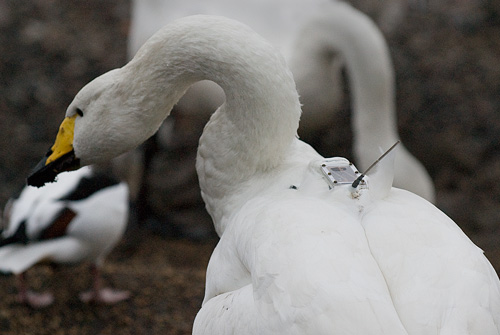
And in order to find out what the precise route of the migrating Whooper swans is, the WWT has fitted transmitters to the backs of some swans.

For their flight at migration time, every bit of extra weight puts the swans at risk. So in order to be at their optimum weight for the flight, Whooper swans stop drinking for a period before they begin their annual migration.

The Ideal Weight
Some birds weigh 12kg (26lbs) or more, and I guess that like me, you would think that bigger birds are stronger and more likely to make a successful flight. The staff at the Wildlife Centre know, however, that a bird that weighs about 10kg (22lbs) is most likely to make the journey successfully.

The shot of this swan was taken in very poor light at dusk. And it is a nice snippet of information to know that in all probability the swan weighs about 10kg.

Whooper swan at Martin Mere with transmitter fitted
transmitter


This is the link to the Wildfowl and Wetland Trust site
(note that the link opens in new browser window).