Take A Peek At Boo, The Eagle Owl

A ‘Bubo Bubo’ Named Boo
The Eurasian Eagle Owl is known as ‘bubo bubo’ in Latin, hence the name of Boo for a female of the species whom we met this past weekend at the Wildfowl and Wetlands Trust (WWT) Martin Mere wetland center in Lancashire, England.

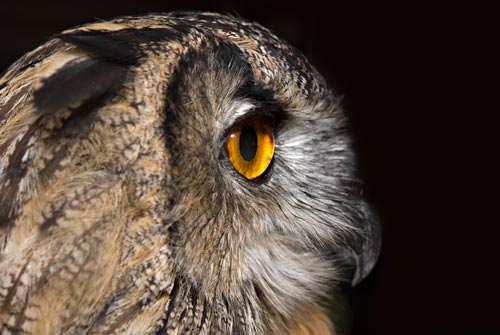
As you can see from these front and side views, Boo is a regal creature:
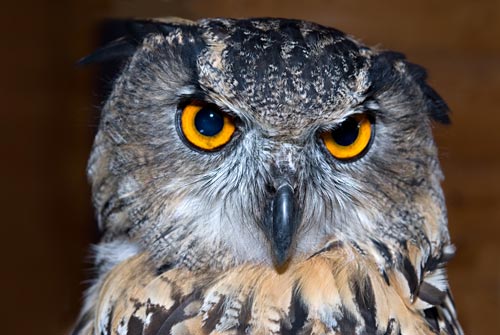
eagle-owl
eagle-owl-profile

Boo’s Story
Boo originally hails from Finland. She’s 20 years old, and she has been under the kind and knowledgeable care of the Corio Raptor Care and Rehabilitation for the past 16 years. Staffed solely by volunteers, this organization rehabilitated her after her owner abandoned her with a severely broken wing.

As one of her carers noted, there are ways that people can buy these birds as pets although of course they are not suitable as domestic pets.

Judging by how calm and collected Boo was when a crowd of us petted her in turn, however, hopefully her memories of the abuse she suffered are now in the past.

Jeepers Creepers, Where’d You Get Those Peepers?
As Boo stared at me with her wild golden eyes and huge irises that reminds one of the creatures in animated Disney fairytales, she seemed completely unfazed by all the attention that her startling beauty prompted in the crowd.

Helping People With Special Needs
Such behavior triggered me to ask her carer if it did not in fact bother her to have so many strangers stroke her.

It turns out that Boo loves the attention and she is used to it because she is taken regularly to a school for special needs in Liverpool where everyone gets the chance to interact with her.

Bits and Bobs About Eurasian Eagle Owls
Like all Eurasian Eagle Owls, Boo is a species of horned owl that is largely noctural and found in many parts of Europe and Asia.

Boo’s carer told us that she weighs about 10 pounds (4.5 kg). That’s typical for females, while males only weigh up to seven pounds (3 kg). The species has a wingspan ranging from 55 to 79 inches (138-200 cm), and they measure 23 to 30 inches (58 to 75 cm) long. Their prey is usually small mammals, but they can kill foxes and young deer.

She Can’t See For Miles and Miles…
Looking at a massive raptor like Boo, I figured that she would have fabulous eyesight to see for miles when scouting for prey.

However, her carer explained to me that that stereotype is false: Like all Eurasian eagle owls who are largely nocturnal raptors (that is, raptors who are active during the nighttime), Boo’s long-distance vision is actually very similar to that of humans.

The Diurnal Raptor’s Gift
It is only diurnal raptors (that is, raptors who are active during the day) who can spot prey like a rabbit on the move from up to three miles away.

Tripping the Light Fantastic
The retina of the human eye contains two photoreceptors called ‘rods’ and ‘cones’. Cones are sensitive to color, rods are sensitive to light.

Eurasian Eagle Owls have far fewer cones in their eyes than we humans do, so these owls can only see primary colors.

With far more rods, however, what Eurasian Eagle Owls like Boo do have in spades compared to humans is extreme sensitivity to light.

Boo’s Buddies
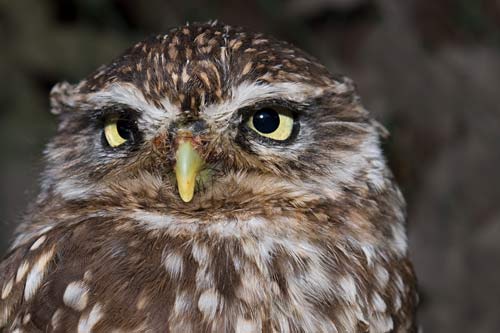
Here are two of Boo’s friends who were also at the exhibit this past weekend. I didn’t get the chance to find out why and how they ended up in care at the rehabilitation center, but I was able to make note of their breeds: The first is a White-Faced Scops Owl, and the second is a Little Owl.

As you can see, along with Boo they made a magnificent and memorable trio.
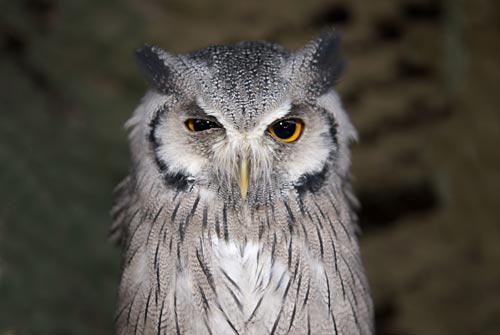
White-faced Scops Owl
Little Owl
Little Owl

References
Corio Raptor Care & Rehabilitation
Wikipedia
The Wildfowl and Wetlands Trust (WWT)

You can send distinctive ecards featuring our photographs by Joining Quillcards.
TweetMeme and Krumlr

Update March 2014:
Tweetmeme and Krumlr are no longer operating so the information in this post is no longer relevant.


Tweetmeme is a service which aggregates links on Twitter and displays the popular ones on the TweetMeme site.

Website owners can add a TweetMeme button to any kind of web page and there is a dedicated WordPress plugin which is easy to install.

The advantage to people surfing websites is that when they discover content they like, they can tweet it by hitting the TweetMeme button.

The advantage to website owners is that it gives them a way to enable their visitors to popularize their web pages – one that is very easy for their visitors to use.

In my opinion, the Tweetmeme button is easier, more prominent, and more inviting than the Add This or Add to Any widgets (useful though they are) or any of the other widgets that a web surfer might be invited to click on when he or she visits a web page.

Of course TweetMeme is limited to tweeting to Twitter, but from the website owner’s point of view that can be a powerful way of promoting a page. That’s because each visitor has his or her own circle of Twitter friends, and Twitter is highly interactive.

Krumlr describes itself as social bookmarking on Twitter. When a member adds a web page to Krumlr, they also tweet it.

While Krumlr describes itself as ‘social bookmarking on Twitter’ it is also an appealing social bookmarking site in its own right.

Where Krumlr scores is in the high visibility it gives to its members.

Not only are the web pages – the ‘krums’, I guess – saved, displayed and tweeted, but the Krumlr users themselves – the ones who are feeding those good web pages into Krumlr and onto Twitter – are also featured.

And the more well-regarded web pages a member sends to Krumlr, the more visible that member becomes on the site, thus further promoting the pages he or she has added.

There is always a slight worry with social bookmarking sites. What if the site closes – what happens to all my bookmarks then?

York and New York

York - September 2009

York - January 2008
York - January 2008

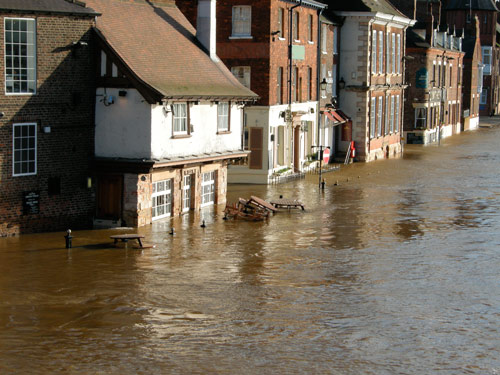
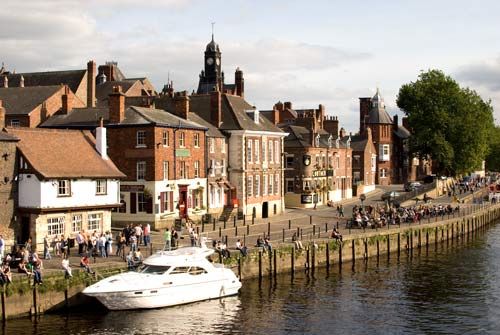
These are views of the cathedral city of York in the north of England. The first was taken this month and the second a year and a half ago when the river Ouse burst its banks, as it has done many times.

The worst of the most recent floods was in the year 2000 when the water all but covered the ground floor windows of the King’s Arms Public House, which is the building with the jettied upper floor in the photographs.

New York

In 1663 the Duke of York – James Stuart, the second son of Charles I and the brother of Charles II – bought Long Island and other islands on the New England coast.

The next year, his forces captured New Amsterdam from the Dutch and he renamed the whole possession the Province of New York.

His province included what are now New York State, New Jersey, Delaware and Vermont, and parts of Connecticut, Massachusetts, and Maine.

The Dutch subsequently recaptured the city of New Amsterdam and it remained Dutch until it was traded back to the English under the Treaty of Westminster in 1674.

The Dutch got the island of Run in Indonesia in exchange – something they were happy enough with at the time as the island of Run was the only place where the nutmeg tree grew and from which the valuable spices nutmeg of and mace could be obtained.

James II

When James Stuart became king he was James II of England and Ireland, and James VII of Scotland in 1685.

His reign lasted three years before he was deposed and forced to escape to France as a result of his attempts to re-establish Catholicism and a stronger throne in England.

He was succeeded by the joint reign of William and Mary, then of Anne, then George I, and George II, until the reign of George III, when New York again changed hands.

If you enjoyed this article, please consider leaving a comment or subscribing to the feed to have future articles delivered to your feed reader.
The ‘York Flood’ image is available here as a Quillcards ecard.