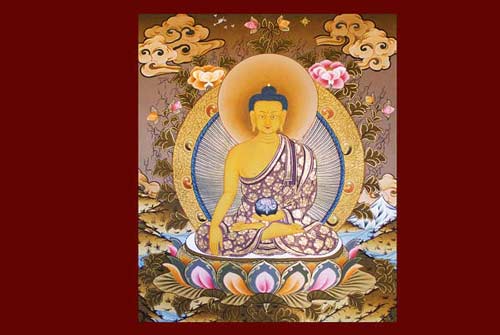
‘Pearls Of Wisdom’ In Buddhist Sacred Relics

Buddha Wall Hanging - A Quillcards Ecard

A Buddhist Verse
In the ‘Exalted Sublime Golden Light Sutra’, there is this verse that talks about a number of impossibilities in nature:

When white lilies grow
In the Ganges’ swift currents,
When crows become red
And cuckoos turn the color of conch,
When palm fruit grows on the rose-apple tree
And on the date tree mangos form,
At that time a relic the size
Of a mustard seed will appear.

The Ganges In Varanasi
Now, it just so happens that my husband David and I saw the Ganges River this past spring as it flowed through various cities in India.

However, as you might easily conclude – never in our travels did we see ‘white lilies grow in the Ganges’ swift currents’, as the poem here proposes.

Relics The Size Of A Mustard Seed
A few weekends ago, however, we did actually see a ‘relic the size of a mustard seed’.

In fact, we saw a number of clusters of them – and it happened here in the cold summer weather of the city of Leeds rather than in the heat of India.

Sacred Objects From Buddhist Masters
We saw these relics at an exhibition called the ‘Maitreya Project Relic Tour: Sacred Relics Of The Buddha’, sponsored by the Jamyang Buddhist Centre in Leeds that was being shown in the Leeds City Museum.

The exhibition of Buddhist relics included some donated by the Dalai Lama. It was qualified as a rare collection that included relics of the Buddha and of masters from different Buddhist traditions.

Remembering Majnu-ka-Tilla
We were interested to see what these relics were. As we stood in the subdued queue of people waiting to see them, David and I spoke to one another about the Buddhists we had met in India.

We recalled in particular the lovely practitioners of the faith that we had seen in Majnu-ka-Tilla, the Tibetan enclave in Delhi where we had stayed for almost a week when we were in Delhi.
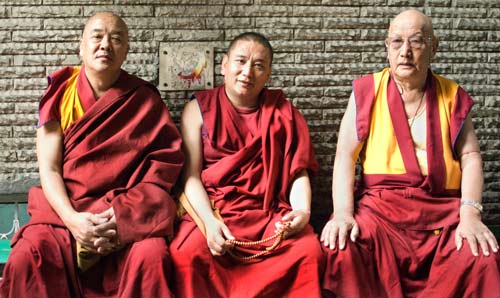
Buddhist Monks
Buddhist Monks

In Majnu-ka-Tilla we had stayed at Wongden House, a friendly hotel with airy rooms that looked out at the Yamuna River and the fields and huts on the riverbank.

Life In Those Alleyways And Byways
Once you leave the hotel, you go through winding, unpaved alleyways and paths where colorful prayer flags, handy Tibetan crafts, mom & pop food shops, clothing stores, phone outlets, and corner pharmacies. Even an Internet cafe or two dot the streets.

As you walk, you often pass Buddhist monks radiant in their simple vermillion robes. Everything and everyone winds down to the very wide boulevard where bicycle rickshaws and some auto-rickshaws (if you are lucky enough to find them!) transport you to the local subway station and from there you can get to the heart of Delhi.

Once in the center of Delhi, you’re back in the thick of it, of course. You can see everything from the ancient to the new in terms of transport, as this photograph of the city traffic reveals:
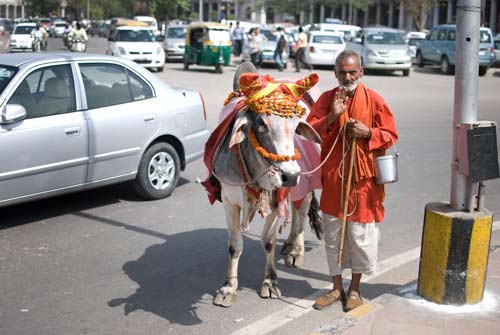
Pilgrim In Delhi
Pilgrim In Delhi

The Community As Our Refuge
The commercial center of the exiled Tibetan refugee community, Majnu-ka-Tilla is a quiet, peaceful area that offered us respite from such chock-a-bloc traffic and the frenetic, all-guns-blazing hubbub that is Delhi.

Wongden House also has a marvelous small and simple restaurant on its premises where we ate several times.

There one night we met some Buddhists who were passing through en route to a retreat. We asked them questions about their way of life as we ate delicious Tibetan noodle soup called ‘tenthuk’ made with vegetables, steamed dumplings called ‘momos’, and vegetables that sizzled on a huge bed of lettuce.
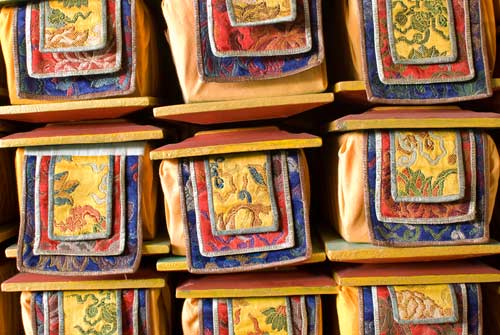
Buddhist Sacred Texts - A Quillcards Ecard

Visiting The Buddhist Exhibit
Cut from that experience of the Buddhist culture in Delhi this past spring back to the exhibit that we saw recently here in England.

Before entering the exhibit, we were asked to take off our shoes. After that we entered a large, dimly-lit rotunda where calming music was being piped in. The lights were low as all of us museum goers progressed forward on a narrow plush red carpet.

On one side of the queue, people sat on chairs and mats. Some assumed the lotus position as they meditated.

On the other side, a monk dressed in beautiful vermillion robes blessed people who came one by one to kneel in front of him. He placed a golden vessel on each person’s head, which we learned also contained some relics of the masters.

In the center was a large golden Buddha, golden bowls lined up in a semi-circle, and a number of exhibits in glass cases.

As we wound around the table, we also saw a copy of the Exalted Sublime Golden Light Sutra, the same book from which I chose the verse that I used to begin this article.

What Are ‘Relics’ According To Buddhists?
The highlight of the show were the relics of the Gautama Buddha and of other masters.

We discovered that ‘relics’ is the word Buddhists use to describe the bits of hard, pearlized balls of bone that are found in the sifted material that remains after a holy master is cremated.

We saw about 10 glass cases filled with delicate bowls that had about half a dozen or so or fewer of these gleaming remains.

The Two Usual Sources For ‘Pearls Of Wisdom’
And so I wonder: Is this where the term ‘pearls of wisdom’ first came from?

The usual answer about where this phrase comes from is that the phrase is considered to come from two sources.

The first source is considered to be from the Christian religion, specifically from Matthew 7:6 in which there is a reference to casting pearls (that is, the wisdom of the gospel) before swine.

The second source is from James Russell Lowell, the nineteenth-century American Romantic poet, critic, editor, and diplomat who referred to the poetry contained in the classic Rubaiyat of Omar Khayyam as follows:

These pearls of thought in Persian gulfs were bred,
Each softly lucent as a rounded moon;
The diver Omar plucked them from their bed,
Fitzgerald strung them on an English thread.

The Rubaiyat of Omar Khayyam is the title that the nineteenth-century writer and translator Edward FitzGerald gave to his famous translation of about 1,000 poems.

The poems were originally written in Persian and are attributed to the Persian poet, mathematician, and astronomer Omar Khayyam who was born in 1048 and died in 1131.

A Possible Third Source For The Expression ‘Pearls Of Wisdom’?
After seeing these relics recently, I now wonder whether they are in fact a third source for the expression ‘pearls of wisdom’.

I asked this of a Buddhist monk who was there and she said that Buddhists believe it is only masters’ remains who yield such relics. However, I do not know what experts of cremation would say about this.

I do know this, however: Although we can use the term “pearls of wisdom” sarcastically, at its heart the expression is meant as intelligent advice, commentary, or instruction that someone imparts to others.

And does that not sound exactly like what the Buddhist teachers and masters strive to do throughout their lives?

The tiny silver- and cream-colored ‘pearls’ glittering so perfectly in their glass cases with the photographs of lovely, smiling Buddhist monks from whom they came next to them makes me think that this derivation seems like it may well be possible.

And so as the poem at the beginning of this article stated, it may well be that flowers don’t bloom in the Ganges, that crows are black and not red, that mangos certainly don’t form on date trees and the like – but we did see a good number of ‘relic[s] the size of a mustard seed’ that came from the bodies of Buddhist holy leaders.

However, whether it’s a bit of magic fluttering in the air a bit or the result of what a truly spiritual person’s remains can leave after his or her body leaves this Earth – well, that I do not know.
Sheep Ecards: Spending Time Under A Tree

Sheep Scratching
Sheep Scratching

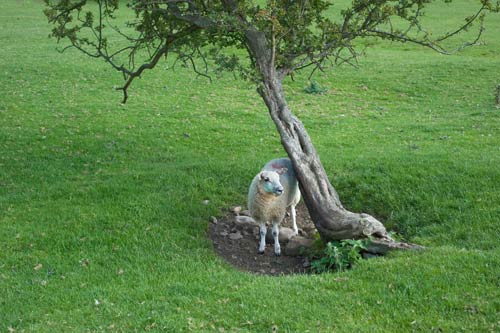
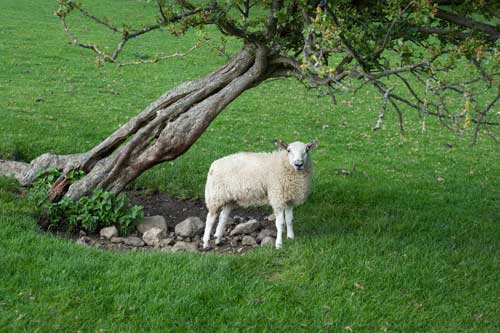
We have just added these photographs of this lamb to our ecard collection.

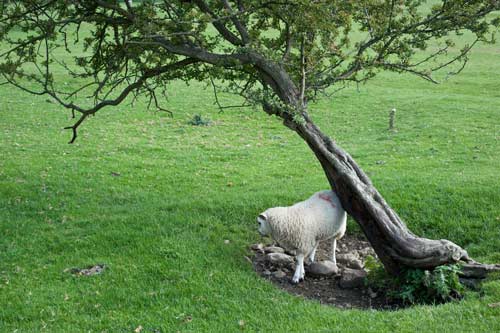
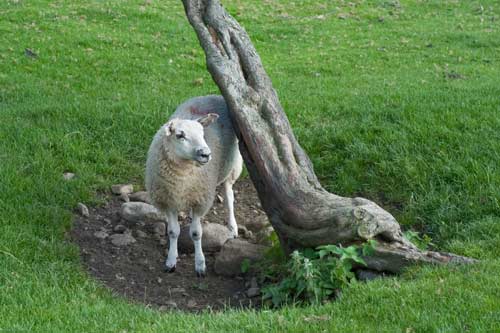
We came across this young sheep – still practically a lamb – scratching its fleece against an gnarled old hawthorn tree.

It was so preoccupied with this that we were able to walk quite close to it. We knew it would make a good subject for our ecards, so we took our time and walked slowly towards it.

From there I was able to circle around to get the rise of the ground behind the sheep so that I could keep the background plain and uncluttered.

In fact the sheep was so preoccupied that I was able to walk right around it and watch it as it scratched.

As I walked around and got nearer, my height meant that I could look down and take advantage of a plain background (the grass) and keep the sheep and tree in the frame.

I expected the sheep to run away at any moment. I didn’t want to scare it but things were unpredictable. It’s important in these kind of situations, therefore, to be completely familiar with your camera and know just what knobs and dials to twist in order to get the shot.

The sheep eventually took notice of me and moved a yard or two away from the tree. It still didn’t look bothered on account of me being so close.

I was shooting with my Nikon D700 and a 50mm lens, so the angle of view was quite wide. That was great for capturing the whole of the tree but not so good for homing in on the sheep.

So I walked a bit closer still and even then it didn’t panic or skedaddle as I expected. I was able to take several shots and then back off and leave it to get back to its scratching.

Did You Know That Farmers Mark Their Sheep?
You might just be able to see a mark on the back of the sheep in the photograph above. It is red dye or paint that farmers use to mark their flocks.

Sometimes farmers paint individual numbers on their sheep to identify mother ewes and their particular lambs.

It is fun to stand watching a flock of sheep and see a couple of lambs with a number, for example ’34’, written on their backs running across the field to their mother – which also has number 34 marked on its fleece.

Sheep Under Tree - A Quillcards Ecard
Sheep Looking - A Quillcards Ecard

Up Close With Ponies On Dartmoor

Dartmoor Ponies - A Quillcards Ecard

Memory And Travels

Memory… is the diary that we all carry with us.
Oscar Wilde

What has often been most memorable in my travels are those moments that were unplanned and unexpected, and not necessarily those places about which I have had great hopes that something wonderful would occur.

One such space in time happened last month when my husband David and I went to Devon, a county in southern England. I was expecting gorgeous countryside because Devon is always described with such a superlative.

However, I hadn’t given much of a thought in particular to Dartmoor National Park and what I would see there – but it was in fact there where something took place that has become a lasting memory.

Ponies At Dartmoor National Park
First, however, some background about the area:

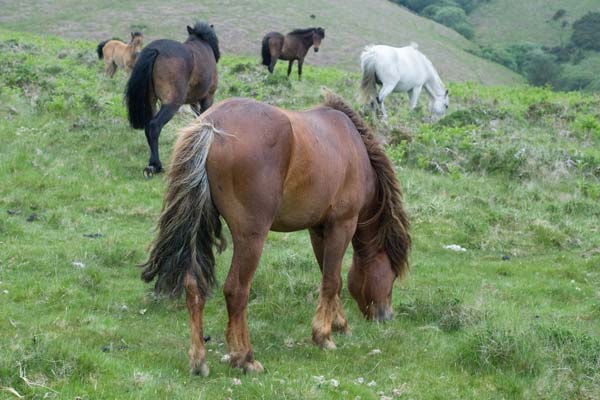
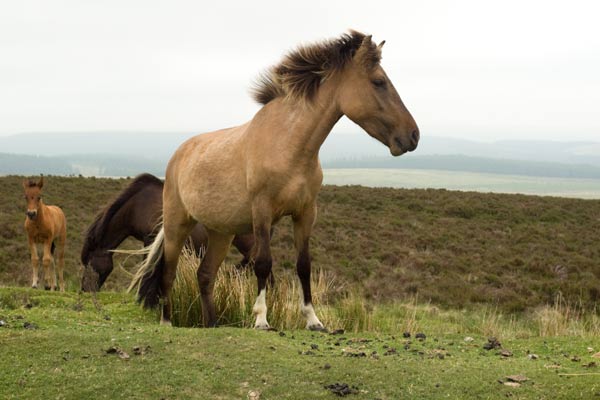
Dartmoor National Park is the largest and wildest area of moorland in the UK. It is well known for its Dartmoor ponies who roam free on its land, like the three horses pictured above. In fact, the pony is also the park’s logo since it is such an important part of life on the moor.

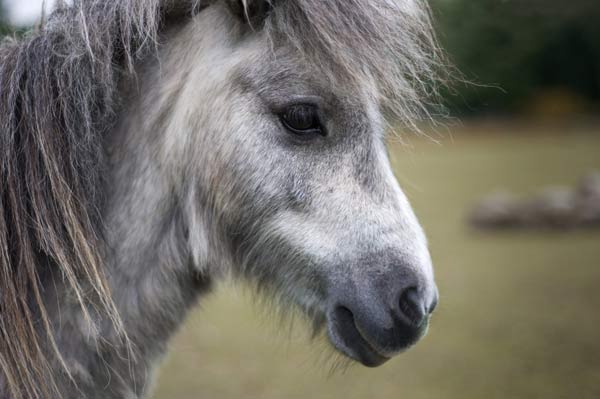
Ponies have roamed on the moor since prehistoric times. Many other kinds of ponies have also lived on the moor, such as those from the Shetland Islands. Shetland ponies like the one pictured below adapt well to the harsh conditions on Dartmoor.

Shetland Pony - A Quillcards Ecard

Aside from the Shetland, cross breeding also means that there are a lot of ponies living in Dartmoor who are of no particular breed.

Some History About These Dartmoor Equines
During the 1970s, an archaeological excavation came upon hoof prints providing evidence that domesticated ponies where found on Dartmoor around 3,500 years ago.

In fact, horses have been on Dartmoor for so long that an indigenous breed – the Dartmoor pony – evolved.

In the mid-1800s, Dartmoor was one of the main sources of granite in Britain. A railway was built to transport the rock, and ponies were used to haul trucks to and from the railway. By the first half of the 20th century, ponies were also used for farm work and for delivery of goods and services.

Locals, visitors, and tourists also liked to see the ponies then as they do to this day.

In Modern Times
By the middle of the 20th century, there were nearly 30,000 ponies on Dartmoor.

However, today there are fewer than 1,500 including fewer than 900 breeding mares left – which is why the Dartmoor pony breed is considered rare.

The reason for the decline is that in earlier years ponies were sold for horse meat – in Britain and then when that was no longer acceptable to the British public, in Europe.

With the rising tide of public opinion against the sale of horse meat to Europe, the number of ponies that the farmers could afford to keep declined.

A 1998 article in the Independent newspaper tells the whole story under the title The Ponies Killed By Kindness.

From Foal To Pony ‘Vital Statistics’
Some say that Darmoor ponies have the majority of their foals between April and July, others between May and August. At whatever time they are born, foals remain with their mothers for some time afterwards.

When a foal reaches maturity, it is never more than 12.2 hands (that’s 50 inches or 127 centimeters).

The colors for the breed include bay (which means that the horse has a reddish brown body color with a black mane, tail, ear edges, and lower legs), brown, black, grey, chestnut, and roan (which means that the horse has an even mixture of white and pigmented hairs that does not get gray or fade as the animal ages).

Piebalds (who are black and white) and skewbalds (who are brown and white) are crossbreds, and usually part Shetland pony.

Wild They Are Not, Though Close To It They Are
Some people mistakenly think that the ponies at Dartmoor are wild: They seem to roam as they wish; they don’t have saddles; and for the most part there are no people about.

Actually, all of the ponies are owned by local farmers, who mark the ponies to indicate their ownership and who let them out on to the Dartmoor commons to graze for most of the year. These farmers have rights to graze a certain number of sheep, cattle, and ponies on the moor.

Drifts
The ponies live out on the moor all year ’round. They spend the majority of their time in small herds of mares with young ponies and one adult stallion.

In late September and early October the local farmers get together to round up their ponies. These round-ups are called ‘drifts’.

During a drift, ponies are herded towards a small field or yard that’s easy to access. Not only people on horseback, but others using four-wheeled bikes and some on foot as well all get in on the act.

After they are herded, the ponies are separated into groups. They are checked out health-wise and treated if necessary. Those who are too old or ill or those to be sold are separated out, while the others return once again to the moor.

Out On The Moor
Intent on seeing the moors, we drove through the narrow roads that wind their way across Dartmoor.

Soon we came to a part of the moor where small clusters of the ponies with their foals were congregated on either side of the road. We parked our car and walked out gingerly on to the springy turf to try and get a closer look at the lovely creatures.

Here is a young foal that we saw at that time, cuddling up to its mom on the moor:

Dartmoor Ponies - A Quillcards Ecard

Visions On The Land
History, statistics and characteristics about the ponies aside, there are few things more peaceful and moving than being in the presence of these ponies as they walk and trot about, chomp down on the vegetation, snuggle against one another, and otherwise while away the time and play around at their home in Dartmoor.

The gentle mist wafting in the atmosphere during the afternoon when we were there also provided a soft and protective veil to the splash of colors and quiet sounds of these generally placid ponies and their foals.

Acknowledging Our Presence
The ponies and foals that we ‘met’ on Dartmoor quietly gave us the merest slip of a nod in a type of recognition of our presence.

We managed to get within a foot of some of them so we tried to pet them. However, they would have nothing of that: They skidaddled when they saw us get too near, and then they resumed their grazing and romping about further up a patch in that ancient and gloriously memorable setting.

A Beautiful Dignity
As we turned around from the horses to make our way back across the moor toward our parked car, we spotted this final scene:

The Power Of Dartmoor - A Quillcards Ecard

Seeing that pony looking majestically into the haze of the horizon with another grazing peacefully and the little one looking straight ahead at us, we felt a world away from our normal urban living in that serene and tranquil setting.

So as the mist softly drizzled over all of us humans and horses, this was the peaceful memory that I was lucky to get – and to remember, whenever I wish.