Henry Moore, Ai Weiwei, and More

At The Exhibition
Leeds Art Gallery in collaboration with the Tate Britain Gallery in London is hosting an exhibition of Henry Moore’s sculptures, paintings, and drawings.

There is a permanent exhibition of his sculptures at Leeds Art gallery. For this exhibition, however, pieces have come from many other galleries and from private collections. So this is a unique opportunity to see a lot of Moore’s work in one place.

Henry Moore was born in 1898 and brought up in Castleford, which is about 14 miles from Leeds. So many people in Leeds are acquainted with his sculptures. In fact, there is a large bronze Henry Moore sculpture on permanent show outside Leeds Art Gallery.

Moore died in 1986, and during his long life he drew on African primitive and pre-Colombian art to sculpt his favourite subject over and over again.

His favorite subject was people. Many of his sculptures are of women and most of them are simply figures – standing, sitting, thick and bulky mothers holding babies, delicate women with heads turned up to the sky.

And they range from the greater than life size (with a couple that are simply huge) down to many that are just a couple of feet tall or less.

Often their faces are twisted in some way – just in a simple distortion away from the regular – that seems to show their personalities.

Even though many of his figures might look like a cross between pre-Colombian art and a Picasso during his ‘bathers’ period, they hold together as figures.

They all ‘work’ as works of art. Their isn’t a dud among them. I think that is in part because Moore was a very good draughtsman.

I didn’t once get the feeling that the head on this one or that one was the wrong size, or the shoulder here or there was wrong, or this or that neck needed to be moved over a bit.

An Official War Artist
Moore was commissioned as an official war artist during the Second World War and he chose to paint and draw the civilian population sheltering in the London Underground during the German air raids.

He was famous before the war, but his drawings of people sheltering in the Underground made him internationally famous. The drawings went on tour – including to the United States to help drum up enthusiasm for America’s entry into the war in Europe.

They are very moving drawings in muted dark blue-grey with pale wraith-like people sitting or sleeping in long rows stretching into the dark interior of the tunnels.

If you get the chance, the exhibition is well worth visiting. It runs until 12 June.
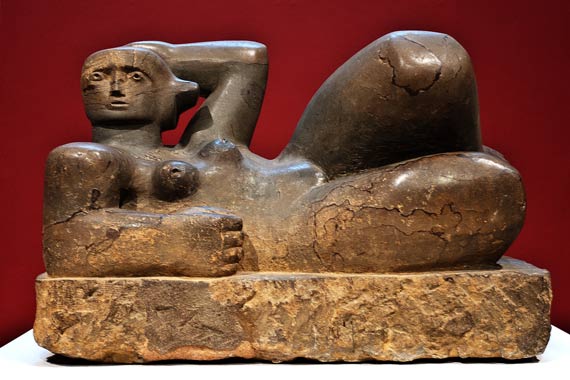
Henry Moore Reclining Figure

Ai Weiwei Detained and Shown
Following up on my article on Ai Weiwei’s Sunflower Seeds exhibition at the Tate Gallery, I was very sad to learn that Ai Weiwei has been detained by the Chinese authorities. It is now more than a month since he was detained, with no word on what the future holds for him.

The Lisson Gallery in London is showing an exhibition of his work. The exhibition was planned before Ai Weiwei was detained so it is not a reaction to his detention. Having said that, his detention cannot have come as a complete surprise. The exhibition runs until 26 June.

There is also an exhibition of Ai Weiwei’s animal figures on display in the courtyard at Somerset House in London – so that is something else to see.

Quillcards Web Server Status
Now for something technical. We run this site on a virtual private server with a web host that is noted for its reliability. There are nonetheless times when maintenance is scheduled, and there is always the possibility of a piece of hardware failing unexpectedly.

As the rather spectacular recent outage with Amazon cloud storage has shown, even world-class services can go down for extended periods.

So it is with some pleasure that we can say that our uptime has been more than 99.85% over the whole period we have been running Quillcards.

However, we have always worked on the principle that if the service were to go down, members would like to know what is happening rather than be left in the dark.

And that presents a problem when the very service that could alert people to a problem is itself out of action.

So to deal with this, we have an admin site running on a separate web host to Quillcards.

We post messages on the admin site when maintenance is due to be run on Quillcards. And apart from that the admin site more or less just sits there and twiddles its thumbs.

Or rather it did until six days ago when the web host where it runs had a catastrophic failure on one of its servers.

Just to make it absolutely clear – this had no effect on Quillcards because the admin site that had the problem is run on a different server with a different web host.

The Failover Fell Over
Normally the server on which the admin site is running would ‘failover’ to another server and service would continue uninterrupted.

A ‘failover’ system works by one server continuously copying its information across to a second server in real time.

Meanwhile the second server monitors the health of the first server and if it detects that the information that is being copied across to it is corrupted, it stops accepting information and it takes over and becomes the main server.

Except that on this occasion the second server failed as well….

So now the company that runs the web host for our admin server has been working hard over the past five days reconstructing hundreds, possibly thousands, of websites – including our admin site.

Our admin site is now back up, but until yesterday it was falling over intermittently as the load on the servers kept spiking. Thankfully, it seems to have settled down now.

I have mixed feelings about what has happened. I have sympathy for the people at the web host company working hard to get the service back up, but something was badly wrong that allowed a failover server to fail at the same time as the original server.

Was Leslie Howard Shot Down On Purpose
Leslie Howard, the film actor who played Ashley Wilkes in the 1939 film Gone With The Wind, was shot down in 1941 by a german aircraft while he was a passenger on a plane bound for Portugal.

It was widely thought at the time that he was targeted by the enemy because of his role in Pimpernel Smith – a 1941 anti-nazi film in which he starred and because he was thought to be a British spy on his way to convince Franco not to join in the war on the German side.

New light has now been thrown on this – as revealed in an article of 17 April in the Sunday Times – from transcripts held in the British National Archive and recently rediscovered by a German historian, Professor Neitzel.

The transcripts are of recordings made of the conversations of captured German pilots, including the conversations of one Corporal Heinz Dock.

Corporal Dock was secretly recorded describing to a cell mate in a detention camp in England how he came across flight KLA 777 by chance and chased it across the skies above the Bay of Biscay before shooting it down.

So Leslie Howard was not the victim of a targeted killing, but simply one of the unlucky people on that ill-fated flight.

Selfridges And Overfishing
On a positive environmental note, the famous London store Selfridges – which has a food emporium that can turn anyone into a food lover – announced on 5 May that it is no longer selling several dozen species of fish that are threatened by overfishing.

Selfridges has teamed up with a number of conservation partners, advisors, and collaborators on Project Ocean – the declared aim of which is to “celebrate the beauty of the ocean, highlight the issue of over-fishing, help us all understand the threats to the ocean and make positive choices about the right fish to buy and eat.”

The End Of The Line
A good place to learn about overfishing in the world’s oceans is the End Of The Line.

Overfishing has depleted the fish in the world’s oceans by 90% compared to fifty years ago – so that stocks are at the point of no return and unable to regenerate themselves.

It’s a sobering thought, isn’t it.
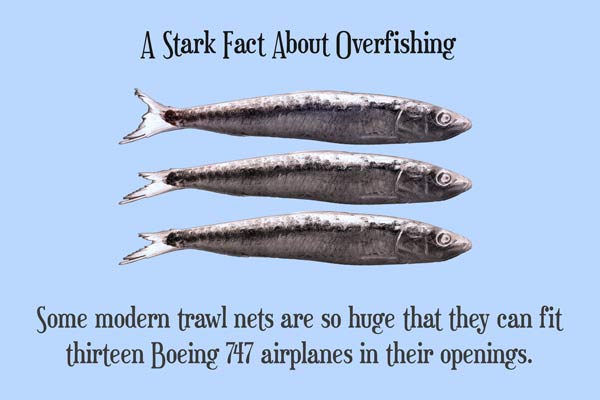
Facts About Overfishing - A Quillcards Ecard
Facts About Overfishing – A Quillcards ‘Animals and Nature’ Ecard

Reclining Woman - Henry Moore
Reclining Woman – Henry Moore – Outside Leeds Art Gallery

Going Back To Waterloo Lake

Back To Waterloo Lake

I have been making some loose panoramas, including some of Waterloo Lake in Roundhay Park, Leeds.

I call them ‘loose’ panoramas because of how I shoot them.

Articles and tutorials on how to make panoramas by blending a number of photographs say you should place your camera on a tripod. Then the idea is to pan around taking a series of photographs, overlapping each shot with the next.

Then you should raise the tripod head and shoot another string of photos.

And then raise the tripod again, and shoot a third set.

The next step is to merge all these separate photographs in Photoshop using the Automate > Photomerge tool that combines all the individual shots to make one huge composite photograph.

There are also special tripod heads that eliminate parallax distortion.

That is the distortion you get when you hold your finger up in front of your face and look at it with one eye closed, then with just the other eye closed, and your finger appears to move.

These special pano-heads as they are often called, sit on top of the tripod and offset the camera on the tripod so as to eliminate that distortion.

Back To Fast And Loose

Which brings me back to the ‘loose’ panoramas I prefer to take because frankly, sometimes I don’t care about the distortion, which anyway is much less for objects that are further from the camera.

So my technique is to do away with the tripod completely and just take a whole series of overlapping shots handheld.

Why Not Just Take One Photograph

One reason for making panoramas from a number of photographs is to cover a larger area than can be covered in one shot.

That leads to the second reason. While, of course, you can often move back to take a single shot, you cannot get the perspective you can get by raising, lowering, and panning the camera for a whole series of shots that you combine into one photograph.

A third reason for making composites is that the resulting photograph is very big. Instead of the 6, 10, 12, or whatever number of megapixels the camera has in its sensor, the finished panorama can be 100 megapixels or more.

That means you can print the photograph as big as the side of a bus if you wish.

Waterloo Lake Roundhay Park Leeds
Waterloo Lake - Roundhay Park - Leeds

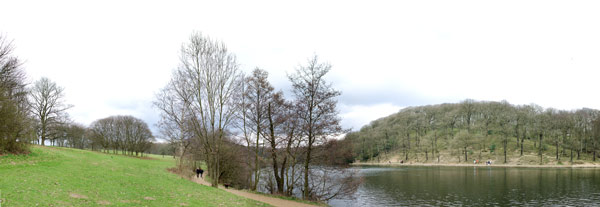
This is a ‘loose’ panorama I took today of the head of Waterloo lake in Roundhay Park in Leeds under a leaden sky.

The park is over 700 acres (280 hectares) and is owned by the local council for the benefit of the public.

Roundhay Park – A Very, Very Brief History

The park was laid out in 1815 and the lake was made by damming up the far end of the quarry that was there.

The work was done by the then recently-unemployed soldiers who had ended their service following the battle of Waterloo and the defeat of Napoleon’s forces earlier that year.

And that is why the lake was named Waterloo Lake.

When I Was Little

When I was very little – perhaps two or three years old – my mum, dad, and I would go out on the lake in one of the rowing boats you could hire.

I can picture my dad rowing, with his shirt sleeves rolled up.

Faintly in my memory I can hear the boatmaster calling out to boats on the lake: “Come in number nine, your time is up,” but I may be confusing this with other boating lakes that hired out boats.

A Phrase That Entered English Folk Language

Certainly the phrase ‘Come in number nine, [or whatever number you want] your time is up,’ became part of English folk language used by comedians and raconteurs in all kinds of situations.

It was so much a part of the language that it was used as the title of a song by Pink Floyd, who re-recorded and retitled one of their tracks to “Come in Number 51, Your Time Is Up” for the film Zabriskie Point.

Foreign Shores

When my parents and I were out on the lake, they would tell me that we were rowing to another country.

At three years old that bothered me because I couldn’t reconcile the idea of ‘another country’ with the knowledge that I could see the land around the lake encircling us.

The Seed That Sowed The Travel Bug

Looking back, I wonder whether the travel bug that bit me was sown when I was told we were traveling to a foreign country on Waterloo lake.

Waterloo Lake Today

Tamara and I came to live in Leeds three years ago, temporarily while we consider our next move.

The boats that used to be for hire on the lake are no longer there, but the cafe above the former boathouse has been spiffied up and we often drop in there after a walk around the lake and through the woods that dot the park.

Note:
There are times when ‘loose’ panoramas produce some wacky results, such as when photographing large buildings close up. I will post some of these photographs in another article shortly, so why not sign up for the RSS or email so that you know when the article appears.

Ai Weiwei Sunflower Seeds

One Hundred Million Sunflower Seeds In The Turbine Hall At The Tate Modern

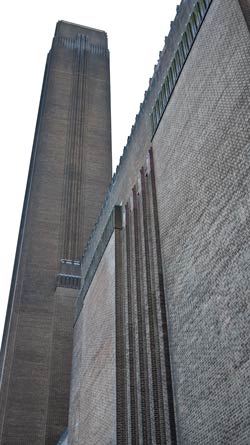
The Tate Modern is the natural gallery in London to show ground-breaking, avant garde artworks. The kind that as often as not might make you shrug, dismiss, and despair of.

I am talking about bricks laid out on the floor so that their only distinctive feature is the ease with which one can trip over them. Or rubber tyres in the shaped of a half-submerged submarine.

On the plus side, I remember some years ago liking a grand piano that was suspended from the ceiling and which repeatedly dropped ten feet while spilling its innards before winding itself up to the ceiling again.

These are personal opinions of course, and you may feel differently. And if not you, then someone else may love the bricks or the tyres. The only constants are that to each his own, and that there is no accounting for taste.

So when I read about Ai Weiwei’s exhibition, Sunflower Seeds, I was spectacularly unimpressed and uninterested.

I had read that Ai Weiwei was considered to be a dissident in China, but beyond that I knew very little about him.

 Some Of The One Hundred Millions Sunflower Seeds

Why We Went To The Tate Modern
The Sunflower Seeds mass sculpture was an afterthought. We drifted towards it after seeing the Gauguin exhibition.

We went to the Tate Modern specifically to see the Gauguin exhibition. It was a major exhibition with paintings from all period’s of the artist’s life. It was a huge and spectacular exhibition and we saw many paintings from all periods of his life. We also learned a lot about Gauguin’s perspective on life and the troubled times to which that led him.

The Tate Modern

The Sunflower Seeds Exhibition
But of course, this article is not about Gauguin but about Ai Weiwei’s Sunflower Seeds exhibition.

As I said, we drifted towards it at the end of a long afternoon, out of curiosity over the sheer size of it.

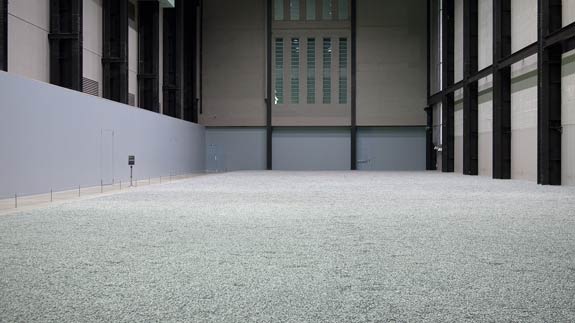
The mass sculpture that comprises the exhibition is laid out on the floor of the Turbine Hall and covers about one half of the hall.

The one hundred million sunflower seeds that comprise the exhibition trail off into the distance.

To give you a sense of the huge size of the Turbine Hall, take a look at the photograph at the head of this article. Can you see the doorway in the left corner down at the far end?

They dwarf the attendants walking along the narrow walkway that leads to the administrative offices at the far end of the Turbine Hall.

Dust and Health & Safety
I had read that the curators at the Tate Modern had had to fence off the seeds to prevent people walking across them.

The original idea was that visitors would crunch their way through the seeds, but the dust they were throwing up was considered dangerous to health.

The reason for that is that the seeds are not real sunflower seeds.

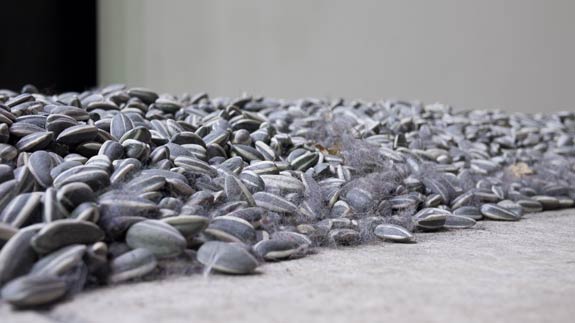
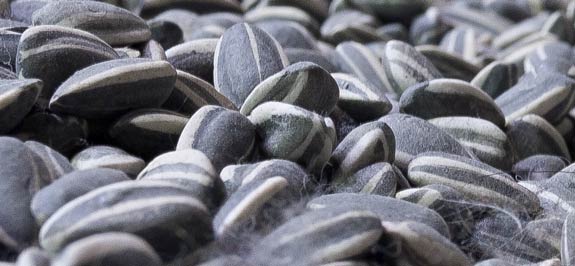
They are individually crafted, life-sized porcelain sunflower seed husks.

Each of the 100 million seeds that make up the exhibition were made by hand in Jingdezhen in China- a city that has long been associated with pottery production. The video that accompanies the exhibition shows dozens and dozens of people in the city employed in making the seeds – a laudable undertaking.

The seeds were mass-produced in the sense that little balls of clay were individually put into tray moulds and fired in a hug kiln. Then each seed was cleaned and hand-painted, stripe by stripe.

The Idea Behind the Sculpture
So what is the idea behind this mass sculpture? According to Ai WeiWei it is about several things. It is about ‘made in China’ and the politics of a culture that turns individuals into mass producers.

Ai Weiwei comes across as a very sympathetic person in the video, and as we stood in the huge Turbine hall looking at the sea of seeds, we started to be drawn into what we were seeing.

So in contrast to the pile of bricks of earlier exhibitions, we liked this one.

Each seed is attractive; each is different. But from a distance they are very nearly the same.

It left us feeling part of the caring family of man.

One Hundred Millions Sunflower Seeds Close Up

Ai Weiwei
By chance after I had written this article, but before publishing it, I saw a programme on TV where Alan Yantob interviewed Ai Weiwei.

Alan Yentob had been refused a visa to enter China, so the interview was conducted by video from their respective computers half a world apart.

I came in partway through the programme at the point at which Ai Weiwei was describing how the Chinese authorities had placed a security camera across the street from his house in Beijing so that they could monitor his comings and goings.

In response, Ai Weiwei had sculpted a number of marble security cameras, and it was particularly amusing to see them lined up on a bench – iconic and unseeing.