Promenading In Regency Costumes
All this week the 2011 Jane Austen Festival has been celebrated in the city of Bath in Somerset, England.
Hundreds of Jane Austen fans and aficionados dressed in Regency costume kicked off the opening last weekend with a promenade through the streets of Bath.
It’s the 11th year that the festival has been held. It runs through tomorrow, and as always it has attracted Austen devotees from all over the world.
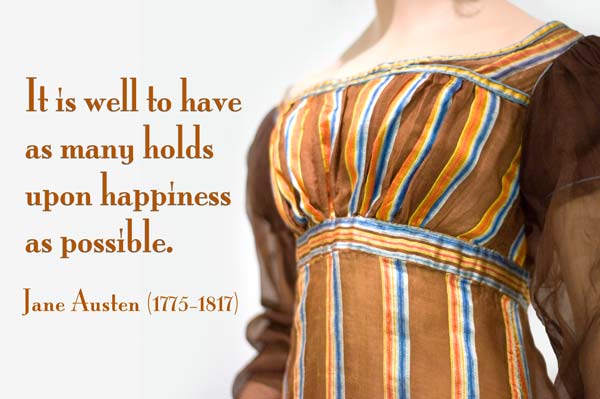
A Jane Austen Character In Bath
The quotation in this ecard – “It is well to have as many holds upon happiness as possible” – comes from Jane Austen’s novel Northanger Abbey.
It is the novel’s protagonist Catherine Morland who is so advised during her first visit to Bath with family friends.
On The Street Where She Lived
The Jane Austen Centre organizes the Jane Austen Festival, and then all year ’round the center tells the story of the five years that Jane lived in the city and the effect that this experience had on her writing.
Located at No. 40 Gay Street, it’s similar in layout to No. 25 on the same street – which was the house where Jane lived for some months following her father’s death in 1805.
Jane’s Parents’ And Grandparents’ Connections With Bath
Bath is not a large city, and so it’s not that far from 25 Gay Street to the city’s Walcot area.
Walcot figures in Jane’s life because on April 26, 1764, Jane’s father George and her mother Cassandra were married at St. Swithin’s Church there.
Cassandra’s connection with the city was through her mother since her mother settled in Bath following the death of Cassandra’s father.
However, Jane’s parents did not stay in Bath after they got married because Jane’s father held the position of rector of the Anglican parishes in Steventon, Hampshire and a village near by. So Jane lived in Hampshire for the first 25 years of her life.
It was not until December 1800 that the family reacquainted themselves with Bath when it is reported that much to everyone’s surprise, George Austen announced as head of the household that he had decided to retire from the ministry, leave Steventon, and move the family to Bath.
More Associations With St. Swithin’s Church
Five years after he moved his family to the city, Jane’s father George died in Bath in 1805.
The reverend was buried in the southeast burial ground of St. Swithin’s, the same church in which he had been married more than four decades before.
St. Swithin’s is still a functioning church today. However, some time in the mid-18th century after the Austins got married, St. Swithin’s was rebuilt from its medieval state to something more roomy and contemporary.
Jane’s Visits To The Paragon In Bath
Jane was her parents’ seventh child. She had five older brothers, one younger brother, and one older sister.
Her sister was named Cassandra, and she was Jane’s closest friend. She also died unmarried like Jane.
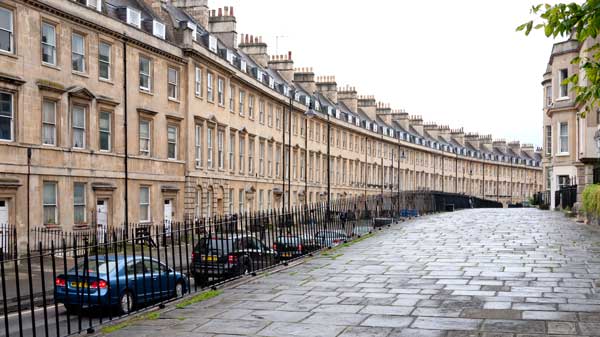
Jane visited Bath before her father moved the family there in 1800 because Jane’s mother’s brother, James Leigh Perrot and his wife, had a house in the Paragon which is a street of beautiful and historic Georgian houses that still exists today.
Jane’s And Cassandra’s Travels From Hamphire to Somerset
During the time when James Leigh Perrot and his wife lived there, they did not have children and so they frequently invited their nieces Jane and Cassandra to visit them.
The Austen sisters would come up from the country parsonage of Steventon in Hampshire where the large Austen family lived, traveling about 65 miles (105 kms) to get to Bath.
About The Georgian Architecture That The Austen Sisters Saw
Through staying at their uncle’s residence in the Paragon and by walking around the city, Jane and Cassandra could see a lot of the Georgian architecture that still dominates the city today.
The King’s Circus In Bath
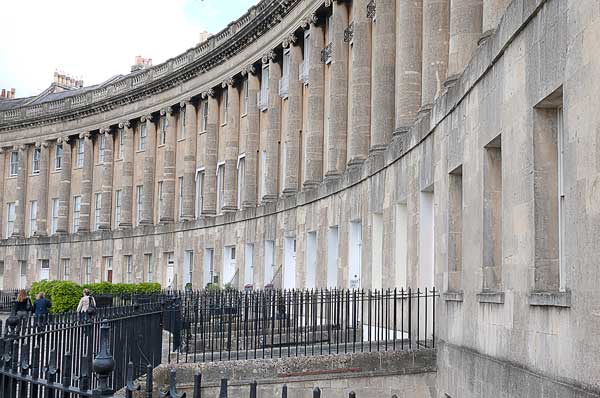
A beautiful example of Georgian architecture in Bath is the Circus, begun in 1754 and completed 14 years later in 1768:
Circus In Latin
The construction was given the name of ‘circus’ because in Latin it means a ring, oval, or circle, which is the striking shape of this structure.
It was originally called King’s Circus, though now it’s known simply as the Circus.
The Classical Facade
The Circus is divided into three segments of equal length, and in the center is a large grassed area with trees surrounded by wrought iron railings.
In keeping with Georgian architecture’s aim, each of the curved parts faces on to the three entrances – which means that all visitors see a classical facade straight ahead, whichever way they enter.
‘Famously Scarce’ Information About Jane
As one biographer put it, getting solid biographical information about Jane Austen is “famously scarce.”
This is because it is estimated that out of 3,000 letters written by Austen, only about 160 are known to have survived.
Most of the letters were originally addressed to her sister who it is said later burned “the greater part” of the ones she kept.
Cassandra then censored those she did not destroy.
There were other letters that were destroyed by the heirs of one of her brothers, Admiral Francis Austen.
Other biographical material produced in the 50 years after Jane’s death was written by her relatives. It is said to reflect the family’s preference to portray the author as “good quiet Aunt Jane.”
Jane’s Impressions Of Bath, From The Weighty To The Light
We do know some of the impressions Jane had of Bath, taken from her surviving letters and from two novels set in Bath, namely Northanger Abbey and Persuasion.
Writing in Northanger Abbey and featuring several of her characters, Jane wrote this about Beechen Cliff:
“That noble hill whose beautiful verdure and hanging coppice render it so striking an object from almost every opening in Bath.”
“The Tilneys were viewing the country with the eyes of persons accustomed to drawing; and decided on its capability of being formed into pictures, with all the eagerness of real taste… In the present instance Catherine confessed and lamented her want of knowledge, declared that she would give anything in the world to be able to draw;… He talked of foregrounds, distances and second distances; side screens and perspectives; lights and shades; and Catherine was so hopeful a scholar that when they gained the top of Beechen Cliff she voluntarily rejected the whole city of Bath as unworthy to make part of a landscape.”
Writing about buying fabric in Bath Street in a letter in June 1799, Jane wrote:
“I saw some gauzes in a shop in Bath Street yesterday at only 4s. a yard, but they were not so good or so pretty as mine.”
Writing in a letter in January 1801 about her mother’s search for a suitable house in Bath, Jane wrote this about Chapel Row:
“But above all others, her wishes are at present fixed on the corner house in Chapel Row, which opens into Prince’s Street. Her Knowledge of it however is confined only to the outside, and therefore she is equally uncertain of its being really desirable as of its being to be had.”
Writing about Gay Street in a letter in January 1801 on the search for a house, Jane wrote:
Gay Street would be too high, except only the lower house on the left hand side as you ascend; towards that my Mother has no disinclination; it used to be lower rented than any other house in the row, from some inferiority in the apartments.”
Writing about Gay Street in Persuasion, Jane wrote:
“The Crofts had placed themselves in lodgings in Gay Street perfectly to Sir Walter’s satisfaction. He was not at all ashamed of the acquaintance.”
Writing about the Pump Room in Northanger Abbey, Jane wrote:
“Every morning now brought its regular duties… the Pump Room to be attended, where they paraded up and down for an hour.”
Later in the book she writes how the Thorpes and Allens stayed:
“…long enough in the Pump Room to discover that the crowd was insupportable, and that there was not a genteel face to be seen.”
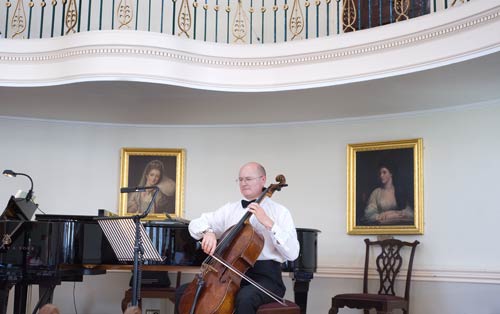
In Persuasion, Jane also wrote,
“In the Pump Room one so newly arrived in Bath must be met with.”
Writing about the Axford buildings which are now a continuation of the Paragon, Jane wrote this about her aunt in a letter in January 1801:
“We know that Mrs Perrot will want to get us into Axford Buildings, but we all unite in particular dislike of that part of the Town, and therefore hope to escape.”
Writing about Walcot Church in a letter in June 1799, Jane wrote:
“My Aunt has told me of a very cheap shop near Walcot Church [for hat trimmings] to which I shall go in search of something for you.”
Writing about her father’s funeral to take place in Walcot Church, Jane wrote simply in a letter in January 1805:
“The funeral is to be on Saturday at Walcot Church.”
Writing about Sydney Gardens in a letter in May 1799, Jane wrote:
“There is a public breakfast in Sydney Gardens every morning, so that we shall not be wholly starved.”
Writing about Sydney Gardens again in a letter in June 1799, Jane wrote:
“There is to be a grand gala on Tuesday evening in Sydney Gardens; a Concert, with illuminations and fireworks; to the latter Eliz. & I look forward with pleasure, & even the Concert will have more than its usual charm with me, as the gardens are large enough for me to get pretty well beyond the reach of its sound.”
Writing in a letter in May 1801 about the Upper Rooms now known as the Assembly Rooms, Jane wrote:
“By nine o’clock my Uncle, Aunt and I entered the rooms & linked Miss Winstone on to us. Before tea, it was rather a dull affair; but then the before tea did not last long, for there was only one dance, danced by four couples. Think of four couples, surrounded by about an hundred people, dancing in the upper rooms at Bath! After tea we cheered up; the breaking up of private parties sent some scores more to the Ball, & tho’ it was shockingly & inhumanly thin for this place, there were people enough I suppose to have made five or six very pretty Basingstoke assemblies.”
Writing about the main theatre in the city in Persuasion, Jane wrote:
“The theatre, or the Rooms, where he [Captain Wentworth] was most likely to be, were not fashionable enough for the Elliots, whose evening amusements were solely in the elegant stupidity of private parties.”
Writing in Northanger Abbey about her characters the Allens and the Thorpes at the Royal Crescent (then known simply as the Crescent), Jane wrote that they:
“… hastened away to the Crescent, to breathe the fresh air of better company.”
Writing in a letter in May 1801 about coming into Bath with the evening sun in her eyes, Jane wrote:
“The first view of Bath in fine weather does not answer my expectations; I think I see more distinctly through rain. The sun was got behind everything, and the appearance of the place from the top of Kingsdown was all vapour, shadow, smoke and confusion.”
In Northanger Abbey, Jane’s characters Henry Tilney and Catherine discuss Bath when Henry tries to disillusion Catherine as follows:
“Bath, compared with London, has little variety, and so everybody finds out every year. For six weeks I allow Bath is pleasant enough; but beyond that, it is the most tiresome place in the world. You would be told so by people of all descriptions, who come regularly every winter, lengthen their six weeks into ten or twelve, and go away at last because they can afford to stay no longer.”
Jane’s character Isabella Thorpe in the same novel expresses it more dramatically:
“Do you know I get so immoderately sick of Bath, your brother and I were agreeing this morning that, though it is vastly well to be here for a few weeks, we would not live here for millions.”
Lastly, it is believed that in her novel Persuasion, Jane’s character Anne Elliot may be thought to express Jane’s own opinion about Bath:
“Anne disliked Bath, and did not think it agreed with her.”
[Anne] “dreaded the possible heats of September, in all the white glare of Bath.”
However, Jane brought in the positive side of Bath too. This can be seen through her character Admiral Croft in her novel Persuasion who asserted heartily that Bath met his requirements very well:
“We are always meeting with some old friend or other; the streets full of them every morning; sure to have plenty of chat.”
City Mouse, Country Mouse
As well as the hustle and bustle of the city, Jane and her characters often showed a great love of the outdoors and nature, as shown by the quote in this Quillcard that appeared in her novel Mansfield Park:
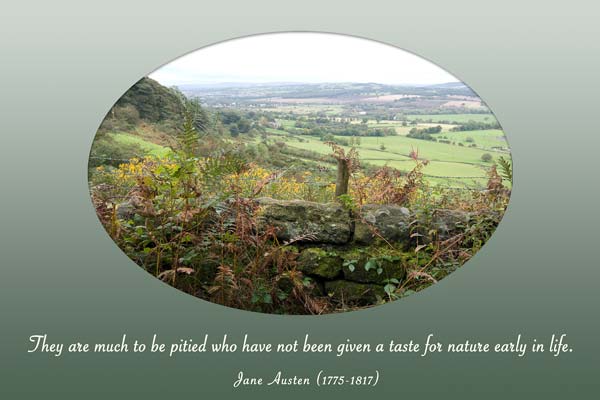
Showing the author’s love of the great outdoors, Jane asserts through her novel that “they are much to be pitied who have not been… given a taste for nature early in life.”