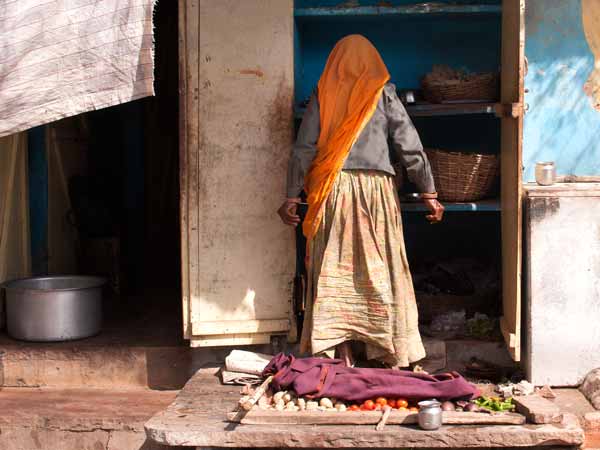
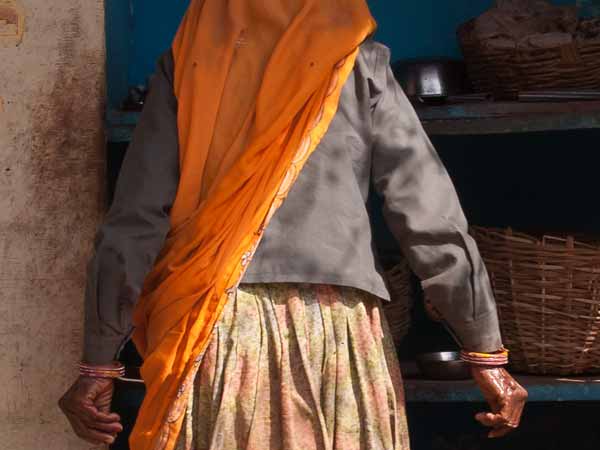
The marks of life are evident in this woman in Bundi in Rajasthan in India, and her poverty is evident in the small stall of vegetables set out by the roadside.
Were she to turn around, would her face enthral and entrance? There is a beauty in old age, isn’t there.
Never. He will not.
Age cannot wither her, nor custom stale
Her infinite variety. Other women cloy
The appetites they feed, but she makes hungry
Where most she satisfies, for vilest things
Become themselves in her, that the holy priests
Bless her when she is riggish.
This is said by the character Domitius Enobarbus in Act 2, scene 2 of Shakespeare’s Anthony and Cleopatra.
Enobarbus is speaking about Cleopatra and explaining why it is that although Anthony should leave Cleopatra, he never will.
The reason he says, is that unlike the case with many relationships, familiarity makes Cleopatra all the more desirable. And even when she is promiscuous, even the priests are so entranced that they bless her.
Weathered And Weatherbeaten
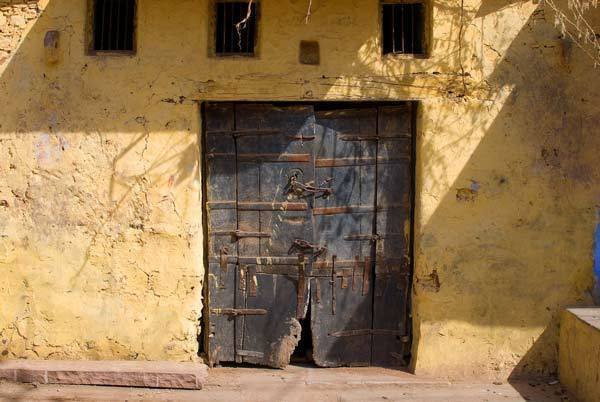
These are the doors to a building in Bundi. You will find the photo in the Windows and Doors range of images in our ecards here at Quillcards. Click the link to take a look.
Like a lot of photographers, perhaps like a lot of us, I am drawn to structures that have settled in over time.
Wood sawn to size, iron beaten into shape, clay daubed on a lattice of wooden sticks tied together with knotted rope. And then yellow paint with spatters of it on the door.
When things like this grow old we can see the marks, but they don’t destroy the authenticity of the materials. They don’t show the materials up as being fake. They show the beauty, don’t they. Or as they say… beauty is in the eye of the beholder.
We took this photo a few years ago when we lived in the south of England.
And you will find it in the English Cottages section of Quillcards and you can use it in one of your ecards.
There’s a free trial that allows you to use any of the images in Quillcards, so you can definitely use the photo, just click here to get started.
Gold Hill
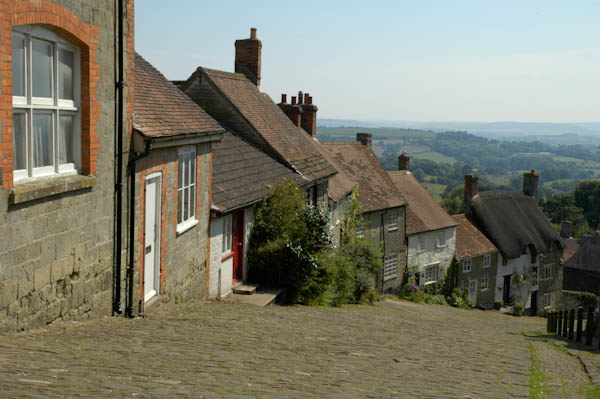
The photo shows a view of the steep cobbled street named Gold Hill in the town of Shaftesbury. If you look past the cottages you can see how the hill tumbles down to the plain below.
It’s quite a surprise to enter Shaftesbury from one direction and then suddenly find yourself at the top of Gold Hill looking down over the Blackmore Vale in the distance.
Gold Hill is famous as the setting for a television advertisement for Hovis bread that was shown in the UK in the 1970s. Made by the film director Ridley Scott, you can see it here in this YouTube clip.
You might catch a reference to ‘doorsteps’ in the narrator’s voiceover to the advertisement, which is a way of describing particularly thick slices of bread.
Shaftesbury In Context
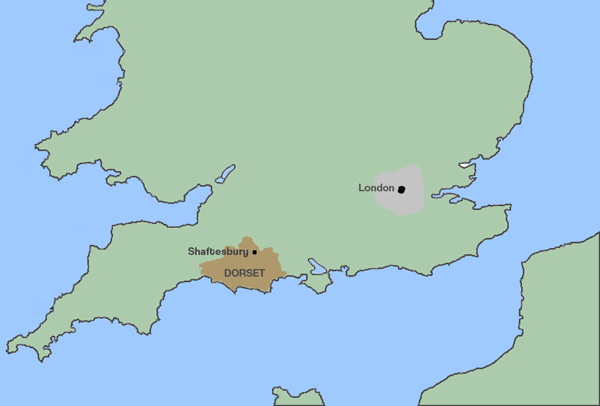
The town of Shaftesbury is in the county of Dorset, which is in the south west of England.
You can see its location on this map:
Dorset has a rich history. You can get a flavour of that rural history from Thomas Hardy’s novels. And although his later novels took in other surrounding counties, Dorset was always at the heart of his work, fictionalised and based on the medieval Anglo-Saxon kingdom of Wessex.
And it is on the Dorset coast, on the beach at Lyme Regis, that young Joseph Anning found a part of a fossil of an ichthyosaur in 1811 and where his sister Mary found the remainder of the skeleton in 1812.
The fossil was several feet long and the find was seen to some Victorians as a threat to the creationist vision of history and was highly controversial.
Because of the number of fossils found along the coast of Dorset, it is fondly known as the Jurassic coast and the home of the modern science of palaeontology.
‘Hogmanay’, the Scottish Twist To New Year’s Festivities
Here in Scotland, New Year’s celebrations are known as ‘Hogmanay’.
The Scots word for the last day of the year and a reference to festivities here that begin with the ushering in of the New Year, Hogmanay is celebrated with events from December 30th through New Year’s Day.
The festivities have their roots in the celebration of the winter solstice amongst the Norse.
It also folds in customs from the Gaelic celebration of Samhain, which takes place earlier in the year from sunset on October 31st to sunset on November 1st. Samhain marks the period of the year which is halfway between the autumn equinox and the winter solstice.
Moving on towards the winter solstice, the Vikings celebrated Yule. This later contributed to the Twelve Days of Christmas, or the “Daft Days” as they were sometimes called in Scotland.
The French Connection
The most common explanation for where the word ‘Hogmanay’ comes from is that it is a
a derivation from the Northern French dialect word ‘hoguinané’, or from variants such as ‘hoginane’, ‘hoginono’ and ‘hoguinettes’.
These words in turn are derived from 16th century Old French word of ‘aguillanneuf’ which is said to mean a gift given at the New Year, children’s cries for such a gift, or New Year’s Eve itself.
Fireworks Countdown
Here in the capital of Edinburgh where my husband David and I live, there are a number of wham-bang celebrations to bring in the New Year.
For example, why waste fireworks solely on midnight when Hogamany is in full swing?
Instead, we’ve got hourly firework displays that count down to our final Midnight Fireworks that dazzle the skies above Edinburgh at the city’s landmarks of Edinburgh Castle and Calton Hill.
Amongst other events, the city has high-flying rides at its large carnival, a more sedate candlelit concert at a local cathedral, a huge street party with live music smack in its center, and an event called ‘The Ceilidh’ that celebrates traditional Scottish music.
Edinburgh Castle Overseeing It All
Speaking of this time of the year and the castle which overlooks this capital, Scotland gets mighty dark particularly during these winter months.
And so we’ve tried to capture the feel of that here in this Quillcards black-and-white photo of the imposing, commanding, sheer rock of this iconic landmark:
Edinburgh Castle – A Quillcards Ecard
Auld Lang Syne, A Scottish Original
To celebrate the launch of Homecoming Scotland 2014, this year simultaneous Midnight Fireworks will be fired across Scotland.
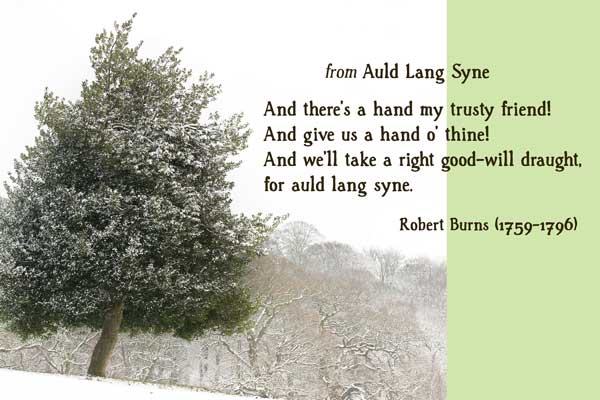
The country is aiming to get as many people as possible to join hands with friends in the biggest rendition of Auld Lang Syne, the verses of which were written by the country’s much-loved national poet and hero Robert (‘Rabbie’) Burns in 1788.
Those verses were later set to the tune of a traditional folk song which is what we still sing today.
Auld Lang Syne – A Quillcards Ecard
Have You Got A Tall, Dark Man For The ‘First-Foot’?
Want to set luck for yourself for the rest of the year?
The most widespread national custom here in Scotland is that of ‘first-footing’, which starts immediately after midnight. It refers to the the first person to cross the threshold of a friend or neighbor.
In the past people gave symbolic gifts like salt, which is less common today. However, giving coal, shortbread, whisky, and black bun (which is a rich fruit cake) are still given today by some, and all of these gifts are intended to bring different kinds of luck to the household.
The members of the household then give food and drink to the guests who have just stepped over their thresholds. This can go on throughout the early hours of the morning and well into the next day, although in modern times people will often visit houses well into the middle of January.
Traditionally, tall dark men are preferred for this ‘first-footing’.
Who knows, maybe it’s because they match well with the likes of high, dark heights of Edinburgh Castle at this time of the year!
Swinging Stonehaven Fireballs In Aberdeenshire
Different areas of Scotland have developed their own Hogamany rituals over the centuries.
Take Stonehaven, Aberdeenshire, in the northeast part of the country: There, fireball swinging brings in the new year.
The fireballs are actually ‘balls’ of chicken wire filled with old newspaper, rags, sticks, and other dry flammable material. These balls can be up to a diameter of 2 feet, and each of them is attached to about 3 feet of chain, wire, or rope.
As the Old Town House bell sounds to mark the new year, the balls are set alight and the swingers set off up the main street, swinging the burning balls around their heads as they go. If there are any fireballs still burning at the end of the ceremony, they are thrown into the harbor.
Large crowds of people flock to see this event, like in 2008 when 12,000 were accounted for who were watching this ceremony.
Memories Of Hogmanays Past
Remember the first-footing ceremony described earlier in this article?
Well, in the east coast fishing communities and in Dundee, ‘first-footers’ as they were called once carried a decorated herring.
In Fife, local men marched in torchlight procession to the top of the Lomond Hills as midnight approached.
Over in St Andrews, bakers created special cakes for their Hogmanay celebration (known as ‘Cake Day’) and distributed them to local children.
Glasgow’s Hogamany Today
In the central areas of Scotland and in Glasgow, its largest city, it’s traditional to hold Hogmanay parties that involve singing, dancing, eating of steak pie or stew, storytelling and drink.
These festive parties usually extend into the “wee” hours of the morn on January 1st.
Our New Year’s Wishes To You
Wherever you are in the world, we hope you have a grand New Year – and we here at Quillcards wish you and yours all the best for a lovely, healthy, and peaceful 2014 ahead.