A couple of days ago I was looking through the photos from our visit to the Isle of May last year when I decided to take a look at a couple of shots that I had not processed.
They were photos of razorbills. I had to photograph them against the backdrop of the open sea, which meant that the camera set the scene optimally but the birds looked very underexposed and the faces were just dark shadows.
If I had set exposure compensation – see my article on exposure compensation here – I might have produced a better RAW image. Be that as it may, I recall that I opened the images up in Photoshop, but I don’t think I tried very hard to optimise them.
Enter Photoshop CS6
I opened the images up again a couple of days ago, and they were easy to process. Perhaps it is because I have an updated version of Photoshop. Certainly, the tools in Adobe Camera Raw are very good for optimising images.
Razorbill On The Isle Of May – Close-Up
Seeing the razorbill’s beak close up makes me realise that they have a somewhat similar appearance to the puffin’s beak, with the markings on the side of the upper part of the beak.
It’s not so surprising because they are both part of the same family of auks.
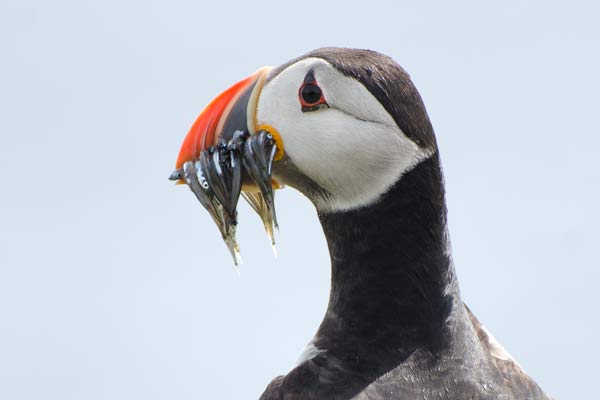
Razorbills and puffins don’t compete for the same food, however. Puffins eat sand eels, as you can see in the photo below – while Razorbills (which are quite a bit bigger) eat juvenile cod, sprats, and herring.
Puffin On The Isle Of May
You will find these and more than fifty other images of birds in our Bird Ecards.
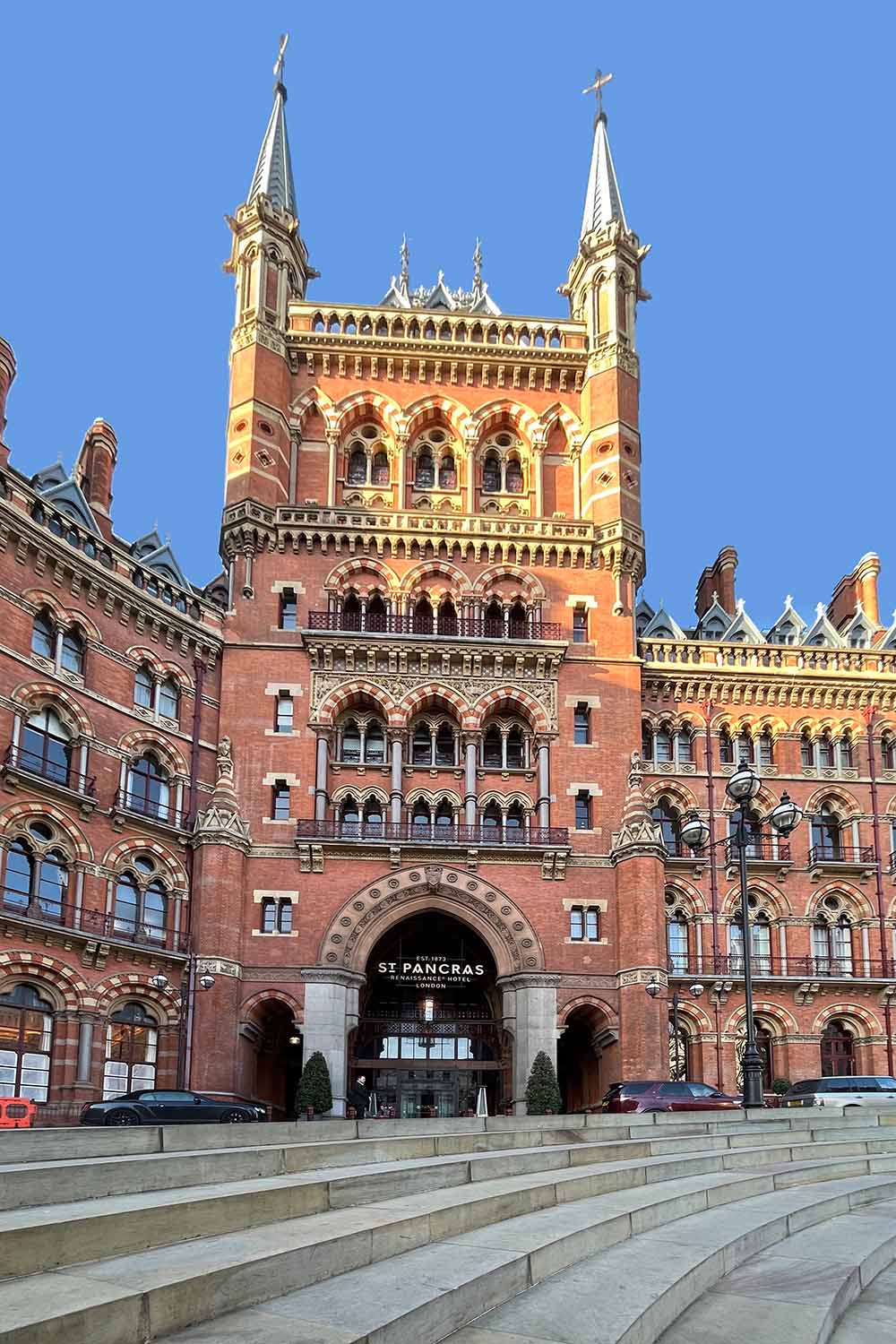
The Spires Of St. Pancras Station Rising From Behind The British Library
Fairy Tale London
Ah, the beautiful buildings of fairy tale London. Aren’t they terrific?
This photo shows the spires of the renovated St. Pancras Station peeping out from behind the forecourt of the recently renovated British Library in London.
St. Pancras Station was famously saved from demolition by the poet John Betjaman, who mounted a campaign to save the station.
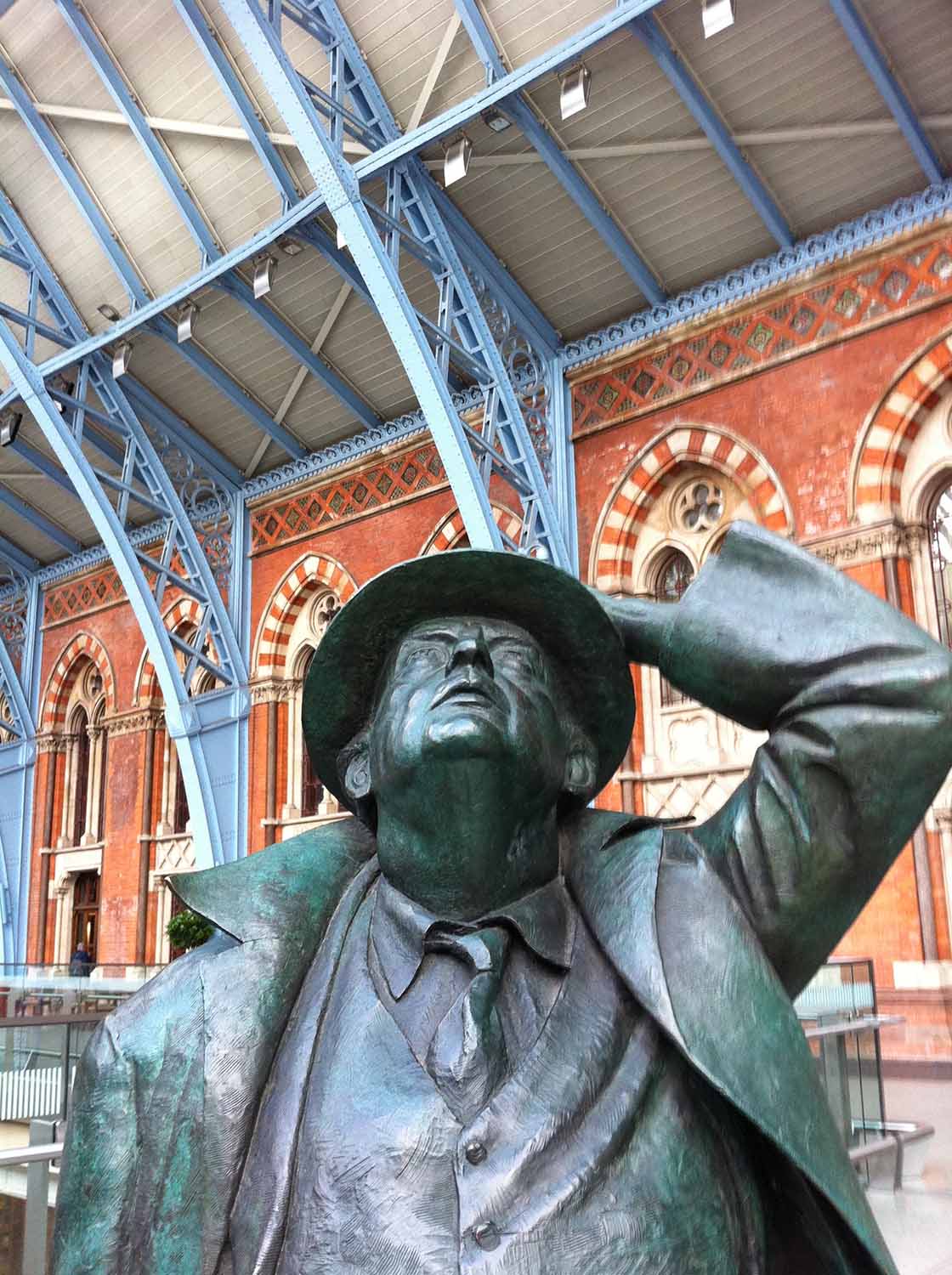
His statue stands on the upper floor of the station, where he is gazing up at the roof – although of course what was really intended to be conveyed was of him gazing up at the outside of the station.
John Betjeman Statue – Looking At St. Pancras Station
John Betjaman had strong views on architecture – particularly what he saw as the bad architecture that was intent on destroying English towns.
Shortly before the Second World War, he wrote a poem about the English town of Slough:
Come, friendly bombs, and fall on Slough!
It isn’t fit for humans now,
There isn’t grass to graze a cow.
Swarm over, Death!
Come, bombs and blow to smithereens
Those air -conditioned, bright canteens,
Tinned fruit, tinned meat, tinned milk, tinned beans,
Tinned minds, tinned breath.
Mess up the mess they call a town-
A house for ninety-seven down
And once a week a half a crown
For twenty years.
And get that man with double chin
Who’ll always cheat and always win,
Who washes his repulsive skin
In women’s tears:
And smash his desk of polished oak
And smash his hands so used to stroke
And stop his boring dirty joke
And make him yell.
But spare the bald young clerks who add
The profits of the stinking cad;
It’s not their fault that they are mad,
They’ve tasted Hell.
It’s not their fault they do not know
The birdsong from the radio,
It’s not their fault they often go
To Maidenhead
And talk of sport and makes of cars
In various bogus-Tudor bars
And daren’t look up and see the stars
But belch instead.
In labour-saving homes, with care
Their wives frizz out peroxide hair
And dry it in synthetic air
And paint their nails.
Come, friendly bombs and fall on Slough
To get it ready for the plough.
The cabbages are coming now;
The earth exhales.
To explain:’Ninety seven down’ refers to £97.00 deposit to buy a property with a mortgage and, ‘half a crown’ was a coin whose value was one eighth of a pound.
Betjaman was criticised heavily at the time for even talking about the possibility of bombs falling on an English town (something that became all too true just a couple of years later).
He was also criticised for what was seen as his upper-class attitude that wanted to preserve England as some pleasant idyll that in reality meant hardship for the ordinary man in the street.
I think he just knew terrible architecture when he saw it.
The History Of Mr. Polly
The mention in the poem of the poor young men who “daren’t look up and see the stars” reminds me of the theme of the novel ‘The History of Mr. Polly’ written by H.G. Wells in 1910.
In it, the hero – a poor downtrodden wisp of a man – escapes a life of drudgery and finds his own tune to which to dance through life.
In some ways it all seems so long ago. In modern England, everyone is free, free to buy what they want and to behave as they want. All the strictures of class divisions seem laughable – but they should are still there.
The Man Who Could Work Miracles
For another look at H.G. Wells’ views on the way the world works, there is the story of what happens when the gods grant a draper’s assistant unlimited power.
Rather, they grant George McWhirter Fotheringay unlimited power except power over the human heart.
He starts out bemused by his powers and is given advice from every quarter. In the end he decides for himself what to do with his powers.
Look Out, We’re Surrounded
Two and a half miles (4km) from St. Pancras station, lies Bishopsgate – a street close to the heart of the financial district of the city.
I sipped my coffee on a terrace cafe and looked out at the old buildings.
For a while I was blind to what was behind them.
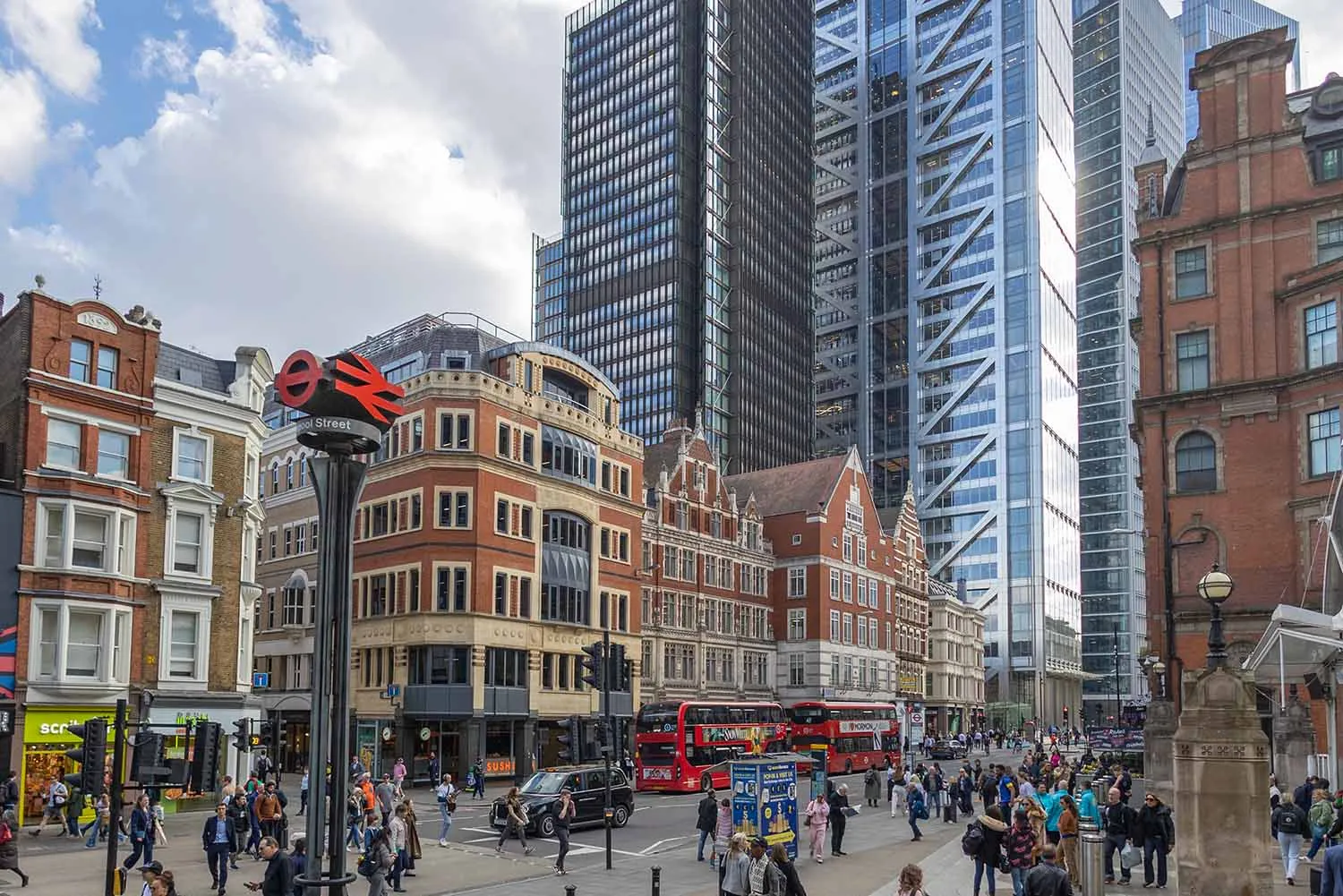
Then I saw, from under the lip of the large umbrella over my table – like something from the War Of The Worlds – a ring of glass and steel skyscrapers surrounding the old buildings.
Coffee On The Terrace At Bishopsgate
Do you feel dwarfed and rebuffed by these sleek modern buildings?
Tamara and I do. It’s not that we dislike modern glass and steel buildings per se, but the way the new buildings dwarf the old is unappealing.
We like buildings on a human scale.
Just because people can build huge buildings, doesn’t mean people have to build huge buildings, does it?
We modern humans may be taller than our ancestors, but we are not that much taller or bigger, are we?
Tamara and I feel the same way about large, empty city squares surrounded by monolithic buildings.
When they are filled with people, they can be lovely. But take away the crowds and large empty squares seem to be products of an idea that has forgotten its human roots.
Of Course, There Are Fine Buildings Too
There are fine buildings and other fine structures in London, of course, and some fine views. And some of them are large structures – but the detail seems to make them more accessible, less like glass mountains.
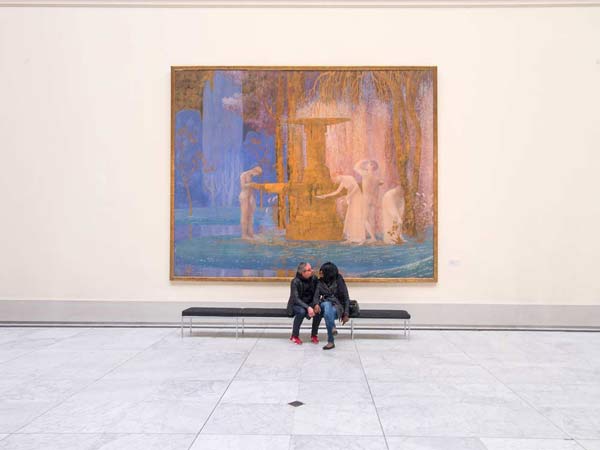
Visitors By A Painting By Constant Montald In The Musee des Beaux-Arts – Brussels
The Joke Goes Like This
The joke goes something like: Name five famous Belgians – and of course no one can. It’s supposed to prove that Belgium is boring.
It’s not true – at least as far as Brussels is concerned. After spending a week there, we suspect that Belgium has just had bad PR – and that the Belgians don’t mind that at all. In fact we heard that they kind of like being overlooked so they can get on with the business of living.
Getting There
Brussels: the capital of Belgium. It’s on the same latitude as Brighton on the south coast of England, just a hop, skip, and a jump across the channel – or under the Channel via Eurostar, with a route that terminates at Gare du Midi in the middle of the city.
Of course from Edinburgh where we live, it was cheaper to fly – and we had lots of Avios airmiles to our credit, which made it even cheaper.
Brussels – Isn’t That Where The European Parliament Is?
Yes, the seat or permanent home of the European Union Parliament is in Brussels, but it wasn’t fixed until quite recently in the history of the European Union.
For years there was a provisional arrangement under which the Parliament was located in Strasbourg, while the European Commission (the executive body of the EU) and the Council (the heads of state of the member countries) had their seats in Brussels.
Then in 1985 the Parliament had a second chamber built in Brussels so it would be near the Commission and the Council.
1997 Treaty Of Amsterdam
That ‘temporary’ situation was regularised by the 1997 Treaty Of Amsterdam under which Brussels became the workaday home of the Parliament under an arrangement whereby the Parliament also kept its seat in Strasbourg and would hold twelve sessions a year there.
Apparently, there is still some ill feeling between certain of the member states about the location of the Parliament in Belgium.
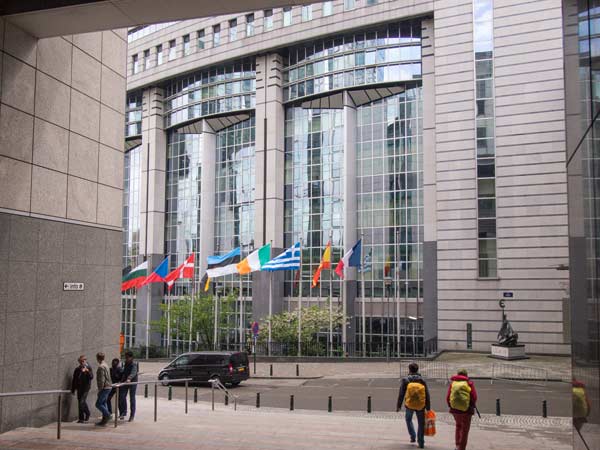
For Brussels it means that there is an EU quarter with new glass, steel, and concrete buildings – stretching onwards and upwards for block after block.
The European Parliament in Brussels
The Grande Place
Lined all around with such fine buildings, the Grand Place or main square in Brussels doesn’t disappoint. It is crammed to the corners with gold-leaf covered buildings. Take away the tourists and the odd sign here and there, and we could be back in the heyday of Flemish ascendance.
Brussels – The Grande Place
Belgian Independence
Belgium has only been independent since 1830, when it seceded from the Netherlands. There’s a painting in the Royal Art Museum of the moment of revolution in July 1830.
The painting shows a skirmish in the park opposite the museum when crowd in the street, protesting unfair representation in the Netherlands parliament, met with the well-to-do who were leaving the opera.
The theme of the opera performance was the overthrow of a regime, so everyone was in similar mood.
The Netherlands took the kind course of granting the Belgians’ wish to secede and the secession passed peacefully enough with a guiding hand from the French.
Historically, it was out of this mix that Belgium gained its status as a neutral country, the invasion of which by Germany was the match that lit the fuse that brought Britain into the First World War.
Musee Royaux Des Beaux-Arts
The rooms of the Musee Royaux Des Beaux-Arts (Royal Art Museum) that house modern art are closed for renovations (due to reopen next year).
The earlier art that is on show is wonderful, with several Breugels, Bosch, and at least one Rembrandt.
The outside of the building has seen better days, and the fact that it isn’t in tip-top condition may say something about how much money there is (or isn’t) floating around in the public coffers.
We did hear that a lot of money comes into Brussels because of the European Union having its institutions here. But for a capital city the state of its pavements (sidewalks) is pretty bad, with small up-tipped paving stones everywhere. (Not that we’re grumbling or grouchy or anything…)
Musee Royaux Des Beaux-Arts – Brussels
Breugel
The Comic Strip Center
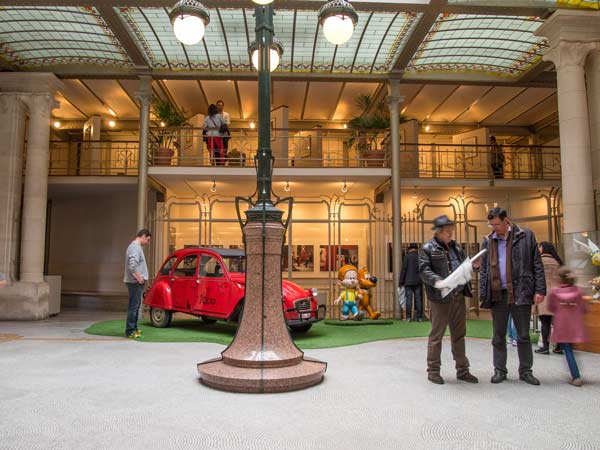
The photo below is of the foyer of the Comic Strip Center, which is located in the former Waucquez Warehouse, an Art Nouveau building designed by the architect Victor Horta (1906).
Typical of Horta’s style, the structural elements are left on show rather than being hidden behind decoration. In fact, the decoration is purposely made to seem like decoration.
You can see this in the closeup in the second photo below, with the comparison between the stubby square sections of raw steel above the ‘classical Greek’ decoration that sits in ‘mid air’ partway up the columns.
The Comic Strip Center – Brussels
Decoration In Mid-Air
Boule & Bill
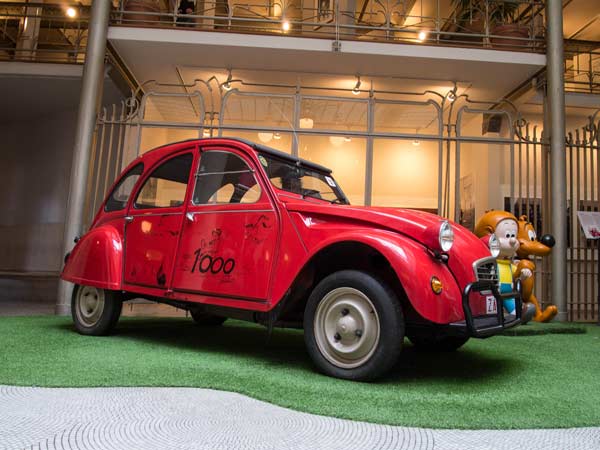
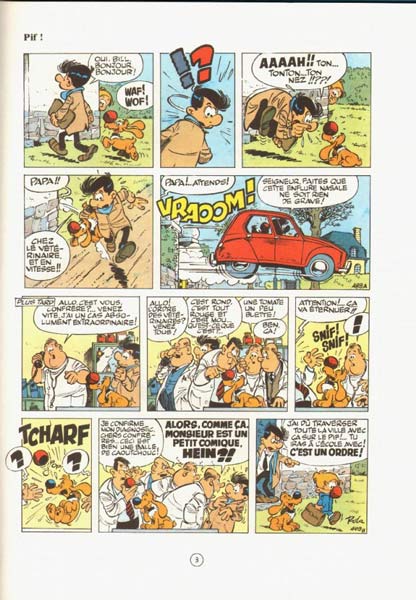
A red Citroen 2CV features in the comic strip Boule & Bill. It’s the invention of the artist Jean Roba, who died in 2006 and who has a small room in the Comic Strip Center dedicated to his work.
Citroen 2CV
The car in the foyer of the museum was given to Roba when he published his 1000th Boule & Bill cartoon, and it has been signed and dedicated with sketches by many popular and pioneer artists who were friends with Roba.
The staff at the museum explained all this when they kindly emailed this page from the cartoon strip to us.
Boule & Bill With Their Family Car
A Load Of Waffles
And now to the most important part of Belgian culture, outranking even Belgian chocolate (which is world famous): Namely waffles.
You will find waffles in any small food shop, in little kiosks, and you will definitely find them in the screaming yellow vans strategically located in busy squares around the city.
Doused in chocolate, covered in cream, or just plain – take your pick.
Mmmm, mmmm, mmmm, delicious.
Waffle Van with Scenery – Looking Towards The Old Town In Brussels
Trams
We took a tram ride to a meeting one evening – on #92 out to the terminus stop at Fort Jaco. When we finished our meeting, we got back on the tram and waited.
The driver came on board and before settling into his seat to begin the journey, he started to pour sand into little metal boxes at strategic points along the inside of the tram.
We asked him what he was doing and he said it was for the brakes. How interesting. How seemingly old fashioned. We guess the dribble of sand helps to make contact between the metal wheels and the metal tramlines.
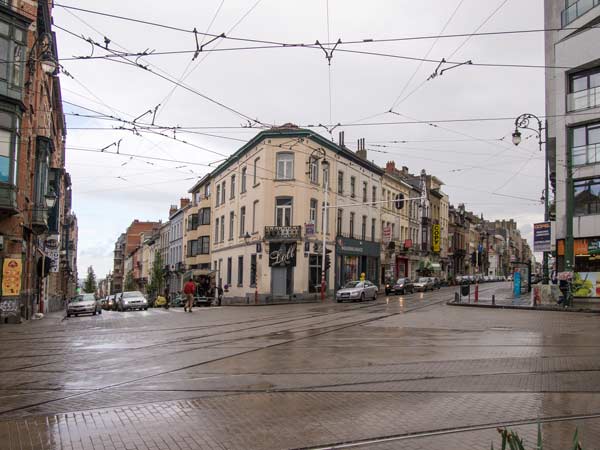
Trams are a big feature in Brussels. They glide along while people dodge across the tramlines in front of them.
People have also made a speciality of deciding at the last moment that a different tram is the one for them – and they sprint to another stop to catch an approaching tram.
It was quite disconcerting the first time we saw it, with people suddenly running away from the tram stop at which we were standing.
One a more decorative note, even when the trams are nowhere is sight there is a tracery of overhead tram wires to set off the scene.
Overhead Tram Wires – Brussels
A Final Word On The Grand Place
The Grand Place is a UNESCO World Heritage Site, and here is a photo of one of the buildings that flank it. It is the town hall, started in 1402 and completed in 1410.
It was here that the provisional government met in 1830 to set the seal on the secession from the Netherlands and the founding of the country of Belgium.
Town Hall – Brussels
Look out for Part II of this look at Brussels, when we will give the lowdown on the Horta House – the wonderfully intact and renovated Art Nouveau house that Victor Horta designed.