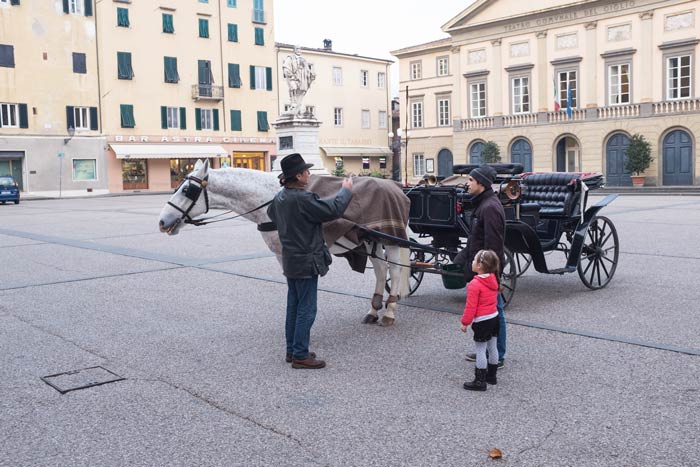
Horse and carriage with young girl in Piazza del Giglio, Lucca, Italy
How interesting to be a young girl with your father discussing the prospect of a ride in a carriage.
The setting in the photo above is the Piazza del Giglio, just a short walk inside the city walls of Lucca.
Lucca is rather run down in a ‘faded beauty’ kind of way. It has Squares and narrow streets and a massive city wall twenty or so feet high, built in brick that encircles the town.
The wall is breached by footpaths, and that is the route we took walking into town from the station. It was a special feeling walking through the tunnel in the wall – like entering a besieged town.
Go to Lucca
“Yes, Lucca is nice to visit.”
You know how one has to listen to the choice of words and the intonation when someone local recommends a place to visit.
We often have discussions about exactly what we did hear with these recommendations. Did we both hear the moment of someone holding back when we asked about visiting such and such a place?
Did we both hear an intonation that reveals that while Lucca is nice, it is not that nice?
And then there are all the other competing places to visit on a day trip from Florence. Are some of these better choices?
The town is nice and homely. People are friendly. We stood in the early evening looking at the fair in the Piazza Napoleone, drinking in the atmosphere and the pace of life.
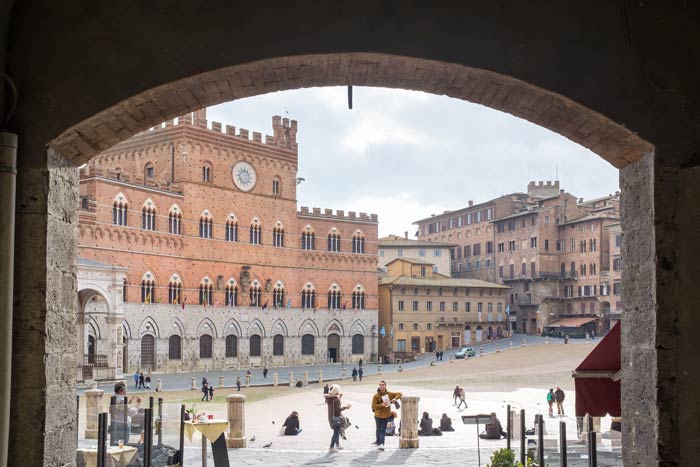
View through an archway onto the Piazza del Campo in Siena
Siena is an Italian hilltop town lying to the south of Florence in Tuscany.
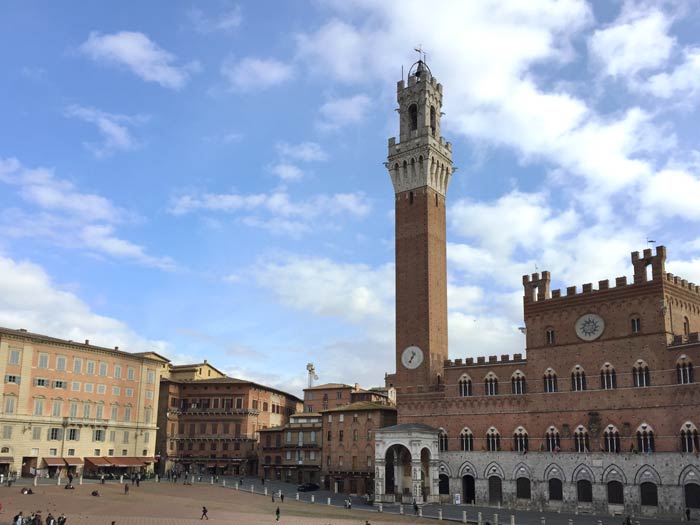
Being a hilltop town it is of course hilly. And in the center is the beautiful Piazza del Campo. It is a huge, perspective-bending Piazza built on a slope leading down to the Torre del Mangia. Walking into the fan-shaped Piazza truly is confusing to the senses.
Next to the tower is the museum – as run down as a faded heirloom.
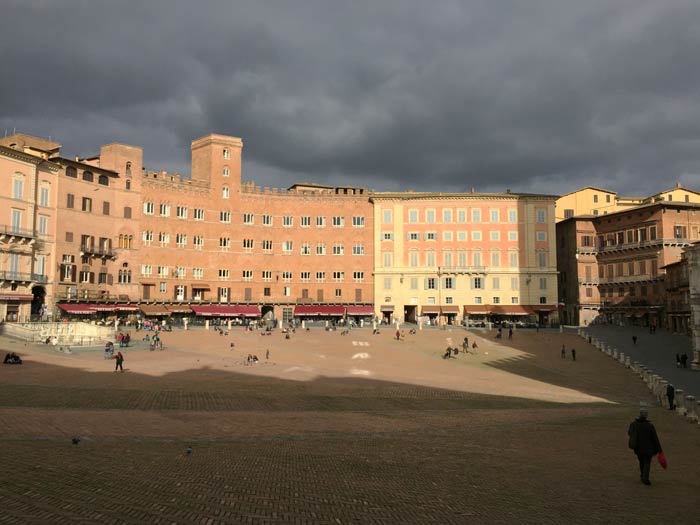
The next photo here shows the threatening sky above the Piazza. It did not rain, but see how dramatic the scene is.
And see how big the space is: Walking down into the Piazza is dizzying.
There’s a horse race very year, when horses race around the Piazza. Look in the cafes and shops and you will see photographs of previous horse races displayed on the walls.
One photo we liked was from the 1960s, with crowds behind barracades erected in the Piazza. The horses were galloping past at a furious pace.
It’s fitting too, seeing that the Piazza del Campo is on the site of a Roman forum.
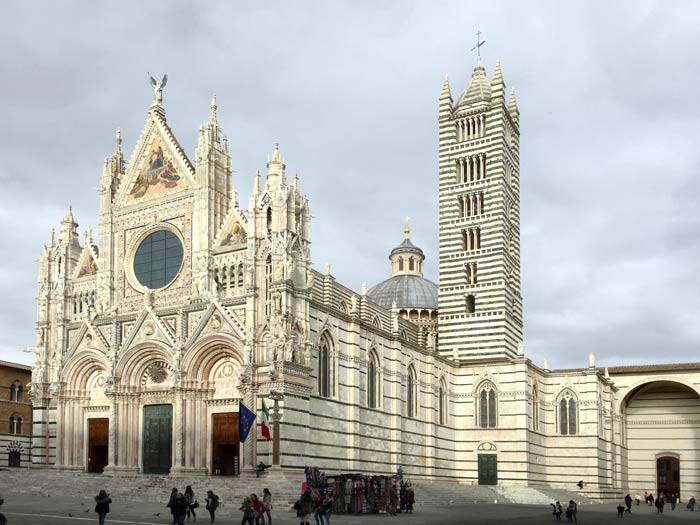
The Duomo In Siena
Up the hill from the Piazza is the Duomo. Another white marble edifice like in Florence. You might think it would be more commanding given its elevated position. In fact it is less impressive. Maybe it is a case of ‘once you have seen one white marble church you have seen them all’ or perhaps it is because it is smaller.
Or perhaps it is the design. The campanile (bell tower) is integrated into the building, unlike in Florence where the campanile stands on its own as another piece of marble magnificence.
Or it could be that the building speaks of the magnificence that did not happen. The guide books say that the intention was to expand the Duomo so that it would be bigger than the Vatican in Rome. But in 1348, less than ten years after work began, the Black Death killed half the people of Siena and work on the cathedral stopped.
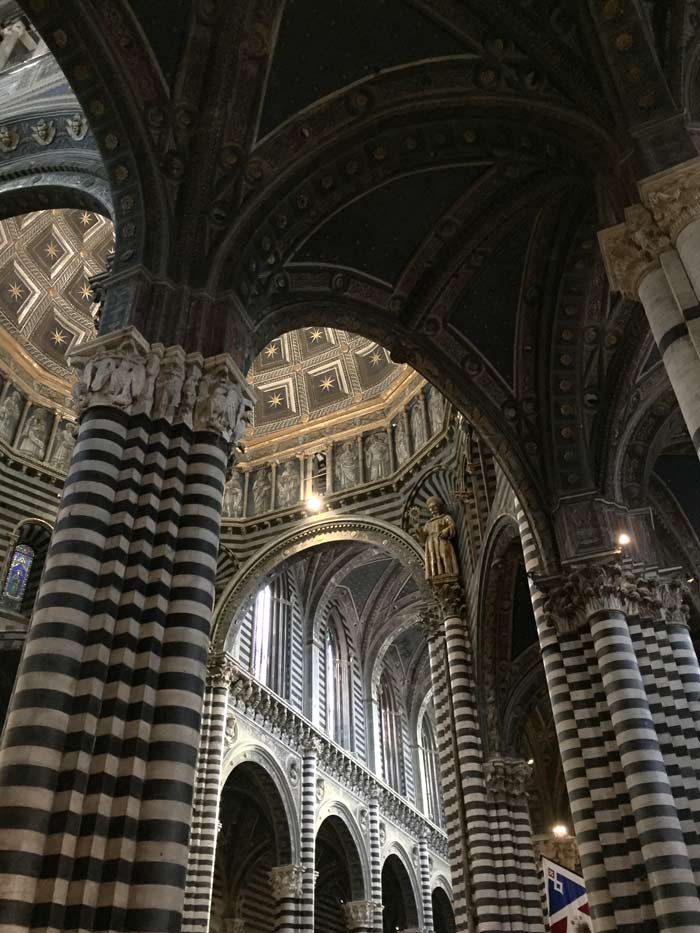
The real difference here compared to Florence is on the inside of the building. The contrasting stone and the interwoven arches are wonderful.
Here’s a tip. You need a ticket to go into the cathedral. Perhaps you are the kind of person who objects to paying to go inside a church. Perhaps you don’t want to traipse around to the ticket office that is in a separate building towards the rear of the church.
Well the walk is not that far and there are two kinds of tickets: free and not-free. To go around the ground floor of the Duomo you only need a free ticket. To see the library and to go down into the lower floor, you need to pay for a ticket.
Why, you might wonder, do they require even free visitors to have a free ticket? We wondered the same. We even thought for a moment of asking. We didn’t ask but we decided between ourselves that the tickets acted as a kind of clicker to monitor who was in the building. Come closing time they would know how many people they needed to usher out.
The guidebooks we read didn’t think that Pisa was that interesting, beyond the obvious attraction of the leaning tower of Pisa.
We found it a city that is much more than the leaning tower. It is very pleasant to wander the streets and broad boulevards. It has an entirely different feel to Florence; more open and spacious.
The Leaning Tower Of Pisa
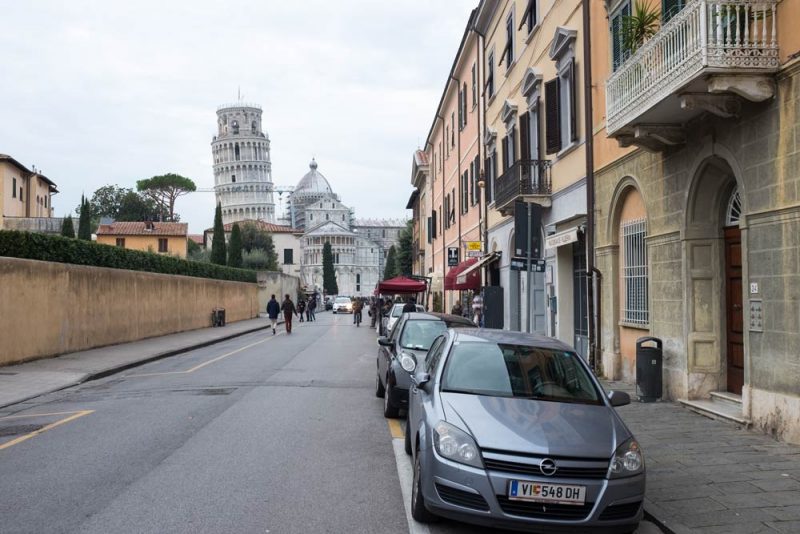
Of course want to go to see the leaning tower and we got our first site of the tower as we walked down the street and turned a slight bend.
We gasped.
Oh boy, does it lean!
It isn’t always easy to convey the true look of something in a photograph. Cameras cause aberrations because they are not perfect. Camera lenses are a collection of lens elements designed work together to take photos of all kinds of distant and near scenes.
Then there are the distorting effects introduced by tilting the camera this way or that.
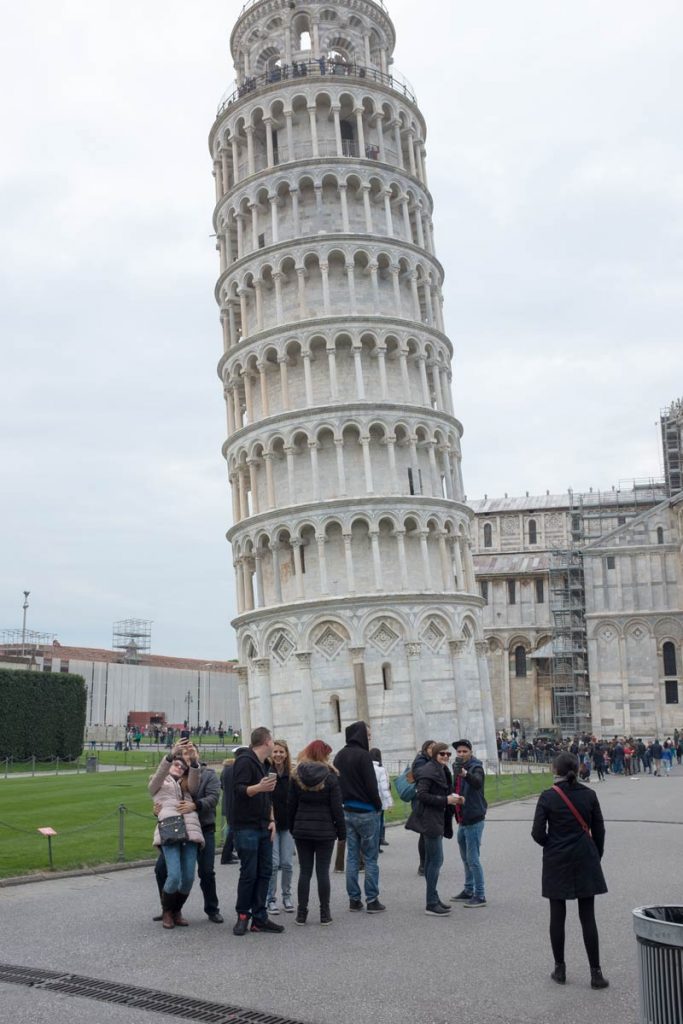
So it is not surprising that cameras sometimes distort the scene. Knowing that, we took particular care to hold the camera straight and level and not to tilt it upwards to get all of the tower in the shot.
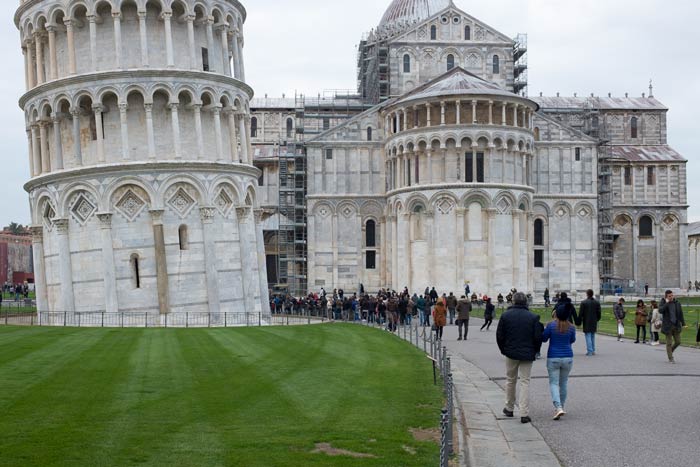
Here is a shot where the people are upright, and the view of the ‘lean’ in the tower is pretty accurate.
There was a question that was bubbling away in our minds, and that was to wonder what exactly the leaning tower of Pisa is? Of course, it is a tower. But what kind of tower and why was it built?
As we got near to the tower it became obvious that it was the campanile or bell tower for the Duomo, or church. It is a separate bell tower, not integrated into or connected to the main building. It’s the same in Florence, where the bell tower is a separate building.
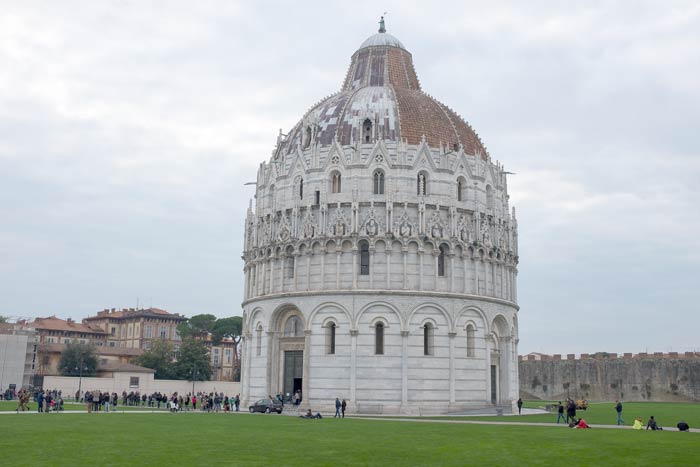
At the far end of the Duomo, again separate from it, stands a most beautiful building. It is the baptistry. Unlike the octagonal baptistry in Florence, this one is circular. It reminds us of a crown such as Charlemagne might have worn into battle.
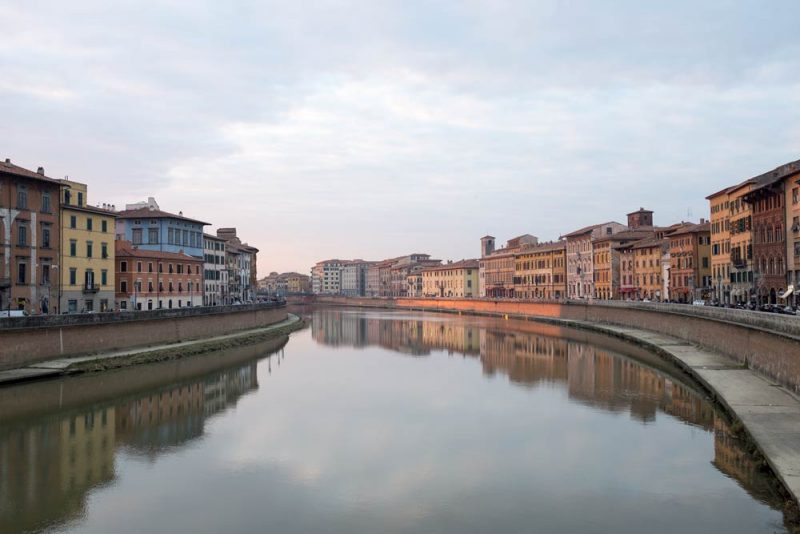
The River Arno at Pisa
Here’s a photo we took later that day as we crossed the Arno on our way to the train station. At just that moment, the sun shone briefly over the tops of the buildings and lit up the opposite bank.