It’s the two-hundredth anniversary of the invention of the bicycle.
Two hundred years ago in Mannheim in Germany, Karl Freiherr von Drais invented the ‘draisine’ – the forerunner of the bicycle.
It had two wheels, with the front able to be steered by handlebars. But it had no pedals, the rider instead ‘scooting’ the machine along the ground with his or her feet. It was really more of a standing affair than a sit-down experience, and with minimal suspension that might have been the better and wiser choice.
Then in the 1860s in France, came the vélocipède invented by Pierre Michaux and presented at the Paris International Exposition of 1867. It was an immediate success because its frame was sprung metal – giving it an early form of suspension. And unlike the draisine, it had pedals!
And from there to the Penny-Farthing and all kinds of experiments in perambulation based on two wheels. On on and on until we fast forward to today, and the topic if this article, which is bicycles in Cambridge.
How Many Bicycles In Cambridge
Tens of thousands of people use their bikes in Cambridge and its surroundings each day, and it is growing. Cambridge County Council monitor the number of cyclists crossing the River Cam.
And in April 2015 the number that crossed the river in an average 12 hours was 32,091 with a 69% increase in cycle traffic since 2005.
To put that into perspective, the population of Cambridge declared in the United Kingdom Census 2011 was 123,867. That included 24,488 students. The population in 2015 was, say 130,000. That means that according to the Council monitor, on any given 12-hour period in April 2015 approximately a quarter of the population was on a bicycle.
And what is remarkable is that because Cambridge grew up before that two-wheeled traffic grew so big, there are not very many cycle lanes. There is just not the room for them. There are some, but not enough to say that Cambridge is a city built for cyclists. Well, other than that it is flat.
Who Rides A Bicycle
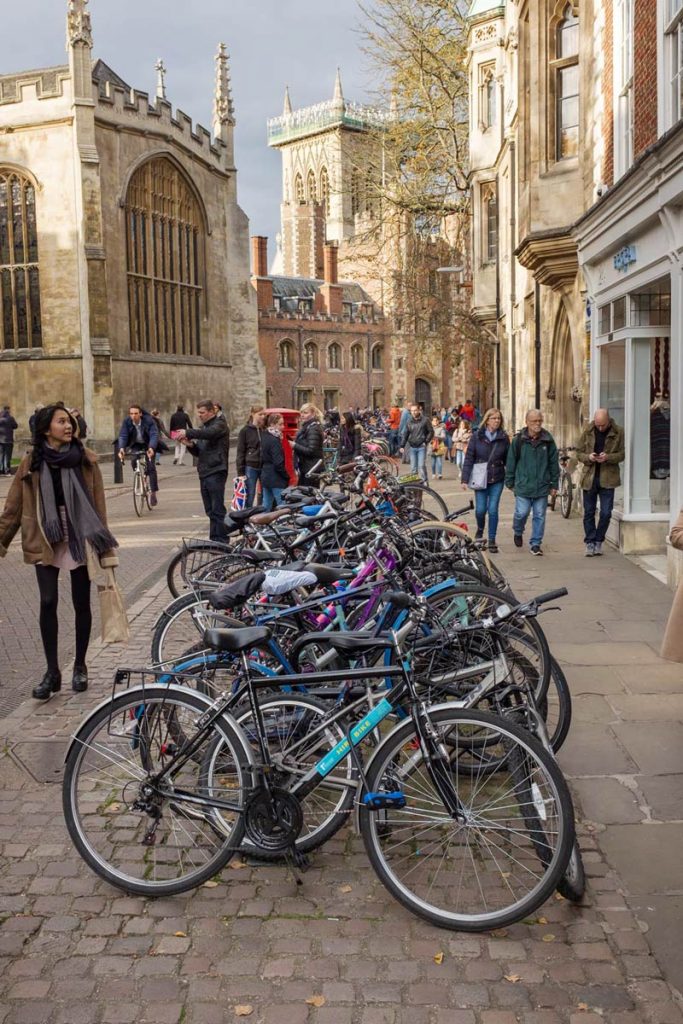
All around you see Cambridge dons on bicycles, students on bicycles, children on bicycles, fathers and mothers with children in tow in special carriages attached on bicycles, and old men and women perilously tottering and weaving along on bicycles.
In a word, everyone at every age rides a bike.
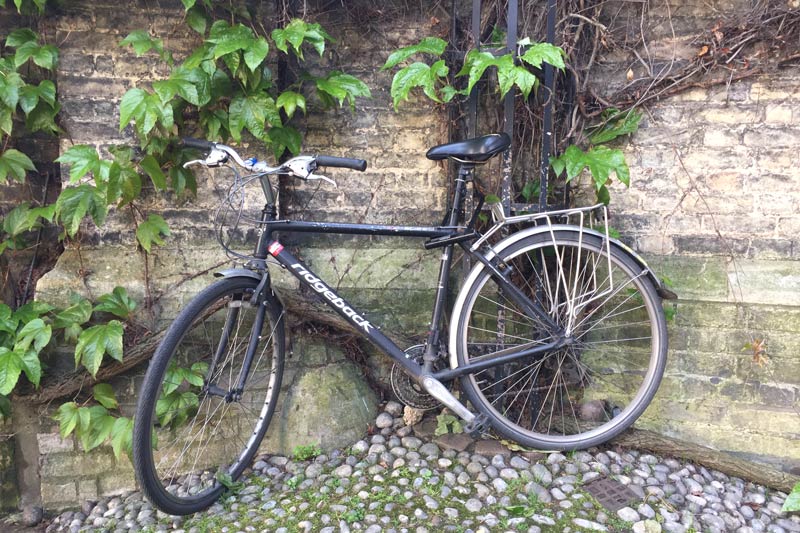
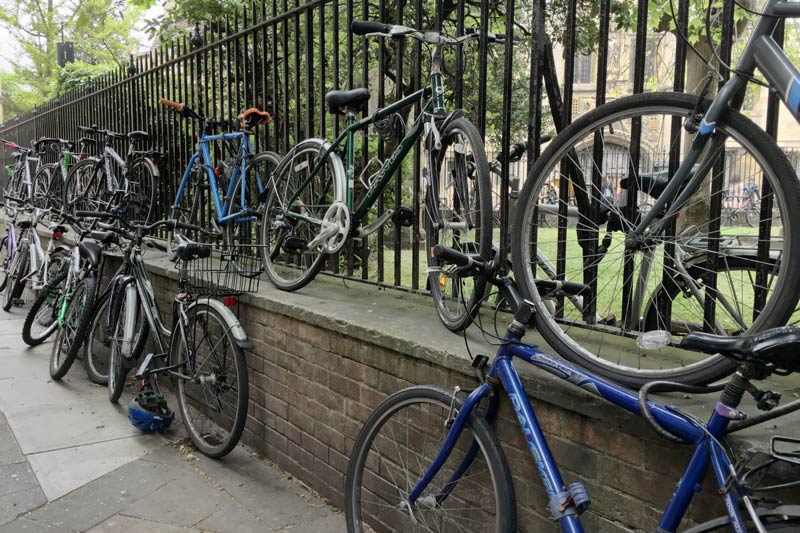
And then there is the question of where to park these bicycles. Here is one decorously parked against the wall of one of the Cambridge Colleges. And below that, bicycles on St. Andrew’s Street ‘double’ parked.
Because the buildings are so lovely in the centre of Cambridge, bicycles in Cambridge lining the railings of this little park take on a their own ‘loveliness by association’.
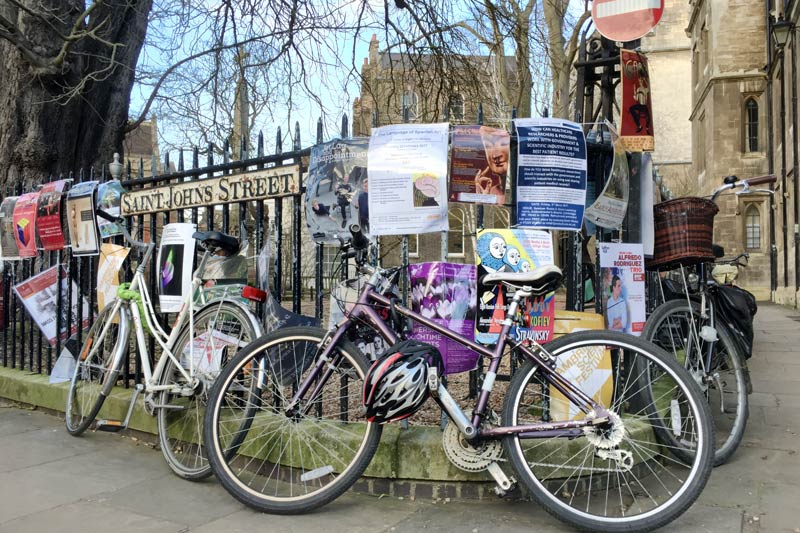
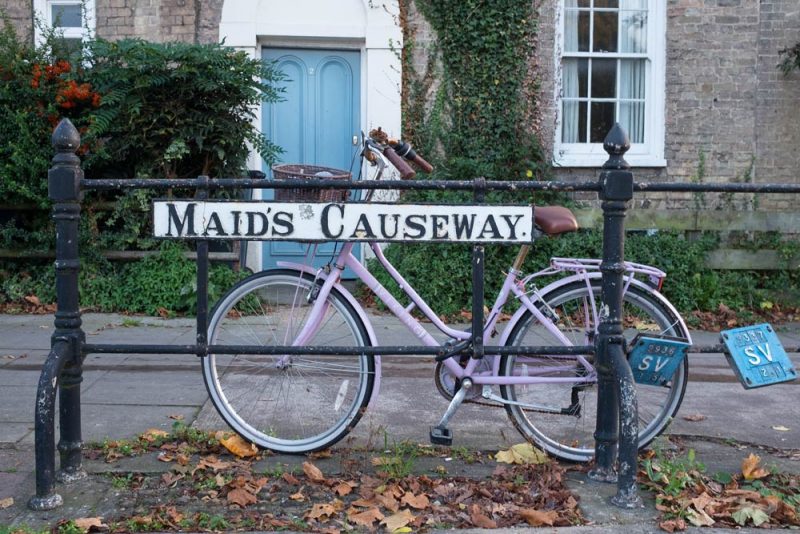
And similarly with this pink affair parked on Maid’s Causeway. And then in the last photo with the backdrop of St. John’s College buildings in the heart of Cambridge, a row of parked bicycles takes on its own appeal.
The Downside
I hesitate to write about the downside, but I must because it truly is a constant threat. Bicycles whizzing by. I tell you and I tell myself – watch out for those bicycles. And don’t ask a taxi driver what they think about bicycles 🙂
Ely is just a short train journey from Cambridge, where we live, so it is easy to do in a day.
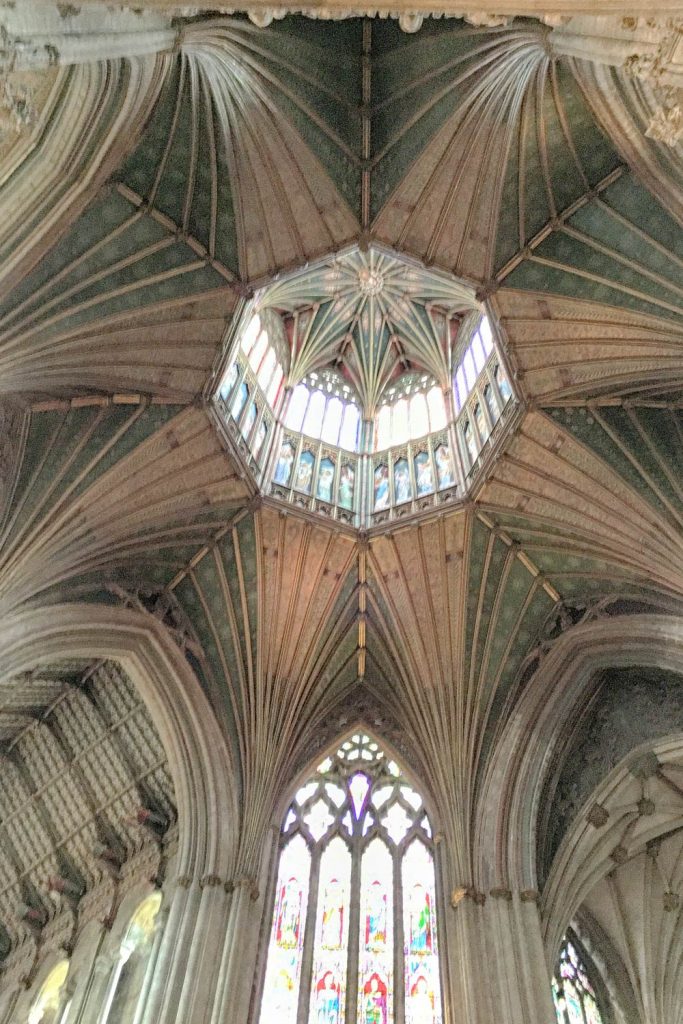
This is the lantern in the cathedral, and it’s just a quick shot on my phone. Next time I go I will set up something with my camera to get a better shot, but maybe even then I will not be able to capture the Wow! factor.
And it is a big Wow! Looking up and seeing the lantern set into the roof with the light streaming in, and the fact that the whole thing is made of wood and seems suspended on slender struts, makes it well worth seeing.
From Wikipedia
The central octagonal tower has eight internal archways that lead up to timber fan-vaulting that appears to allow the glazed timber lantern to balance on their struts.
The central lantern has panels showing pictures of musical angels, which can be opened, with access from the Octagon roof-space, so that choristers can sing from there.
That must be something – choirboys singing ‘up in the heavens’.
Getting There From The Station
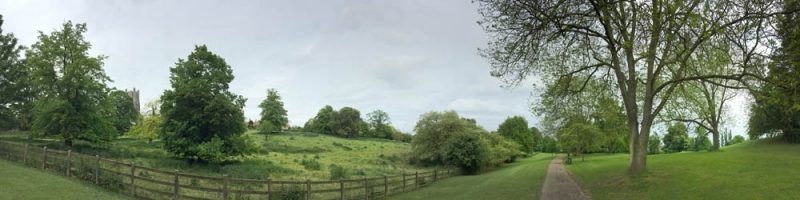
There are a couple of roads to the cathedral that lead up from the railway station. I asked a nice woman which way to go and she said both ways were equidistant (what a lovely word) and she recommended that instead of either of these roads, that I walk up through the park. You can see the cathedral up on the hill in this view from the park.
It’s hiding behind the trees on the left of the shot.
Ely is set in the fens – a flat area of England that was under water until drained in the 1600s. A man I met near the cathedral mentioned that the cathedral is known as the battleship of the fens because of the way it sticks out on the horizon against the otherwise flat landscape.
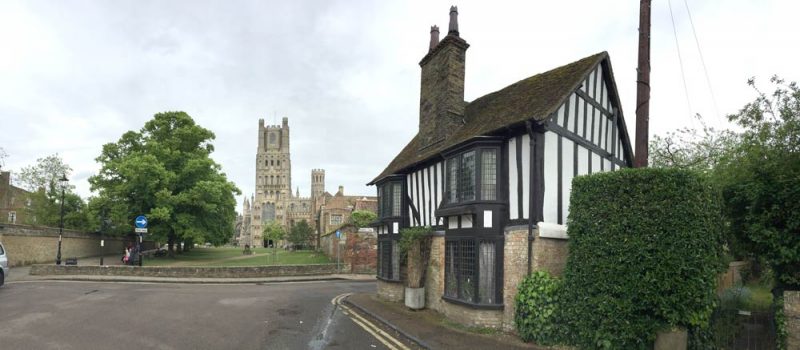
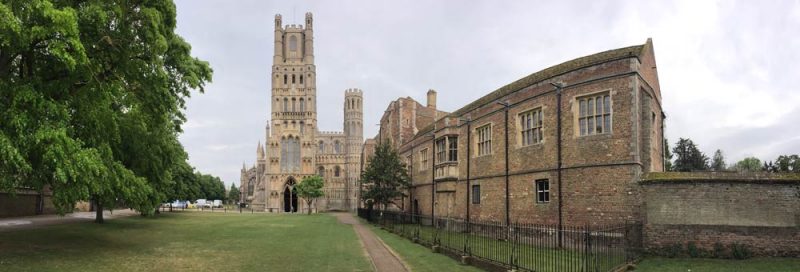
And here are a couple of shots of the cathedral from the ‘top’ of the town. The long brown building to the right of the cathedral in the second shot is The Old Bishop’s Palace.
There is a plaque on the fence in front of the old palace that says:
The Old Bishop’s Palace, built by John Alcock in 1486 and was home of the bishops of Ely from then until 1941. From 1588-1597 it was also a prison for 32 Catholic recusants.
I had no idea what a recusant was, and wondered whether it had any connection with the verb to recuse (to remove oneself from participation in) and have just now found the definition.
A recusant is
‘a person who refuses to submit to an authority or to comply with a regulation.’
Wikipedia gives a fuller explanation:
Recusancy was the state of those who refused to attend Anglican services during the history of England and Wales; these individuals were known as recusants. The term, which derives ultimately from the Latin recusare (to refuse or make an objection) was first used to refer to those who remained loyal to the pope and the Roman Catholic Church and who did not attend Church of England services, with a 1593 statute determining the penalties against “Popish recusants”. The “Recusancy Acts” began during the reign of Elizabeth I and were repealed in 1650.
So the repeal was a year after the execution of Charles I (who was an Anglican).
Here is Wikipedia again on the religious views of Charles I.
His religious policies, coupled with his marriage to a Roman Catholic, generated the antipathy and mistrust of reformed groups such as the English Puritans and Scottish Covenanters, who thought his views too Catholic. He supported high church ecclesiastics, such as Richard Montagu and William Laud, and failed to aid Protestant forces successfully during the Thirty Years’ War. His attempts to force the Church of Scotland to adopt high Anglican practices led to the Bishops’ Wars, strengthened the position of the English and Scottish parliaments and helped precipitate his own downfall.
Charles I came to the throne in 1625 after the death of James I and VI (that’s one person with two titles that refer to the English and Scottish crowns), and was monarch until his execution in 1649.
And here is how Oliver Cromwell fits into the picture. In 1636 Cromwell inherited control of various properties in Ely from his uncle, as well as his uncle’s job as tithe collector for Ely Cathedral.
And of course it was Oliver Cromwell who led the Republican revolution against the monarchy and had Charles I executed for high treason.
Scottish Prisoners Drain The Fens
Oliver Cromwell’s house is now the tourist information office, and I picked up a book there about Scottish prisoners captured during the English Civil Wars being sent out to work to drain the fens. I’ve only just started it, but I googled around for more information and found that the Third English Civil War (1649–1651) was the last of the English Civil Wars, that had begun in 1642, between Parliamentarians and Royalists.
The war ended at the battle of Worcester when Cromwell’s New Model Army defeated the Royalists under Charles II.
Charles’ army of 16,000 who fought at Worcester included 14,000 Scots, so as the Royalist army was mostly Scottish, and as there was no major rising or support of the Royalists in England, historians have described the war as an Anglo-Scottish War rather than the last gasp of the English Civil War.
After Cromwell’s death there was total confusion that ended with the restoration of the monarchy in 1660. (I have sometimes wondered how that ever happened.)
An American Tribute To The Battle Of Worcester
In 1786, John Adams and Thomas Jefferson visited the battlefield at Worcester. John Adams wrote that he was deeply moved but disappointed at the locals’ lack of knowledge of the battle, and gave a lecture to the townspeople, noting:
‘The people in the neighborhood appeared so ignorant and careless at Worcester that I was provoked and asked ‘And do Englishmen so soon forget the ground where liberty was fought for? Tell your neighbors and your children that this is holy ground, much holier than that on which your churches stand. All England should come in pilgrimage to this hill, once a year.
Charles, Prince Of Wales Settles An Old Debt
Before the battle of Worcester, King Charles II bought uniforms for his army from the Worcester Clothiers Company. Having lost the battle and the war, he couldn’t pay the £453.3s bill. He escaped to France after the battle, and didn’t not return to England for nine years, until after the death of Oliver Cromwell in 1658.
Despite being restored to the throne, Charles II didn’t repay his debt and the debt remained unpaid until 2008 when Charles, Prince of Wales paid off the 357-year-old debt (without interest).
It’s in Bath that crowds gather every year for a ‘Grand Regency Costumed Promenade’ that winds through its streets. The colorful walk is under the auspices of the city’s Jane Austen Centre through its annual Jane Austen Festival.
For ten days this year they participated in its tightly scheduled, hour-by-hour daytime and nighttime events to celebrate the genius author and the special ethos that her literature generates.
Full Regency Clothing
What is unique about the Jane Austen Festival and especially its Promenade is that participants dress the part, in full Regency clothing that was the height of fashion from the late 1790s to 1825.
Having lived from 1775 to 1817, Jane Austen straddled this time period and the characters in her novels like Pride and Prejudice, Sense and Sensibility, Persuasion, and Emma dressed in this fashion:
Etiquette in Jane Austen’s Time
Yes, etiquette from centuries ago can sound very genteel: Our modern lives are conducted so differently.
Still, in this present-day predicament where vulgar ways are ever too much in the public consciousness, it’s interesting to note some of the basic etiquette of previous times.
Here’s what the author Daniel Pool inserted in his primer of sorts called What Jane Austen Ate and Charles Dickens Knew: From Fox Hunting to Whist – the Facts of Daily Life in Nineteenth-Century England, which included the following advice for gentlemen:
– Meeting a lady in the street whom you know only slightly, you wait for her acknowledging bow- then and only then may you tip your hat to her, which is done using the hand farthest away from her to raise the hat. You do not speak to her – or to any other lady – unless she speaks to you first.
– If you meet a lady who is a good friend and who signifies that she wishes to talk to you, you turn and walk with her if you wish to converse. It is not “done” to make a lady stand talking in the street.
– In going up a flight of stairs, you precede the lady (running, according to one authority); in going down, you follow.
– In a carriage, a gentleman takes the seat facing backward. If he is alone in a carriage with a lady, he does not sit next to her unless he is her husband, brother, father, or son. He alights from the carriage first so that he may hand her down. He takes care not to step on her dress.
– At a public exhibition or concert, if accompanied by a lady, he goes in first in order to find her a seat. If he enters such an exhibition alone and there are ladies or older gentlemen present, he removes his hat.
Celebrating Women’s Rights While Restoring Lost Subtlety, Respect, and Grace
Now Lord knows I would never, ever like to live by all of these rules and regulations, and I am sure as heck very glad that I live at a time where women’s rights and the struggle of women around the world towards equality with men in all aspects of life is in our consciousness.
This state of the world had not yet evolved for women during Jane Austen’s era. In fact, she wove many of her plot lines around this essential fact of life and all the limitations that women endured in her world.
However, I think that much too often we have lost subtlety, mutual respect, and grace in our relations between men and women during our 21st century these days.
Even the most basic etiquette in Jane’s sphere would never, ever have permitted even a scintilla of today’s vulgar and boorish speech and behavior.
Jane would be very saddened and profoundly shocked and horrified indeed by this modern phenomenon, I cannot think as the very bright, perceptive, and well-mannered person and woman that she would react in any other way.
Back To The Fun: The Festival’s Guinness World Record And Its 2016 Promenade
The modern world does pop up at least somewhat during the festival, including two years ago at the 2014 festival when Jane Austen fans broke the Guinness World Record for the largest gathering of people dressed in Regency costume when about 550 strolled through the streets.
My husband David and I could not estimate the exact number of participants in this 2016 event, but the numbers looked substantial this year too on September 10th when the promenade took place.
Nor did the grayness of cloud cover and a steady splatter of a drizzle dissuade the festival goers from their mission at hand, as you can see in this photo:
Aside from some modern-day umbrellas that were at the ready for the weather that day, the scene provides a lovely step back in time.
Stove Pipe and Bonnets
Note how the gentleman here, the jolly-looking fellow with the stove-pipe hat and white gloves who is walking cheerfully with two bonneted ladies past honey-colored Georgian architecture which dominates even modern-day Bath:
It’s That Sense And Sensibility
Importantly above all else, one gets the feeling that it’s the refined sensibility of Jane Austen’s time and that of her characters which attracts the festival participants.
A genteel atmosphere permeates the celebrations.:
Regimental Red
Speaking of being on guard of those rose-colored ‘spectacles’, you can see men dressed in their regimental red uniforms in the front of this same photo – complete with a drummer who is at the head of the promenade.
Although I have lived overseas in various countries including in the UK now for more than 20 years, still my American roots made me instantly recall the similarly garbed ’redcoats’ who fought in the American Revolution.
In fact, Jane Austen herself was born in 1775, the very year that the “American colonies” gained their independence after fighting such soldiers. So many had seen the horrors of war too in that conflict.
However, I assume that not many of the men dressed up in such uniforms were thinking of the sober reality of war as they marched two by two on the modern-day pavement there in Somerset in their vivid red uniforms. Rather, they looked like they were there for the fun of it all:
Stroud Scarlet
During our stay in this Southwest part of England, we went to the nearby town called Stroud. I learned from my trusty travel guide that the striking shade of these red military coats came from Stroud and its famous “Stroud Scarlet” (which is also known as Stroudwater red cloth).
Red, blue, and green cloth was and still is made in and around Stroud as it has been for hundreds of years. Weavers were drawn to the plentiful supply of water in the area, and they produced a very high quality cloth.
That cloth was made into clothing that could well have been worn at assembly rooms around the country. It is to just such assembly rooms that the promenade’s route wound its way via the center of town.
Flocking Together At The Assembly Rooms
Thinking of Jane Austen and her life and the lives of the characters who made up her novels, assembly rooms like Bath’s during the 18th and 19th centuries in the UK and Ireland were gathering places for members of the higher social classes open to members of both sexes.
In an era when most entertaining was done at home, there were not many public places of entertainment open to both men and women save for the theatres (of which there were few of those outside London).
Jane’s Novels In Bath: Persuasion
Jane Austen lived in Bath from 1801 to 1805. Two of her novels, Persuasion and Northanger Abbey, are partially set in Bath. She used her own experiences to bring the city to life in her books.
For example, Bath’s Assembly Rooms that are still being used today played a small but important part in Persuasion. Its heroine, Anne Elliot, wants to visit the Rooms in the hope of meeting Captain Wentworth. However, her father’s snobbish attitude prevents here from doing so:
The theatre or the rooms… were not fashionable enough for the Elliots, whose evening amusements were solely in the elegant stupidity of private parties, in which they were getting more and more engaged.
Jane’s Novels In Bath: Northanger Abbey
And in Jane Austen’s Northanger Abbey, the heroine Catherine Morland often visits both the Upper and Lower [Assembly] Rooms. She looks forward with great expectation to “the important evening” which was “to usher her into the Upper Rooms”.
Regency Costume Parameters
Back to the fun aspects the festival offers for participants: Here’s a primer the Jane Austen Centre put out in 2014 for members gathering to try and beat the Guinness World Record for the number of people gathered wearing Regency clothing (a feat they were successful in achieving, as I mentioned earlier):
Anyone taking part in the ‘Largest Gathering of People Dressed in Regency Costume’ world record attempt had to comply with seven rules, the first four of which detailed how all participants had to be fully dressed in Regency costume outfit as follows:
2. Males can also be dressed in military or navy uniform of the period.
3. Females in full-length dresses with a high waistline, low cut necks and bonnet.
4. All participants must carry and wear the necessary accessories to complete the costume, e.g. hat or bonnet, reticule, gloves, Spencer jacket, pelisse or shawl. Additionally such items as a parasol, fan, cane or walking stick are not essential but can form part of the outfit.
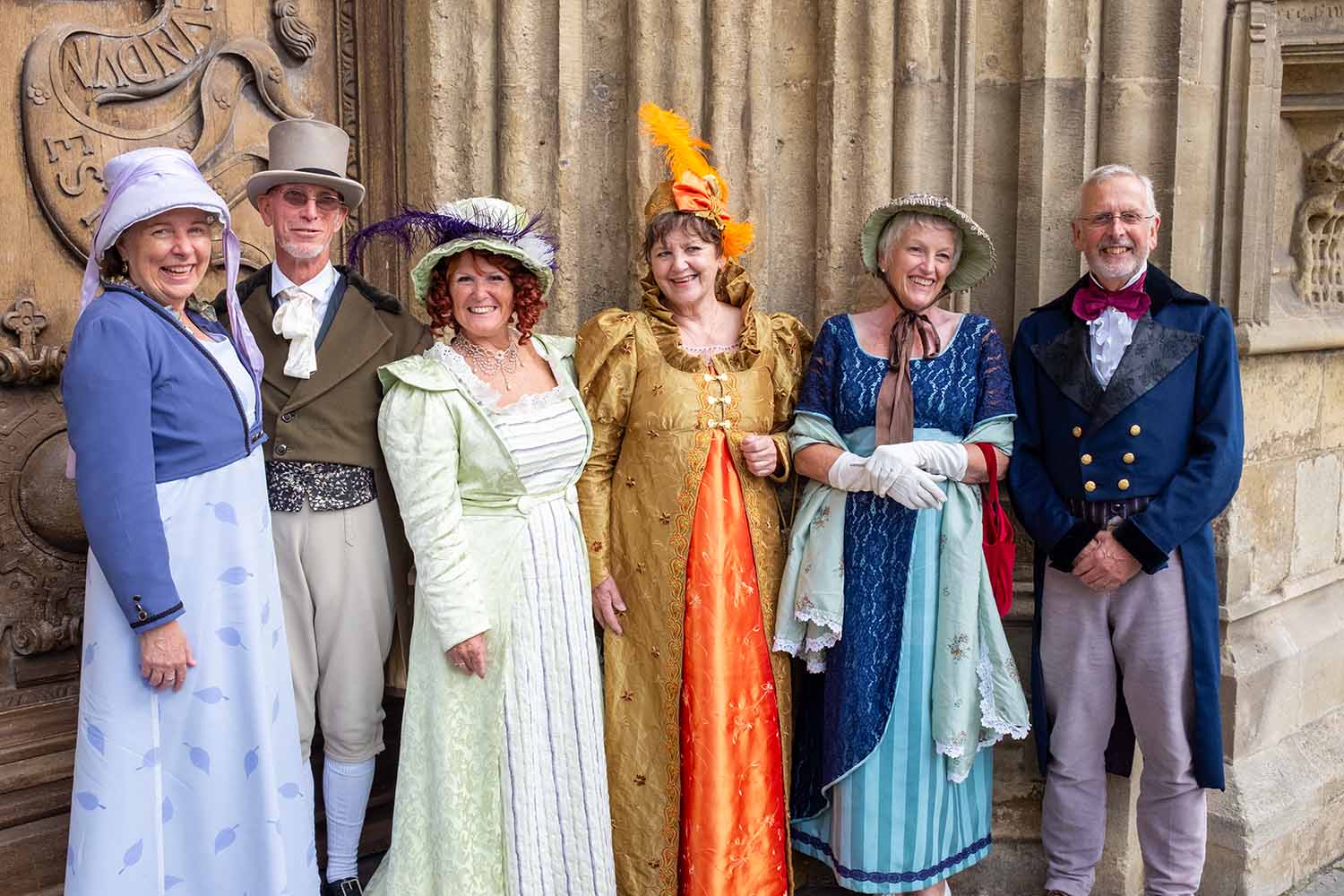
Last month participants were dressed likewise as you’ve seen, and here’s a group photo of six happy souls congregating in town after the promenade last month who were dressed to the nines in full Regency regalia
People dressed in the period of Jane Austen for the Bath Festival
Tea At Bath’s Elegant Pump Room
Now here’s a look at what this clothing looked like from behind as well. Many of the items have a lovely drape and elegance in the tailoring on the back of the body as well.
I took this photo at Bath’s famous Pump Room, at its present-day restaurant set right next to the city’s worldwide famous Roman Baths.
My husband David and I went for lunch there, and these people just happened to be sitting at the table next to us having their tea:
The Pump Room In Jane Austen’s Novels
Perhaps they were trying to channel Jane Austen’s spirit particularly in this room. This seems likely since she used the Pump Room as a setting in her novels Northanger Abbey and Persuasion.
As she described it, it was the place for fashionable people to meet, where “Every creature in Bath […] was to be seen in the room at different periods of the fashionable hours”, as she said in Northanger Abbey.
For example, Catherine Morland, Austen’s heroine of Northanger Abbey, meets her future husband Henry Tilney at the Pump Room.
In her novel Persuasion, Admiral Croft retires to Bath to ‘take the waters’ because of his gout.
As is only fitting, the Pump Room was used as a filming location in screen adaptations of both of the novels.
Inviting Jane To The 21st Century
If I could wave a magic wand and make it possible for Jane herself to have joined in the festivities this autumn, I would have asked her to join me at the Bath Visitor Information Centre that’s only a stone’s throw away from the city’s awe-inspiring Bath Abbey.
I would be a bit of a wizard and make it possible for her to join me when festival-goers and people dressed in 21st century were clustered there together.
In her eyes, she would see fantastical electric lights; what-in-heaven’s-name-are-those computer tills; wonderful piles of her books from large print runs stacked respectfully all about the shop; men and women in casual clothing that most of them had bought off the peg, including men in just their shirtsleeves and women actually wearing trousers — all of which I bet would fascinate and delight Miss Jane Austen.
I imagine her weaving a plot in her head for a new novel, her eagle eyes soaking in all that new and amazing detail of a world several centuries beyond her own.
Perhaps she would then sit down at her writing table (I can’t envision Jane using one of our computers, can you?), and masterfully piece it all together to write another grand tale – this time set in 2016, warts and all.
Whatever would she make of it all, that I do so wonder!