Let It Snow! – Ten Questions & Answers About Snow

Let It Snow! - A Quillcards™ Ecard

New!   Now you can buy a large art print of this image from Quillcards.

1.
Question :
What is recorded as the most snow that has even fallen in a single snowstorm?
Answer:
From February 13 to February 19 in 1959, one continuous snowstorm at Mt. Shasta Ski Bowl in California produced 15.75 feet (4.8 meters) of snow.

2.
Question:
What are snowflakes and how are they formed?
Answer:
Snowflakes are actually a special form of water ice. Clouds are made up of water vapor, and it is in this water vapor that snowflakes are formed.

When the temperature drops to 32°F (0° C) or colder, water changes from its liquid form into ice. Beyond that, several components affect the formation of the snowflakes. Temperature, air currents, and humidity all have an impact on the shapes and sizes of snowflakes.

In addition, particles of dirt and dust can get mixed up in the water vapor. Such particles make the snowflake heavier. They can also cause cracks and breaks in the crystal, thereby making it easier to melt.

On the individual level, each snowflake actually contains from two to 200 separate snow crystals.

3.
Question:
How many different shapes can snowflakes be?
Answer:
According to physicist Kenneth Libbrecht, author of Ken Libbrecht’s Field Guide to Snowflakes, there are 35 different types of snowflakes!

Furthermore, it is extremely unlikely that two snowflakes with complex shapes will ever look alike.
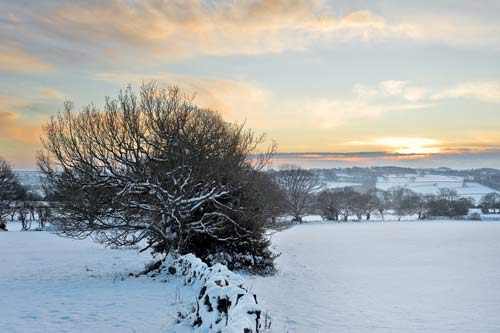
Late Afternoon Winter Snow - A Quillcards™ Ecard

4.
Question:
Does it always have to be at the point of freezing or below freezing to snow?
Answer:
No, that’s a common misconception. That’s why even during the warmer months of March or April when the ground temperature is above freezing, there can be a layer of extremely cold air at several thousand feet. As the atmosphere warms, this layer can become unstable – and snow can result.

5.
Question:
What happens to snowflakes falling in such a situation?
Answer:
The snowflakes don’t have time to melt as they fall through the warmer air, and instead they become very large snowflakes that can be about 3 inches (7cm) in diameter.

6.
Question:
How large was the biggest recorded snowflake that fell?
Answer:
In a freak occurrence, snowflakes fell in Montana in the USA on January 28, 1887 that reportedly measured 15 inches (38cm) in diameter and 8 inches (20cm) in thickness.

A man named Matt Coleman who saw these snowflakes descend to Earth characterized them as being “larger than milkpans.”

7.
Question:
Speaking of snow records, what is the largest piece of ice recorded to have fallen to Earth?
Answer:
An ice block measuring 20 feet (6 meters) in length fell in Scotland on August 13, 1849.

8.
Question:
What about hailstones? Have there ever been any fatalities connected with them?
Answer:
Yes. There are a number of records involving fatalities connected with hailstones.

For example, on April 14, 1986, a tremendous hailstorm in Bangladesh with hailstones 4 inches (10cm) across reportedly killed 92 people. Some of the stones weighed 2.25 pounds (1 kg).

9.
Question:
What was the greatest recorded amount of snow that ever fell in one winter in the USA?
Answer:
95 feet (29 metres), which was the amount of snow that fell at Mt. Baker in Washington State during the winter of 1998-1999. That measurement is almost the height of New York’s Statue of Liberty.

10.
Question:
What prompted the composer Jules Styne and the lyricist Sammy Cahn to create the classic Christmas song, ‘Let it Snow! Let it Snow! Let it Snow!’?
Answer:
Well, it definitely wasn’t the weather since it was written in July 1945 when Hollywood was sweltering from one of its hottest days on record.

However, because of its seasonal references to snow and as one of the best-selling songs ever since it first became a popular hit sung by Vaughn Monroe in October 1945, it is generally considered a Christmas song.

Yet despite its upbeat, festive feel, it was intended as a love song and it never mentions Christmas.
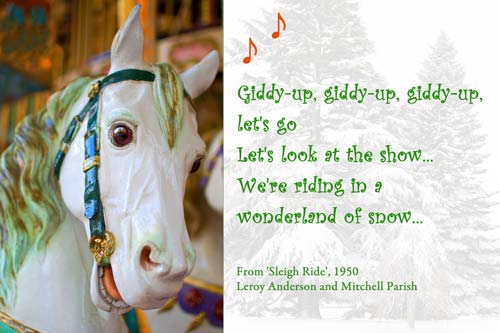
‘Sleigh Ride’: An Accidental Classic Christmas Song

Giddy Up - A Quillcards™ Ecard

Bet You Know This One!
If you live in the West and in a good number of countries otherwise around the world, chances are very high that you’ll recognize this first stanza of the iconic American Christmas song called ‘Sleigh Ride’ composed by Leroy Anderson with lyrics written by Mitchell Parish:

Just hear those sleigh bells jingling,
ring ting tingling too…
Come on, it’s lovely weather
for a sleigh ride together with you.
Outside the snow is falling
and friends are calling “yoo hoo”…
Come on, it’s lovely weather
for a sleigh ride together with you.

We’re Having A Heat Wave
It was actually during a heat wave in July 1946 that Leroy Anderson thought of composing the music for this song.

His idea was to create a light orchestral piece, and it wasn’t until the winter of 1948 that he finished his composition. A year later its first performance took place, played by the Boston Pops Orchestra under the baton of Arthur Fiedler.

‘Sleigh Ride’ Gets Famous
It was the era of 45 rpm and 78 rpm vinyl records, and the song became a hit record for the RCA Victor Red Seal and grew to become the Boston Pops Orchestra’s signature song.

Spicing It Up
A year after the piece was first performed, Mitchell Parish wrote his lyrics for the song, which were about a person wanting to go for a sleigh ride with someone on a winter’s day.

Pass The Pumpkin Pie (And Not The Christmas Turkey)
Although ‘Sleigh Ride’ is generally played most around Christmas and often appears on Christmas compilation albums, the lyrics never specifically mention Christmas or any religious observance.

In fact, the pumpkin pie talked about in the fifth stanza of the song is suggestive of Thanksgiving more than of Christmas.

An Accidental Christmas Classic
Whether or not its composer and lyricist intended it as a Christmas song, “Sleigh Ride” is consistently ranked in the top 10 list of most performed songs during the Christmas season around the world according to the review of Christmas music issued by the American Society of Composers, Authors and Publishers.

How ‘Sleigh Ride’ Ranks in The History of Western Music
And according to the author Steve Metcalf who wrote the book entitled Leroy Anderson: A Bio-Bibliography published by Praeger in 2004, “Sleigh Ride … has been performed and recorded by a wider array of musical artists than any other piece in the history of Western music.”

Now What Was That Line??
Just in case you can’t recall all the lyrics of this wonderfully festive song (including that bit about the pumpkin pie mentioned earlier), here they are:

Just hear those sleigh bells jingling,
ring ting tingling too…
Come on, it’s lovely weather
for a sleigh ride together with you.
Outside the snow is falling
and friends are calling “yoo hoo”…
Come on, it’s lovely weather
for a sleigh ride together with you.

Giddy up, giddy up, giddy up,
let’s go… Let’s look at the show…
We’re riding in a wonderland of snow.
Giddy up, giddy up, giddy up,
it’s grand… Just holding your hand…
We’re gliding along with a song
of a wintry fairy land.

Our cheeks are nice and rosy
and comfy cozy are we…
We’re snuggled up together
like two birds of a feather would be…
Let’s take that road before us
and sing a chorus or two…
Come on, it’s lovely weather
for a sleigh ride together with you.

There’s a birthday party
at the home of Farmer Gray…
It’ll be the perfect ending a of perfect day.
We’ll be singing the songs
we love to sing without a single stop…
At the fireplace while we watch
the chestnuts pop… Pop! pop! pop!

There’s a happy feeling
nothing in the world can buy…
When they pass around the coffee
and the pumpkin pie.
It’ll nearly be like a picture print
by Currier and Ives…
These wonderful things are the things
we remember all through our lives!

Just hear those sleigh bells jingling,
ring ting tingling too…
Come on, it’s lovely weather
for a sleigh ride together with you.
Outside the snow is falling
and friends are calling “yoo hoo”…
Come on, it’s lovely weather
for a sleigh ride together with you.

It’s lovely weather for a sleigh ride together with you…
It’s lovely weather for a sleigh ride together with you.

Sleigh Ride – music by Leroy Anderson, lyrics by Mitchell Parish

Clocking Sunshine: Why We ‘Spring Forward, Fall Back’

The Fading Of The Light

It’s that time of the year again when clocks have been set back and darkness now descends early in the evening – and gone is the lovely daylight that buoyed our spirits throughout the long-lit summer evenings.

Human Conventions And The Sun

So how did this convention of human beings setting back time ever occur in the first place?

Benjamin Franklin on Time

The Flexible Hour of Ancient Rome

The idea of adapting to daylight hours was first practiced in ancient times there was a form of daylight savings in ancient Rome.

They achieved this through a form of flexible hour in which they chopped the daylight into the same number of units in the summer and the winter.

Therefore, each unit or ‘hour’ was longer in the summer and shorter in the winter and so it would get dark at the same ‘hour’ in summer and winter.

Even to this day, some monasteries use such unequal hours.

Benjamin Franklin Admonishes the Parisians

As you can glean from the quotation in the Quillcards ecard at the beginning of this article, Benjamin Franklin valued time greatly.

And so it was centuries later in 1784 that he revived the concept of flexible, daylight hours in his playful essay on daylight saving which he submitted anonymously to the editors of The Journal Of Paris.

His satire proposed waking the Parisians by ringing church bells and firing cannons at sunrise. In addition, he suggested that shutters that kept out the sunshine should be taxed and that candles should be rationed.

The Value of Sunlight

Franklin even detailed for the six months between the 20th of March and the 20th of September the number of nights, hours, inhabitants, candles, and monetary expense that “the city of Paris might save every year, by the economy of using sunshine instead of candles.”

Franklin never proposed anything like our daylight savings time, however. Like ancient Rome, the society of France during the 18th century did not keep precise schedules.

The Effect Of The Steam Engine and Timetables

At the beginning of the 19th century, however, the first steam engine was invented which led to modern railroads, trains, and timetables.

This in turn led to the need for a standardization of time that was unnecessary in earlier centuries.

Hats Off To the New Zealander George Vernon Hudson

Towards the end of the 19th century in 1895, modern DST (‘Daylight Standard Time’, also known in England as British ‘summer time’) was first proposed by a New Zealand entomologist named George Vernon Hudson.

Hudson did shift work, and this gave him time on his own to collect insects – and made him acutely conscious of the value of after-hours daylight.

This awareness led to his 1895 paper presented to the Wellington Philosophical Society proposing a two-hour daylight-saving shift. Due to the considerable interest that this paper generated, he wrote another paper three years later on the topic.

William Willett, The Indefatigable English Campaigner

Many sources incorrectly credit a prominent English builder named William Willett with the invention of DST.

However, Willett was a great lover of the outdoors and he was indeed an indefatigable campaigner on its behalf.

Willett was an avid golfer who hated cutting his games short at dusk. Then one day in 1905 when he was out for a ride before breakfast, he noticed that so many Londoners weren’t up and that instead they slept through what he considered a large part of a summer day.

Willett’s ‘The Waste of Daylight’

Two years later, Willett proposed his solution to this problem through his pamphlet entitled ‘The Waste of Daylight’ in which he suggested advancing the summer clock by 80 minutes broken down into twenty minutes forward on successive Sundays in April; and then turning back the autumn clock by the same amount on Sundays in September.

Cutting the Energy Bills

Besides his proposal that would enable people to devote more time to outdoor recreation, Willett also figured that this plan would save about £2.5 million ($4.1 million) in lighting costs.

Big-Name Supporters In England

At the time, King Edward VII and Winston Churchill also supported the idea of DST as did the managing director of Harrods, the iconic luxury department store in London.

Still A No-Go Plan

Nevertheless, several other leading figures in Britain at that time weren’t keen on the idea and so it never came about.

Willett himself kept up his lobbying, never having seen it successfully adopted when he died in 1915.

An Interesting Aside

One can say that Willett lives on these days in one way, namely that his great-great grandson Chris Martin is the lead vocalist and primary songwriter of the band Coldplay.

The First Adoption of Our Current DST (‘Daylight Savings Time’)

Getting back to the subject of the clocking of sunshine, if Willett had lived just another year until April 1916, he would have seen the first adoption of DST by Germany and its allies as a means to conserve coal during World War One.

Other Nations Follow Suit

Britain, most of its allies, and other European neutral countries soon followed this lead, while Russia and several other countries waited until l917 to adopt the plan. In 1918, the United States joined as well.

A Controversial Human Adjustment

Since that time, DST has gone through various mutations, adjustments, and the like. The practice is controversial.

The Pros and Cons of DST

Here’s how DST stacks up on both sides of the aisle:

On one hand, adding daylight to the afternoons is beneficial for the retail sector, sports, and other activities where having sunlight after working hours is a boon. Traffic accidents and fatalities are also reduced where there are extra hours of sun.

On the other hand, the additional hours of sunlight cause problems for farmers, other occupations linked to the sun, and evening entertainment.

Neither Fish Nor Fowl

Otherwise, it is not clear what the effect of this extra daylight is on health and crime.

Furthermore, whereas an early goal of DST was to reduce the evening usage of incandescent light and light bulbs, these days the patterns and types of modern heating and cooling differ greatly so the benefits are not that clear.

Lastly, there is not much research about how DST affects energy use and it is often contradictory.

Spring Forward, Fall Back

Nevertheless, what prevails all around the world today is still the ‘spring forward, fall back’ pattern, as the mnemonic rhyme indicates: Clocks are adjusted one hour forward near the beginning of spring for DST, and then they are adjusted backwards in autumn as we have recently done once again this year.

And in readjusting our clocks this time of the year, most of us extend a wistful good-bye to those extra hours of sunlight up there in the skies that now seem to darken way too early in the day.

References:

Wikipedia
Benjamin Franklin’s Essay On Daylight Saving
The Guardian – Guide To The Night

Time Out
Time Out