Jane Austen At Home & In Print: Part 1 – Bath, England

Promenading In Regency Costumes

All this week the 2011 Jane Austen Festival has been celebrated in the city of Bath in Somerset, England.

Hundreds of Jane Austen fans and aficionados dressed in Regency costume kicked off the opening last weekend with a promenade through the streets of Bath.

It’s the 11th year that the festival has been held. It runs through tomorrow, and as always it has attracted Austen devotees from all over the world.
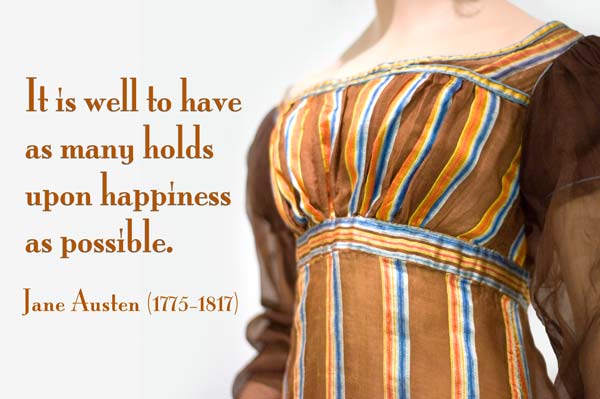
photo of a regency dress and quote about happiness

A Jane Austen Character In Bath

The quotation in this ecard – “It is well to have as many holds upon happiness as possible” – comes from Jane Austen’s novel Northanger Abbey.

It is the novel’s protagonist Catherine Morland who is so advised during her first visit to Bath with family friends.

On The Street Where She Lived

The Jane Austen Centre organizes the Jane Austen Festival, and then all year ’round the center tells the story of the five years that Jane lived in the city and the effect that this experience had on her writing.

Located at No. 40 Gay Street, it’s similar in layout to No. 25 on the same street – which was the house where Jane lived for some months following her father’s death in 1805.

Jane’s Parents’ And Grandparents’ Connections With Bath

Bath is not a large city, and so it’s not that far from 25 Gay Street to the city’s Walcot area.

Walcot figures in Jane’s life because on April 26, 1764, Jane’s father George and her mother Cassandra were married at St. Swithin’s Church there.

Cassandra’s connection with the city was through her mother since her mother settled in Bath following the death of Cassandra’s father.

However, Jane’s parents did not stay in Bath after they got married because Jane’s father held the position of rector of the Anglican parishes in Steventon, Hampshire and a village near by. So Jane lived in Hampshire for the first 25 years of her life.

It was not until December 1800 that the family reacquainted themselves with Bath when it is reported that much to everyone’s surprise, George Austen announced as head of the household that he had decided to retire from the ministry, leave Steventon, and move the family to Bath.

More Associations With St. Swithin’s Church

Five years after he moved his family to the city, Jane’s father George died in Bath in 1805.

The reverend was buried in the southeast burial ground of St. Swithin’s, the same church in which he had been married more than four decades before.

St. Swithin’s is still a functioning church today. However, some time in the mid-18th century after the Austins got married, St. Swithin’s was rebuilt from its medieval state to something more roomy and contemporary.

Jane’s Visits To The Paragon In Bath

Jane was her parents’ seventh child. She had five older brothers, one younger brother, and one older sister.

Her sister was named Cassandra, and she was Jane’s closest friend. She also died unmarried like Jane.

Jane visited Bath before her father moved the family there in 1800 because Jane’s mother’s brother, James Leigh Perrot and his wife, had a house in the Paragon which is a street of beautiful and historic Georgian houses that still exists today.
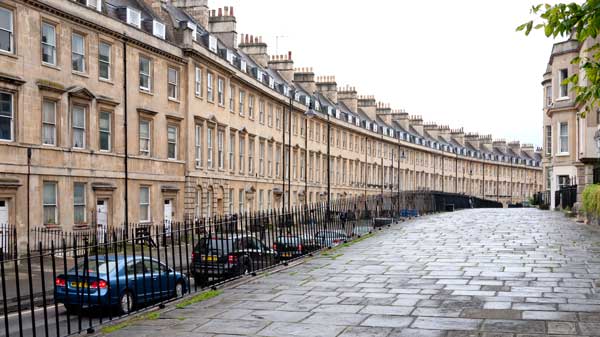
photo of the street named the Paragon, in Bath

Jane’s And Cassandra’s Travels From Hamphire to Somerset

During the time when James Leigh Perrot and his wife lived there, they did not have children and so they frequently invited their nieces Jane and Cassandra to visit them.

The Austen sisters would come up from the country parsonage of Steventon in Hampshire where the large Austen family lived, traveling about 65 miles (105 kms) to get to Bath.

About The Georgian Architecture That The Austen Sisters Saw

Through staying at their uncle’s residence in the Paragon and by walking around the city, Jane and Cassandra could see a lot of the Georgian architecture that still dominates the city today.

The King’s Circus In Bath

A beautiful example of Georgian architecture in Bath is the Circus, begun in 1754 and completed 14 years later in 1768:
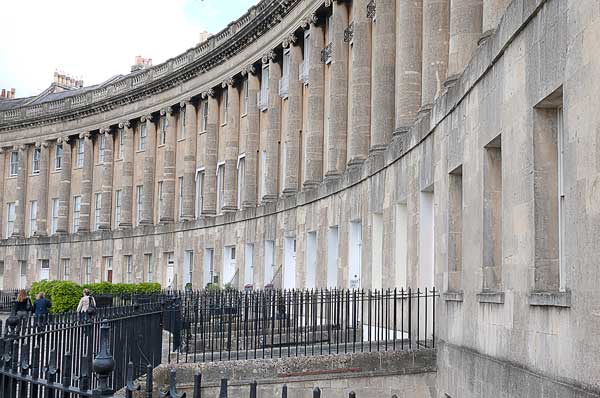
photo of the Circus in Bath

Circus In Latin

The construction was given the name of ‘circus’ because in Latin it means a ring, oval, or circle, which is the striking shape of this structure.

It was originally called King’s Circus, though now it’s known simply as the Circus.

The Classical Facade

The Circus is divided into three segments of equal length, and in the center is a large grassed area with trees surrounded by wrought iron railings.

In keeping with Georgian architecture’s aim, each of the curved parts faces on to the three entrances – which means that all visitors see a classical facade straight ahead, whichever way they enter.

‘Famously Scarce’ Information About Jane

As one biographer put it, getting solid biographical information about Jane Austen is “famously scarce.”

This is because it is estimated that out of 3,000 letters written by Austen, only about 160 are known to have survived.

Most of the letters were originally addressed to her sister who it is said later burned “the greater part” of the ones she kept.

Cassandra then censored those she did not destroy.

There were other letters that were destroyed by the heirs of one of her brothers, Admiral Francis Austen.

Other biographical material produced in the 50 years after Jane’s death was written by her relatives. It is said to reflect the family’s preference to portray the author as “good quiet Aunt Jane.”

Jane’s Impressions Of Bath, From The Weighty To The Light

We do know some of the impressions Jane had of Bath, taken from her surviving letters and from two novels set in Bath, namely Northanger Abbey and Persuasion.

Writing in Northanger Abbey and featuring several of her characters, Jane wrote this about Beechen Cliff:

“That noble hill whose beautiful verdure and hanging coppice render it so striking an object from almost every opening in Bath.”

“The Tilneys were viewing the country with the eyes of persons accustomed to drawing; and decided on its capability of being formed into pictures, with all the eagerness of real taste… In the present instance Catherine confessed and lamented her want of knowledge, declared that she would give anything in the world to be able to draw;… He talked of foregrounds, distances and second distances; side screens and perspectives; lights and shades; and Catherine was so hopeful a scholar that when they gained the top of Beechen Cliff she voluntarily rejected the whole city of Bath as unworthy to make part of a landscape.”

Writing about buying fabric in Bath Street in a letter in June 1799, Jane wrote:

“I saw some gauzes in a shop in Bath Street yesterday at only 4s. a yard, but they were not so good or so pretty as mine.”

Writing in a letter in January 1801 about her mother’s search for a suitable house in Bath, Jane wrote this about Chapel Row:

“But above all others, her wishes are at present fixed on the corner house in Chapel Row, which opens into Prince’s Street. Her Knowledge of it however is confined only to the outside, and therefore she is equally uncertain of its being really desirable as of its being to be had.”

Writing about Gay Street in a letter in January 1801 on the search for a house, Jane wrote:

Gay Street would be too high, except only the lower house on the left hand side as you ascend; towards that my Mother has no disinclination; it used to be lower rented than any other house in the row, from some inferiority in the apartments.”

Writing about Gay Street in Persuasion, Jane wrote:

“The Crofts had placed themselves in lodgings in Gay Street perfectly to Sir Walter’s satisfaction. He was not at all ashamed of the acquaintance.”

Writing about the Pump Room in Northanger Abbey, Jane wrote:

“Every morning now brought its regular duties… the Pump Room to be attended, where they paraded up and down for an hour.”

Later in the book she writes how the Thorpes and Allens stayed:

“…long enough in the Pump Room to discover that the crowd was insupportable, and that there was not a genteel face to be seen.”
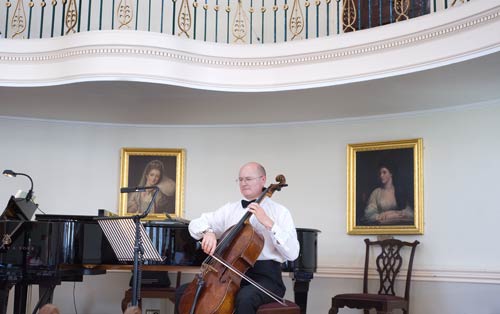
Music At The Pump Room In Bath

In Persuasion, Jane also wrote,

“In the Pump Room one so newly arrived in Bath must be met with.”

Writing about the Axford buildings which are now a continuation of the Paragon, Jane wrote this about her aunt in a letter in January 1801:

“We know that Mrs Perrot will want to get us into Axford Buildings, but we all unite in particular dislike of that part of the Town, and therefore hope to escape.”

Writing about Walcot Church in a letter in June 1799, Jane wrote:

“My Aunt has told me of a very cheap shop near Walcot Church [for hat trimmings] to which I shall go in search of something for you.”

Writing about her father’s funeral to take place in Walcot Church, Jane wrote simply in a letter in January 1805:

“The funeral is to be on Saturday at Walcot Church.”

Writing about Sydney Gardens in a letter in May 1799, Jane wrote:

“There is a public breakfast in Sydney Gardens every morning, so that we shall not be wholly starved.”

Writing about Sydney Gardens again in a letter in June 1799, Jane wrote:

“There is to be a grand gala on Tuesday evening in Sydney Gardens; a Concert, with illuminations and fireworks; to the latter Eliz. & I look forward with pleasure, & even the Concert will have more than its usual charm with me, as the gardens are large enough for me to get pretty well beyond the reach of its sound.”

Writing in a letter in May 1801 about the Upper Rooms now known as the Assembly Rooms, Jane wrote:

“By nine o’clock my Uncle, Aunt and I entered the rooms & linked Miss Winstone on to us. Before tea, it was rather a dull affair; but then the before tea did not last long, for there was only one dance, danced by four couples. Think of four couples, surrounded by about an hundred people, dancing in the upper rooms at Bath! After tea we cheered up; the breaking up of private parties sent some scores more to the Ball, & tho’ it was shockingly & inhumanly thin for this place, there were people enough I suppose to have made five or six very pretty Basingstoke assemblies.”

Writing about the main theatre in the city in Persuasion, Jane wrote:

“The theatre, or the Rooms, where he [Captain Wentworth] was most likely to be, were not fashionable enough for the Elliots, whose evening amusements were solely in the elegant stupidity of private parties.”

Writing in Northanger Abbey about her characters the Allens and the Thorpes at the Royal Crescent (then known simply as the Crescent), Jane wrote that they:

“… hastened away to the Crescent, to breathe the fresh air of better company.”

Writing in a letter in May 1801 about coming into Bath with the evening sun in her eyes, Jane wrote:

“The first view of Bath in fine weather does not answer my expectations; I think I see more distinctly through rain. The sun was got behind everything, and the appearance of the place from the top of Kingsdown was all vapour, shadow, smoke and confusion.”

In Northanger Abbey, Jane’s characters Henry Tilney and Catherine discuss Bath when Henry tries to disillusion Catherine as follows:

“Bath, compared with London, has little variety, and so everybody finds out every year. For six weeks I allow Bath is pleasant enough; but beyond that, it is the most tiresome place in the world. You would be told so by people of all descriptions, who come regularly every winter, lengthen their six weeks into ten or twelve, and go away at last because they can afford to stay no longer.”

Jane’s character Isabella Thorpe in the same novel expresses it more dramatically:

“Do you know I get so immoderately sick of Bath, your brother and I were agreeing this morning that, though it is vastly well to be here for a few weeks, we would not live here for millions.”

Lastly, it is believed that in her novel Persuasion, Jane’s character Anne Elliot may be thought to express Jane’s own opinion about Bath:

“Anne disliked Bath, and did not think it agreed with her.”

[Anne] “dreaded the possible heats of September, in all the white glare of Bath.”

However, Jane brought in the positive side of Bath too. This can be seen through her character Admiral Croft in her novel Persuasion who asserted heartily that Bath met his requirements very well:

“We are always meeting with some old friend or other; the streets full of them every morning; sure to have plenty of chat.”

City Mouse, Country Mouse

As well as the hustle and bustle of the city, Jane and her characters often showed a great love of the outdoors and nature, as shown by the quote in this Quillcard that appeared in her novel Mansfield Park:
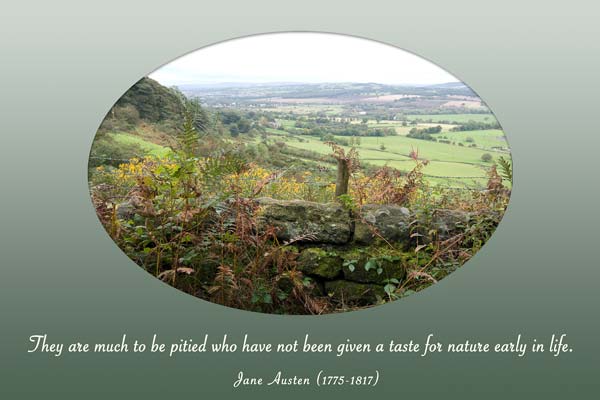
photo of English countryside with Jane Austen quote about nature

Showing the author’s love of the great outdoors, Jane asserts through her novel that “they are much to be pitied who have not been… given a taste for nature early in life.”
‘Pearls Of Wisdom’ In Buddhist Sacred Relics

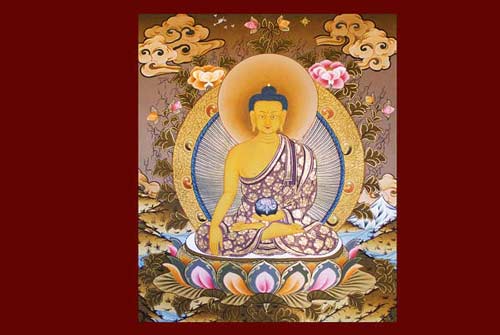
Buddha Wall Hanging - A Quillcards Ecard

A Buddhist Verse
In the ‘Exalted Sublime Golden Light Sutra’, there is this verse that talks about a number of impossibilities in nature:

When white lilies grow
In the Ganges’ swift currents,
When crows become red
And cuckoos turn the color of conch,
When palm fruit grows on the rose-apple tree
And on the date tree mangos form,
At that time a relic the size
Of a mustard seed will appear.

The Ganges In Varanasi
Now, it just so happens that my husband David and I saw the Ganges River this past spring as it flowed through various cities in India.

However, as you might easily conclude – never in our travels did we see ‘white lilies grow in the Ganges’ swift currents’, as the poem here proposes.

Relics The Size Of A Mustard Seed
A few weekends ago, however, we did actually see a ‘relic the size of a mustard seed’.

In fact, we saw a number of clusters of them – and it happened here in the cold summer weather of the city of Leeds rather than in the heat of India.

Sacred Objects From Buddhist Masters
We saw these relics at an exhibition called the ‘Maitreya Project Relic Tour: Sacred Relics Of The Buddha’, sponsored by the Jamyang Buddhist Centre in Leeds that was being shown in the Leeds City Museum.

The exhibition of Buddhist relics included some donated by the Dalai Lama. It was qualified as a rare collection that included relics of the Buddha and of masters from different Buddhist traditions.

Remembering Majnu-ka-Tilla
We were interested to see what these relics were. As we stood in the subdued queue of people waiting to see them, David and I spoke to one another about the Buddhists we had met in India.

We recalled in particular the lovely practitioners of the faith that we had seen in Majnu-ka-Tilla, the Tibetan enclave in Delhi where we had stayed for almost a week when we were in Delhi.

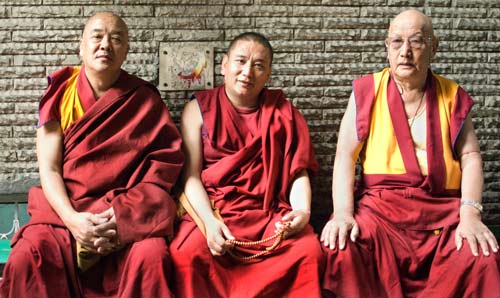
Buddhist Monks
Buddhist Monks

In Majnu-ka-Tilla we had stayed at Wongden House, a friendly hotel with airy rooms that looked out at the Yamuna River and the fields and huts on the riverbank.

Life In Those Alleyways And Byways
Once you leave the hotel, you go through winding, unpaved alleyways and paths where colorful prayer flags, handy Tibetan crafts, mom & pop food shops, clothing stores, phone outlets, and corner pharmacies. Even an Internet cafe or two dot the streets.

As you walk, you often pass Buddhist monks radiant in their simple vermillion robes. Everything and everyone winds down to the very wide boulevard where bicycle rickshaws and some auto-rickshaws (if you are lucky enough to find them!) transport you to the local subway station and from there you can get to the heart of Delhi.

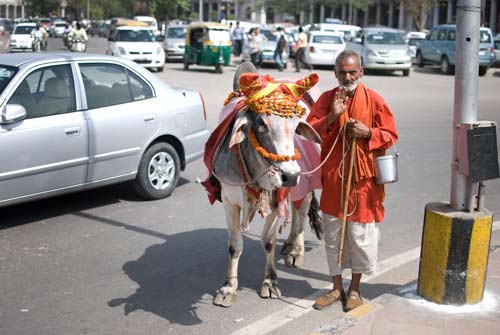
Once in the center of Delhi, you’re back in the thick of it, of course. You can see everything from the ancient to the new in terms of transport, as this photograph of the city traffic reveals:

Pilgrim In Delhi
Pilgrim In Delhi

The Community As Our Refuge
The commercial center of the exiled Tibetan refugee community, Majnu-ka-Tilla is a quiet, peaceful area that offered us respite from such chock-a-bloc traffic and the frenetic, all-guns-blazing hubbub that is Delhi.

Wongden House also has a marvelous small and simple restaurant on its premises where we ate several times.

There one night we met some Buddhists who were passing through en route to a retreat. We asked them questions about their way of life as we ate delicious Tibetan noodle soup called ‘tenthuk’ made with vegetables, steamed dumplings called ‘momos’, and vegetables that sizzled on a huge bed of lettuce.

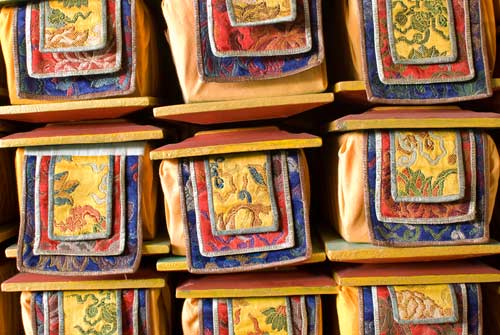
Buddhist Sacred Texts - A Quillcards Ecard

Visiting The Buddhist Exhibit
Cut from that experience of the Buddhist culture in Delhi this past spring back to the exhibit that we saw recently here in England.

Before entering the exhibit, we were asked to take off our shoes. After that we entered a large, dimly-lit rotunda where calming music was being piped in. The lights were low as all of us museum goers progressed forward on a narrow plush red carpet.

On one side of the queue, people sat on chairs and mats. Some assumed the lotus position as they meditated.

On the other side, a monk dressed in beautiful vermillion robes blessed people who came one by one to kneel in front of him. He placed a golden vessel on each person’s head, which we learned also contained some relics of the masters.

In the center was a large golden Buddha, golden bowls lined up in a semi-circle, and a number of exhibits in glass cases.

As we wound around the table, we also saw a copy of the Exalted Sublime Golden Light Sutra, the same book from which I chose the verse that I used to begin this article.

What Are ‘Relics’ According To Buddhists?
The highlight of the show were the relics of the Gautama Buddha and of other masters.

We discovered that ‘relics’ is the word Buddhists use to describe the bits of hard, pearlized balls of bone that are found in the sifted material that remains after a holy master is cremated.

We saw about 10 glass cases filled with delicate bowls that had about half a dozen or so or fewer of these gleaming remains.

The Two Usual Sources For ‘Pearls Of Wisdom’
And so I wonder: Is this where the term ‘pearls of wisdom’ first came from?

The usual answer about where this phrase comes from is that the phrase is considered to come from two sources.

The first source is considered to be from the Christian religion, specifically from Matthew 7:6 in which there is a reference to casting pearls (that is, the wisdom of the gospel) before swine.

The second source is from James Russell Lowell, the nineteenth-century American Romantic poet, critic, editor, and diplomat who referred to the poetry contained in the classic Rubaiyat of Omar Khayyam as follows:

These pearls of thought in Persian gulfs were bred,
Each softly lucent as a rounded moon;
The diver Omar plucked them from their bed,
Fitzgerald strung them on an English thread.

The Rubaiyat of Omar Khayyam is the title that the nineteenth-century writer and translator Edward FitzGerald gave to his famous translation of about 1,000 poems.

The poems were originally written in Persian and are attributed to the Persian poet, mathematician, and astronomer Omar Khayyam who was born in 1048 and died in 1131.

A Possible Third Source For The Expression ‘Pearls Of Wisdom’?
After seeing these relics recently, I now wonder whether they are in fact a third source for the expression ‘pearls of wisdom’.

I asked this of a Buddhist monk who was there and she said that Buddhists believe it is only masters’ remains who yield such relics. However, I do not know what experts of cremation would say about this.

I do know this, however: Although we can use the term “pearls of wisdom” sarcastically, at its heart the expression is meant as intelligent advice, commentary, or instruction that someone imparts to others.

And does that not sound exactly like what the Buddhist teachers and masters strive to do throughout their lives?

The tiny silver- and cream-colored ‘pearls’ glittering so perfectly in their glass cases with the photographs of lovely, smiling Buddhist monks from whom they came next to them makes me think that this derivation seems like it may well be possible.

And so as the poem at the beginning of this article stated, it may well be that flowers don’t bloom in the Ganges, that crows are black and not red, that mangos certainly don’t form on date trees and the like – but we did see a good number of ‘relic[s] the size of a mustard seed’ that came from the bodies of Buddhist holy leaders.

However, whether it’s a bit of magic fluttering in the air a bit or the result of what a truly spiritual person’s remains can leave after his or her body leaves this Earth – well, that I do not know.

Up Close With Ponies On Dartmoor

Dartmoor Ponies - A Quillcards Ecard

Memory And Travels

Memory… is the diary that we all carry with us.
Oscar Wilde

What has often been most memorable in my travels are those moments that were unplanned and unexpected, and not necessarily those places about which I have had great hopes that something wonderful would occur.

One such space in time happened last month when my husband David and I went to Devon, a county in southern England. I was expecting gorgeous countryside because Devon is always described with such a superlative.

However, I hadn’t given much of a thought in particular to Dartmoor National Park and what I would see there – but it was in fact there where something took place that has become a lasting memory.

Ponies At Dartmoor National Park
First, however, some background about the area:

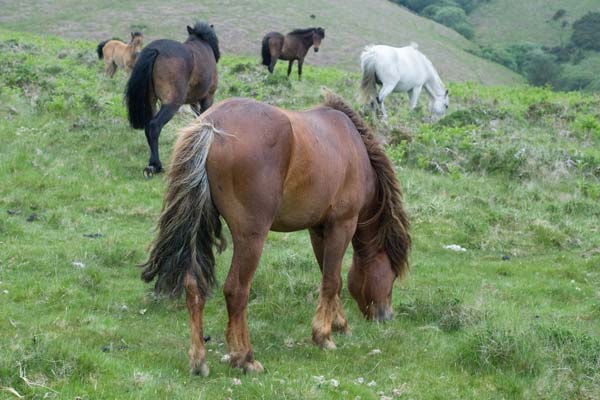
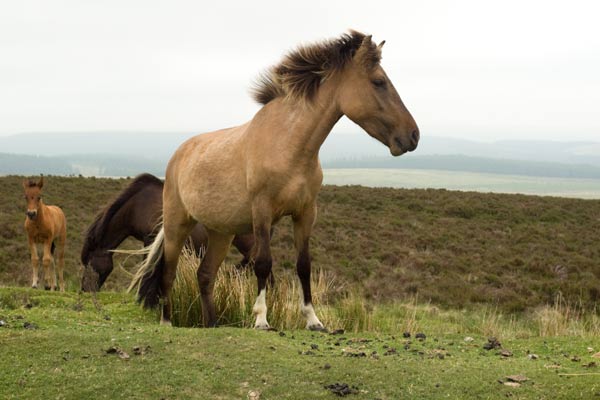
Dartmoor National Park is the largest and wildest area of moorland in the UK. It is well known for its Dartmoor ponies who roam free on its land, like the three horses pictured above. In fact, the pony is also the park’s logo since it is such an important part of life on the moor.

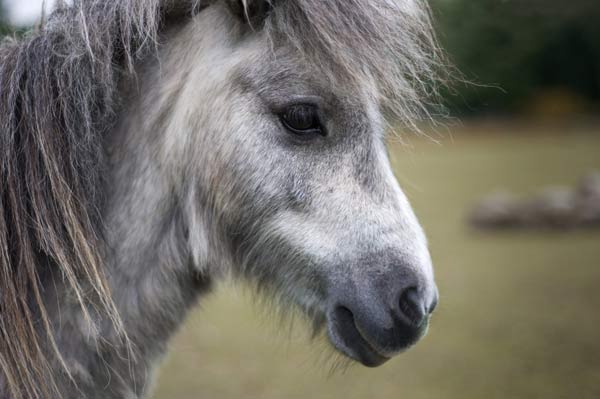
Ponies have roamed on the moor since prehistoric times. Many other kinds of ponies have also lived on the moor, such as those from the Shetland Islands. Shetland ponies like the one pictured below adapt well to the harsh conditions on Dartmoor.

Shetland Pony - A Quillcards Ecard

Aside from the Shetland, cross breeding also means that there are a lot of ponies living in Dartmoor who are of no particular breed.

Some History About These Dartmoor Equines
During the 1970s, an archaeological excavation came upon hoof prints providing evidence that domesticated ponies where found on Dartmoor around 3,500 years ago.

In fact, horses have been on Dartmoor for so long that an indigenous breed – the Dartmoor pony – evolved.

In the mid-1800s, Dartmoor was one of the main sources of granite in Britain. A railway was built to transport the rock, and ponies were used to haul trucks to and from the railway. By the first half of the 20th century, ponies were also used for farm work and for delivery of goods and services.

Locals, visitors, and tourists also liked to see the ponies then as they do to this day.

In Modern Times
By the middle of the 20th century, there were nearly 30,000 ponies on Dartmoor.

However, today there are fewer than 1,500 including fewer than 900 breeding mares left – which is why the Dartmoor pony breed is considered rare.

The reason for the decline is that in earlier years ponies were sold for horse meat – in Britain and then when that was no longer acceptable to the British public, in Europe.

With the rising tide of public opinion against the sale of horse meat to Europe, the number of ponies that the farmers could afford to keep declined.

A 1998 article in the Independent newspaper tells the whole story under the title The Ponies Killed By Kindness.

From Foal To Pony ‘Vital Statistics’
Some say that Darmoor ponies have the majority of their foals between April and July, others between May and August. At whatever time they are born, foals remain with their mothers for some time afterwards.

When a foal reaches maturity, it is never more than 12.2 hands (that’s 50 inches or 127 centimeters).

The colors for the breed include bay (which means that the horse has a reddish brown body color with a black mane, tail, ear edges, and lower legs), brown, black, grey, chestnut, and roan (which means that the horse has an even mixture of white and pigmented hairs that does not get gray or fade as the animal ages).

Piebalds (who are black and white) and skewbalds (who are brown and white) are crossbreds, and usually part Shetland pony.

Wild They Are Not, Though Close To It They Are
Some people mistakenly think that the ponies at Dartmoor are wild: They seem to roam as they wish; they don’t have saddles; and for the most part there are no people about.

Actually, all of the ponies are owned by local farmers, who mark the ponies to indicate their ownership and who let them out on to the Dartmoor commons to graze for most of the year. These farmers have rights to graze a certain number of sheep, cattle, and ponies on the moor.

Drifts
The ponies live out on the moor all year ’round. They spend the majority of their time in small herds of mares with young ponies and one adult stallion.

In late September and early October the local farmers get together to round up their ponies. These round-ups are called ‘drifts’.

During a drift, ponies are herded towards a small field or yard that’s easy to access. Not only people on horseback, but others using four-wheeled bikes and some on foot as well all get in on the act.

After they are herded, the ponies are separated into groups. They are checked out health-wise and treated if necessary. Those who are too old or ill or those to be sold are separated out, while the others return once again to the moor.

Out On The Moor
Intent on seeing the moors, we drove through the narrow roads that wind their way across Dartmoor.

Soon we came to a part of the moor where small clusters of the ponies with their foals were congregated on either side of the road. We parked our car and walked out gingerly on to the springy turf to try and get a closer look at the lovely creatures.

Here is a young foal that we saw at that time, cuddling up to its mom on the moor:

Dartmoor Ponies - A Quillcards Ecard

Visions On The Land
History, statistics and characteristics about the ponies aside, there are few things more peaceful and moving than being in the presence of these ponies as they walk and trot about, chomp down on the vegetation, snuggle against one another, and otherwise while away the time and play around at their home in Dartmoor.

The gentle mist wafting in the atmosphere during the afternoon when we were there also provided a soft and protective veil to the splash of colors and quiet sounds of these generally placid ponies and their foals.

Acknowledging Our Presence
The ponies and foals that we ‘met’ on Dartmoor quietly gave us the merest slip of a nod in a type of recognition of our presence.

We managed to get within a foot of some of them so we tried to pet them. However, they would have nothing of that: They skidaddled when they saw us get too near, and then they resumed their grazing and romping about further up a patch in that ancient and gloriously memorable setting.

A Beautiful Dignity
As we turned around from the horses to make our way back across the moor toward our parked car, we spotted this final scene:

The Power Of Dartmoor - A Quillcards Ecard

Seeing that pony looking majestically into the haze of the horizon with another grazing peacefully and the little one looking straight ahead at us, we felt a world away from our normal urban living in that serene and tranquil setting.

So as the mist softly drizzled over all of us humans and horses, this was the peaceful memory that I was lucky to get – and to remember, whenever I wish.