Giraffes At a Glance

giraffe

Fifty-Four Questions and Answers About Earth’s Tallest Quadrupeds

  1. Do giraffes ever feel blue? Well, they have no tear ducts – but people have seen them cry.
  2. Why can a giraffe stand in the hot sun all day when other animals must find shade? Because its dark patches act like radiators to take away heat: Each of these coverings on the body is surrounded by big blood vessels and criss-crossed by many more vessels, all working together to radiate the heat.
  3. How did ancient cultures regard them? We have this clue: The Egyptian hieroglyph for giraffe means ‘to prophesy’ or ‘to foretell’. Experts believe the animal was given this hieroglyph because of its acute eyesight.
  4. What have giraffes never been seen to do? These creatures have never been seen to bathe.
  5. How much does a giraffe sleep in a day? About half an hour – generally by taking five-minute giraffe naps (and you thought cats had all the fun!).
  6. Should a lion be scared of a giraffe? Yes: One kick from a giraffe’s leg can crush a lion’s skull.
  7. Who are the giraffe’s natural enemies? Lions (yes, actually they are scared of giraffes as one can imply from the previous answer, but they’re also dead set on survival); hyena, the leopard – and of course, humans.
  8. What harm have humans inflicted on giraffes? They have killed them for sport, science, or to make money (the latter by using their tails as flyswatters, good luck charms, and threads for sewing; poaching them for meat; or using their hides for various things).
  9. Are giraffes protected now from humans? Thankfully, it is now illegal to hunt giraffes in the wild. However, there are still some people who poach them illegally for meat and their hides.
  10. What is special and clever about the giraffe’s long and elegant legs? Their wonderfully functional design: Extremely solid and covered with very thick and strong skin, the firm bone of their legs supports their weight and its thick skin stops the blood vessels in their legs from expanding.
  11. Do giraffes faint easily? No, the thick skin on their legs prevents blood from collecting in their legs.
  12. So does that mean that giraffes don’t get swollen ankles? Well spotted – yes, it does mean that.
  13. What giraffe detail do astronauts copy in order to survive exploring space? By wearing Spandex spacesuits, cosmonauts similarly compress their legs like giraffes do. In this way, they avoid fainting in space.
  14. Are giraffes the tallest quadrupeds? Read the title of this article to find the answer. And what exactly is a quadruped? It’s an animal that has four feet, especially an ungulate animal (i.e., a hoofed animal).
  15. So how tall is tall? An adult male giraffe can reach eighteen feet (5.5 meters), while an adult female can get up to a very respectable 16 feet (4.9 meters).
  16. What was the record for a giraffe unfortunately shot by a hunter? A nineteen-foot-three-inch (5.9 meters) bull from Kenya.
  17. How much of a giraffe’s height is its neck? Approximately half of its height.
  18. How much on average do giraffes weigh? The average adult male weighs 2,630 pounds (1.2 tons), while the average adult female weighs 1,830 pounds (0.83 tons).
  19. What are some facts about a giraffe’s muscles? These animals have an elastic muscle that runs from the top of the head all the way down the back of their necks and then down their entire backs. The muscles act like a huge elastic band to keep the giraffe’s head up.
  20. What happens muscle-wise when a giraffe bends and raises its neck? When this creature bends its neck down, it compresses a muscle under its neck. This stretches the big elastic muscle. When it raises its neck, the big elastic muscle lifts its neck like an elastic band snapping back. Pretty neat, don’t you agree?
  21. What’s mating like for giraffes? A brief event with no obvious emotional attachment. And for the female of the pair? It’s also the beginning of a fifteen-month pregnancy.
  22. How tall is a newborn giraffe? Females bear a single calf, who is about 6 feet (1.8 meters) tall. Not bad for a new kid on the block!
  23. How do cows (female giraffes) give birth? Standing up. And the six-foot-tall baby that you just read about above is dropped on the ground and often up walking about within fifteen minutes.
  24. How does a baby giraffe recognize its mother? By her unique coat pattern, because every giraffe’s coat is like a fingerprint – no two are exactly alike.
  25. How many different general patterns can one see in giraffes? There are at least nine different patterns with varying colors that exist in giraffes. These patterns range from the traditional brown and blond splotches to a rich, reddish brown scored with fine, white lines.
  26. Are giraffes prejudiced? Hurrah for these glorious creatures: They do not discriminate based on the color of the skin of other giraffes whom they encounter, and they mate without hesitation with members who look different than they do.
  27. Anything else to recommend them? Yes, they have no territorial inclinations and they are not aggressive. Maybe we should recommend that they have representation at the United Nations, what do you think?
  28. How are giraffes in the babysitting department? Good news – childcare is often cooperative, in nurseries that groups of cows go about forming.
  29. By what age of its life does a giraffe mature? By the time it is four.
  30. How long can a giraffe live? Figures vary, from 25 years in the wild to almost 30 in captivity.
  31. What’s their gait like? Quite strange: When giraffes amble along at a slow pace, they move both right legs at once, then both of the left legs. This creates their unique rocking motion. When they gallop (up to 35 mph), it looks like all four legs appear to leave the ground at the same time.
  32. What’s the same about a human neck and a giraffe’s? Each contains the same number of vertebrae. And how many vertebrae might that be? Figured you’d ask that – seven.
  33. What’s the secret weapon that the giraffe has in its neck? A special joint that enables it to raise its head vertically and even a bit farther back if it wishes.
  34. What’s so great about having that special joint? You get to munch away on leaves that are out of the way – and that’s pretty terrific, don’t you think?
  35. How does a giraffe’s neck work when the animal bends down? It has valves in the veins of its neck to stop the blood rushing down into their brains.
  36. How does a giraffe’s neck work when it raises its neck? A collection of small veins under its brain stops blood rushing away from it – without that, a giraffe would get dizzy whenever it raised its neck.
  37. How would you qualify a giraffe’s blood pressure? As the highest known in a mammal: up to 280/180 mm Hg (millimeters of mercury) at heart level when lying flat, which is more than twice the blood pressure that we humans have.
  38. How long is a giraffe’s tail? Three feet (0.9 meters), just like a yardstick. Handy, yes?
  39. What makes giraffes unique in the animal kingdom? They are the only creatures born with horns, in the form of bony knobs on their foreheads.
  40. How does a giraffe give birth with horns protruding on its calf? The horns are not fused to the baby’s skull at birth, so the baby can slide out easily. Only afterwards do the horns fuse to the skull.
  41. What’s the size of each of the giraffe’s cloven hooves? About the size of a dinner plate – which gives one food for thought (bad pun, I agree).
  42. What does it mean that a giraffe is a ruminant? It indicates that it chews its cud.
  43. The leaves and shoots of which trees are the giraffe’s favorite? A variety of acacia and bushwillow trees. Actually, it may eat leaves from more than a hundred species, depending on what is seasonally available.
  44. What else besides leaves do giraffes have a yen for? Flowers, vines, and herbs. They have also been seen eating weaver-bird nests (with the young inside). They may chew on bones for additional minerals.
  45. What happens when a giraffe eats something with thorns? No problem: It can process such food because of its long, prehensile, muscular tongue; the thick saliva with a gluey consistency that it produces; and the special shape of its upper palate.
  46. How long is that tongue just mentioned? It can be extended up to 18 inches.
  47. How much of the day is taken up with eating for a giraffe? An average of 16-20 hours per day.
  48. Now tell me, how much food does that add up to in one day? Up to 140 pounds (63 kilos).
  49. How does the giraffe’s stomach react to that much food? It has four chambers, and the giraffe is a ruminant, which means it regurgitates its food and chews it again. This is quite like the way a dairy cow deals with food.
  50. What’s the special relationship between some acacia seeds and giraffes? Some acacia seeds only germinate after passing through a giraffe’s digestive track. Isn’t nature astounding?
  51. Compared to other animals, what is the mental prowess of these beautiful animals? People who work with them a lot disagree about this, but one expert noted that “the index of its cerebrum is 29.5 compared with 20 in wild cattle and 14 in pigs.”
  52. Are giraffes talkers? If you mean do they vocalize – yes, they do. Although they are generally quiet, they do emit hisses, snores, moans, coughs, moos, snorts, grunts, low notes, fluttering sounds that are low or flute-like sounds or whistles, and bleats (similar to those made by a calf or lamb).
  53. How did its scientific name of ‘giraffa camelopardalis’ come about? The species name of the giraffe emanates from its early Roman name where it was described as having characteristics of both the camel and the leopard (and perhaps that it was a hybrid of those two animals).
  54. Last but not least, where does the word “giraffe” come from? From the Arabic word ‘zirafah’ – which means “tallest of all”.

Bonus question:

Have you, the writer of this article, ever met a giraffe?

Yes – although we weren’t formally introduced or anything, and it was only a momentary encounter.

However, I did come face to face with the beautiful creature in question. And seriously speaking, it was an enchanting experience.

To read more about Jane the giraffe and other giraffes, check out our article Giraffes: Encounters With Nature’s Skyscrapers.

References:
Book:
‘Tall Blondes: A Book About Giraffes’ by Lynn Sherr. Published by Andrews McMeel, 1997.

TV Program:
‘Inside Nature’s Giants’, segment on giraffes. Aired in 2009 on Channel 4 in the United Kingdom.

Websites:
The Giraffe Information Society
Arkive
Wikipedia
Flickr
America Zoo
Lalibela Game Reserve
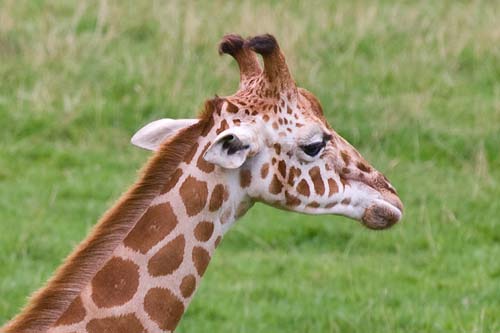
Giraffes: Encounters With Nature’s Skyscrapers

Napping Porcupines, Etc.

What caught our attention first as we entered the house that summer were the large porcupines who were snoozing, their quills at rest cascading down their necks like mohawk haircuts. Across the aisle from them, petite dama gazelles gently chewed hay beneath their feet in another pen.

As we walked further on, however, what I saw in the back inside the wooden structure was almost impossible for me to comprehend at the time.

A Most Peculiar House

That’s because we were in a most unusual house – namely, the giraffe house at Marwell Zoo in Hampshire, England.

And what was looming before my eyes only feet away from me was a large group of those splendid, graceful animals. They were strolling peacefully about their paddock having just come from the outside into the house.

Some of them started grazing from ceiling-high hay racks, and I noticed a ‘youngster’ nursing hungrily in the corner, the two little horns on his head looking for all the world like twin chef hats.

In fact, the baby that I saw that day resembled this other young giraffe whose photograph David took at Longleat Safar Park, another wildlife center located in Wiltshire, England.

As you can see, this juvenile has his own pair of twin chef hats too!

young-giraffe

Sentient Skyscrapers

As I took in more detail about the herd of giraffes so close to where I stood, I was mesmerized: There at arm’s length was a group of animate, breathing skyscrapers.

I tried to make human sense of their height, particularly as they were inside a structure with heads that nearly reached the very high ceilings.

The Art of Loping

Then by chance I noticed a teenage boy near me who was balancing on the ledge next to the paddock. He was reaching out to the animals, trying to pet them. I decided to follow his lead and so I joined him on the ledge.

Like him, I stretched on tiptoe and tried to get the animals’ attention. Soon one giraffe loped past me. Then another swung near me – close, but no cigar. A third drew near – but then it changed its mind, turned around, and bound with its long, graceful stride towards a towering feeder instead.

Jane

In a few moments, however, one of them came over to me. It bent its head way down on its immensely long neck, regarding me quietly with its expressive, dewy soft eyes right in my face.

I leaned forward cautiously to pet its velvety muzzle. Our eyes still united, it calmly accepted the gesture. Then it gently rolled out its very long, prehensile tongue, licked my hand, raised its head – and off it went to join its mates.

I stepped off the ledge, and noticed that David was talking with a couple near by. As he continued chatting, the woman came over to me.

“I noticed that you were petting Jane. We come here a lot, and that’s her name. She’s lovely, isn’t she? She’s our favorite… Don’t you think this giraffe house is wonderful?” she said.

I nodded silently in agreement, still trying to mentally process what I had just experienced.

A Distant Relative

Since our visit to that giraffe house four years ago when we first experienced such close contact with those beautiful animals, spotting giraffes in other wildlife centers has been a special delight for David and me.

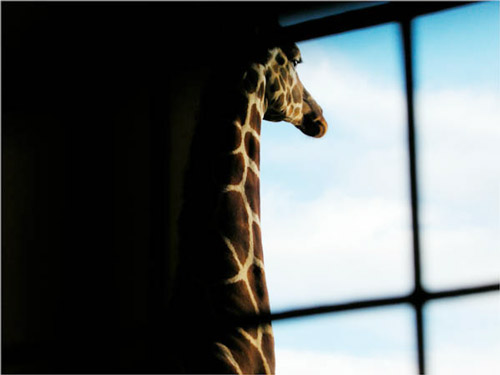
So at another zoo not too long after I met Jane, David took a photograph of a thoughtful giraffe gazing out of a window. I subsequently paired a quotation with the shot, and together we created this image for one of our ecards:

giraffe looking out

Royal Connections

Some time after we took that photograph, I thought about Jane and my experience of meeting her. So I decided to find out more about her from Marwell Zoo, and I was told at the time that she was doing well.

Then the zoo employee asked me if I knew that Jane had a regal connection, namely that she was named after Jane Seymour, Henry VIII’s third wife.

In fact, as I also learned, Jane Seymour’s brother Sir Henry Seymour owned Marwell Hall in the 16th century – which explains why that beautiful building is housed on the grounds of Marwell Zoo, where it is still in use today for various venues.

As far as King Henry VIII goes, it is also very probable that he visited Marwell. It is also thought that he may well have had a private wedding ceremony at Owslebury Church nearby, or at Marwell Hall itself.

Jane’s Fate

In anticipation of writing this piece, I contacted Marwell Zoo once again earlier this month to see how Jane was doing.

I found out, very sadly enough, that Jane died during labor last year.

“There were problems during the birth, and the calf died. Jane ended up being paralyzed in her back legs, and she had to be euthanized. She was 6 1/2 years old when she died,” Britt Jensen, a keeper at Marwell Zoo’s West Section said.

What’s In A Name

Fortunately, however, Marwell has a wonderful giraffe program and life continues there through the seven giraffes who make it their home now.

In addition, like Jane before them – most of the giraffes are named with great care after British or African royalty or some other cultural aspect.

I learned this through Bill Hall, an animal liaison officer who has worked at the zoo since 1976.

As he and a Marwell receptionist named Karen Small further detailed to me with great cheer and good humor, here’s the current line-up:

Kismet, age 11 (named in Germany which was his home before Marwell, he is the sole adult male of the herd);

Matilda, age 12 (named after Empress Matilda, who was the oldest surviving child of King Henry I);

Isabella, age 7 (named after Princess Isabella, who was King Henry III’s sister);

Makeda, age 4 (named after the Ethiopian name for the Queen of Sheba);

Kwane (just born Saturday, June 6, 2009, also the day commemorating D-Day that occurred during WWII, this newborn’s name means literally ‘born on Saturday’ in Twi, the language spoken in Ghana, West Africa);

Christa, 14 months or so (named after her father Christopher who died in February 2008 and whose last baby she was);

Tiye, age 13 months or so (named after the mother of the Pharoah Tutankhamun, Tiye’s mother was Mary and her sister was none other than Jane).

Bachelor Quarters

The reason for the very low number of giraffes at Marwell Zoo at the present time is that the zoo recently moved three young males to Folly Farm in Wales where they joined a bachelor group, Britt Jensen also explained to me.

Herd Mentality

Kismet is currently the only male on the lot, so to speak. Within the confines of Marwell (that is, not in the wild), the herd functions best with only one dominant male.

So down the road when the newborn Kwane reaches about two-and-a-half years old and his “voice breaks,” as Bill Hall put it, he [Kwane] will have to leave Marwell at that time.

Genus ‘Giraffa’

Aside from the wonderfully quirky names that unite these giraffes at Marwell, all of them are also members of the genus ‘giraffa’.

As such, naturally they share certain aspects with one another.

To learn more features and facts about these tallest quadrupds, see our article Giraffes At A Glance.

References

Websites:
Marwell Zoo
Wikipedia
AboutMyArea (Portsmouth area)
Guide to Castles of Europe

Sources:
Courtesy of Marwell Zoo –
Bill Hall, Animal Liaison Officer
Britt Jensen, Keeper, West Section
Karen Small, Receptionist

Pablo Neruda: A Chilean Life Full of Poetry and Politics

Q0103

Poetic Timing

Three days after Pablo Neruda was hospitalized with cancer in his native country of Chile in the autumn of 1973 after having been very ill for some weeks before, he died of heart failure on September 23rd at the age of 69.

However, it wasn’t in just any month that Neruda’s final days took place: On September 11th less than two weeks before he died, a career military man named Augusto Pinochet spearheaded a coup d’etat to overthrow the government of Neruda’s friend, Chile’s first socialist president named Salvador Allende.

Although Allende had run unsuccessfully for the presidency three times before he was finally elected in 1970, he had a respected political career that had endured for forty years during which time he served as a senator, deputy, and cabinet minister.

Moreover, Allende was also a physician, a respected pathologist whose ground-breaking epidemiological work during the 1930s helped establish the field of social medicine in Latin America.

What mattered the most to the United States who engineered Pinochet’s coup d’etat, however, was the fact that Allende was the first Marxist socialist to be a democratically elected president of a state in the Americas.

Brave Mourners

Even as the news swept through the world that the legendary poet, diplomat, political activist, and intellectual free spirit was gone, Pinochet refused to give his permission to transform Neruda’s funeral into a public ceremony. In response, thousands of grieving Chileans took to the streets.

Pinochet could not prevent their actions as they bravely disobeyed curfews and crammed the streets to attend the poet’s funeral.

In this way, Neruda’s funeral served as the catalyst for the first public protest in Chile against Pinochet’s military dictatorship.

Shunning the ‘Practical’

Born in the town of Parral in Chile on July 12, 1904, Pablo Neruda began life as Neftali Ricardo Reyes Basoalto.

His mother, a teacher, died soon after his birth. Afterwards he grew up with his father, a railway employee who wanted his son to have a ‘practical’ occupation.

Hoping that he could keep his poetry from his father by assuming another name and because he happened to be living in a time when it was stylish to adopt a pen name, Neftali assumed his pen name of Pablo Neruda when he was only a teenager.

Roots

Neftali fashioned his pen name from two sources: from the Czech writer and poet named Jan Neruda, and it is thought that his first name was inspired by the French poet Paul Verlaine which he translated into the Spanish ‘Pablo’.

The poet continued to be known by variations of his real name, however, until he legally changed his birth name to his pen name in 1946.

Worldwide Influences

Neruda’s writing was influenced by French, Russian, and Latin American writers.

However, he declared that the writer who inspired him the most was the American poet Walt Whitman.

The Exceptional Poet

When he was only in his twenties, Neruda became famous for a collection of his Spanish-language poems that spoke of melancholy, love, and eroticism.

Written in 1924, the title of this collection translated from the Spanish is Twenty Love Poems and A Song of Despair.

Not Lost in Translation

On ‘la Rive Gauche’ (the Left Bank of the River Seine) in Paris during the 1920s, an American free thinker named Sylvia Beach opened Shakespeare and Company, a bookstore that she turned into a famous gathering place for Paris’ literary expatriate elite.

Among others, Ernest Hemingway, George Bernard Shaw, Gertrude Stein, and Ezra Pound came to her store for their doses of English literature and literary conversation.

Shakespeare and Company still exists today, an alternative reincarnation of the original. Besides the (sometimes musty) shelves with its creative collection of books that are crammed inside the store, this Parisian landmark also displays racks of used books outside on its sidewalk to tempt strolling passersby.

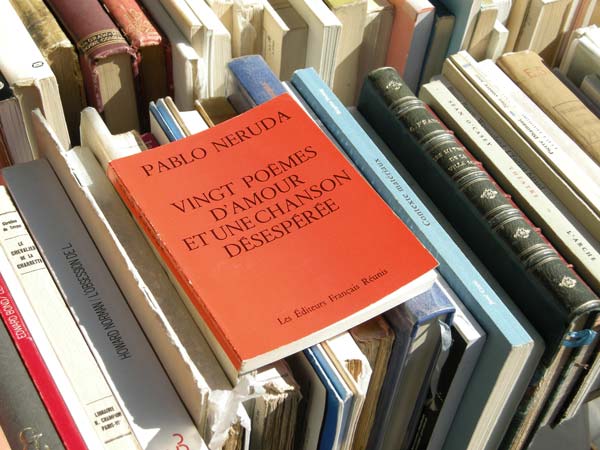
And so it happened that when David and I visited the store last year, he spotted a French translation of this same Twenty Love Poems and A Song of Despair that had endeared Neruda to the Spanish-speaking public when he was young – and so David took this photograph:

00902

This photograph is available as a Quillcards ecard.

Poetic Leanings

Here is an excerpt from one of Neruda’s poems in this celebrated collection captured in this photograph:

From Twenty Love Poems: 7
Leaning into the evenings

Leaning into the evenings I throw my sad nets
to your ocean eyes.

There my loneliness stretches and burns in the tallest
bonfire,
arms twisting like a drowning man’s.
….
The night birds peck at the first stars
that twinkle like my soul as I love you.

Night gallops on her shadowy mare
scattering blue wheat stalks over the fields.

(translated from the Spanish by Mark Eisner)

Diplomatic Assignments

Along with his writing, Neruda was engaged in other work through the government of Chile who bestowed upon him a number of honorary consulships in Burma, Sri Lanka, Java, Singapore, Argentina, Spain, France, and Mexico between 1927 to 1943.

During that period, he continued with his poetry. This included writing enigmatic surrealist poems, historical epics, and undisguised political manifestos, all of which are present in his 1933 collection called Residencia en la tierra.

Mourning Lorca

The cruelty that political conflict can wreak was heightened for Neruda three years later during the summer of 1936 when his cherished friend Frederico Garcia Lorca was executed.

One of the most critically acclaimed Spanish poets and playwrights of the twentieth century, Lorca was killed soon after he wrote the last of his trilogy of plays that included Blood Wedding, Yerma, and The House of Bernarda Alba.

Arrested by nationalist supporters of General Franscisco Franco and murdered without a trial, in death Lorca became an early martyr of the Spanish Civil War.

Lorca’s leftist leanings and his supposed homosexuality had sealed his fate at the hands of the country’s fascists.

Buried in a mass grave, Lorca’s great works were officially banned in Spain until 1971.

The Poet as Political Activist

Lorca’s brutal death, the ongoing Spanish Civil War, plus the poverty that Neruda witnessed in his native Chile had a profound effect on him.

It also propelled him to help 2,000 Spanish Republican refugees dislocated by the Spanish Civil War to relocate to Chile.

Following this, Neruda served as the Chilean consul to Mexico in 1940.

Poems that he wrote during that time in Mexico were included in Tercera Residencia. Although the book was published in 1947, he had actually begun writing parts of it in Spain before his appointment as consul to Mexico.

Explaining Things

Included in Tercera Residencia is Neruda’s poem called I Explain Some Things.

In this poem excerpted here, he addresses his dear, murdered friend Frederico (that is, Frederico Garcia Lorca):

I Explain Some Things
You will ask: And where are the lilacs?
And the metaphysics laced with poppies?
. . . .
Frederico, you remember,
from under the earth,
do you remember my house with balconies on which
the light of June drowned flowers in your mouth?
. . . .
Traitor
generals:
behold my dead house,
behold Spain destroyed:
. . .
Come and see the blood in the streets, . .

(translated from the Spanish by Mark Eisner)

Consciousness Raising

In the early 1940s preceding the publication of this poem and others in Tercera Residencia, several events had impressed upon Neruda the need for unity among peoples: the German attack against the Soviets in 1941; the extension of war throughout the world; a visit to Guatemala in 1941; and a subsequent visit to Cuba in 1942.

Then in 1945, the poet was elected to Chile’s Senate and he also joined the Communist Party.

Fleeing to Argentina

Three years later, the Chilean President Gabriel Gonzalez Videla began to openly persecute labor unions, the Communist Party, and also Neruda.

Neruda responded by going into hiding, ultimately fleeing to Argentina by 1949.

Celebrating Latin America

The year after he was forced to take flight to Argentina, Neruda published Canto General (“General Song”), his tenth book of poems.

An epic piece of writing containing 15 sections, 231 poems, and more than 15,000 lines, Canto General displays Neruda’s heightened appreciation of humanity that he had gained during the early 1940s.

In the collection, he paid homage to political heroes, indigenous leaders, and historical battles.

In addtion, Canto General bore out Neruda’s assertion that Walt Whitman inspired him the most. Described as a ‘Whitmanesque catalog’, it also contains Neruda’s detailed observations about South America’s natural beauty.

Honoring Peru’s Macchu Picchu

After visiting Macchu Picchu in Peru, for example, Neruda wrote the series of poems included in Canto General called The Heights of Macchu Picchu.

It was in those poems that he celebrated the region’s austere beauty.

Macchu Picchu, often called ‘The Lost City of the Incas’, has remained one of the most familiar symbols of the Inca Empire.

Taking Multi-National Corporations to Task

Canto General contains another poem called The United Fruit Co, a poem through which Neruda makes tongue-in-cheek observations about how multi-national corporations at that time had the upper hand over politicians.

It was this that enabled those huge associations to claim for themselves what ‘Jehovah’ [God] had actually intended for mankind to receive, Neruda further claimed.

Here is how Neruda expresses this in this excerpt from his poem:

The United Fruit Co.
When the trumpt sounded, everything
on earth was prepared
and Jehovah distributed the world
to Cola-Cola Inc., Anaconda,
Ford Motors, and other entities:
The Fruit Company Inc.
reserved the juciest for itself,
the central coast of my land,
the sweet waist of America.
It re-baptized the lands
“Banana Republics”
… .

(translated from the Spanish by Jack Hirschman)

The United Fruit Company

Neruda was specifically referring in his poem to the United Fruit Company (UFC), a major US corporation of the time that traded in vegetables and tropical fruit (mainly bananas and pineapple). The food that the company traded in was grown in Third World plantations for sale in the USA and Europe.

By the mid-20th century when Neruda wrote The United Fruit Co., UFC controlled huge swathes of land and transportation systems in Central America, Columbia, Ecuador, and the West Indies. Although it competed with another company named Standard Fruit Company for command in the banana trade around the world, in certain regions it did hold a monopoly.

UFC ran into bad financial times, eventually merging with AMK in 1970 to become the United Brands Company, and in 1984 that brand was transformed into the present-day Chiquita Brands International.

Banana Republics

Several Latin American countries were deeply impacted by UFC in their economic and political development. At the time, critics like Neruda accused UFC of exploitation through neocolonialism, describing the conglomerate as embodying the stereotype of what happens when a multinational coroporation has too much influence on the internal politics of so-called ‘banana republics’.

Coined by the American author O. Henry in 1904, the term ‘banana republics’ became a perjorative one to describe a politically unstable country that is dependent on limited agriculture (like bananas) and ruled by a small, corrupt, and wealthy clique of people.

Such a political reality was one that Neruda thoroughly despised.

Reflecting On Insomnia

Neruda’s worries about his native country of Chile continued. This is illustrated in this excerpt from his poem called Insomnia which was written in 1964, fourteen years after he had composed The United Fruit Co.:

Insomnia
In the middle of the night I ask myself,
what will happen to Chile?
What will become of my poor, dark country?

From loving this long, thin ship so much,
these stones, these little farms,
the durable rose of the coast
. . . .

(Translated from the Spanish by Alastair Reid)

The ‘Long, Thin Ship’

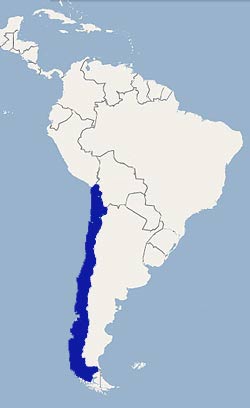
Neruda’s graphic characterization in Insomnia where he compared Chile to a ‘long, thin ship’ mirrors what Chile physically looks like, as you can see here.

map-of-Chile

A Presidential Candidate

Six years after Insomnia was written, Neruda was nominated as the candidate for the Chilean presidency in 1970.

However, in the end he gave his support to Salvator Allende.

Allende went on to win the election, and later that year he became the first democratically elected socialist head of state.

Not too long after he became president, Allende appointed Neruda as the Chilean ambassador to France. After serving at this post from 1970-1972, however, the poet returned from France in ill health.

Winning the Nobel Prize for Literature

It was during that period in 1971 that Neruda received the Nobel Prize for Literature, the same year by chance that the ban on his martyred friend Lorca’s works was finally lifted in Spain.

Neruda had actually sought to win the Nobel Prize for years. However, some of the Nobel Prize committee members were reluctant to award him the prize.

Why was this so? Because like so many leftist intellectuals of his generation, Neruda had supported the Soviet Union of Joseph Stalin because it had had a hand in the defeat of Nazi Germany during WWII.

In the end, however, his Swedish translator named Artur Lundkvist persuaded the Nobel Prize committee members to change their minds about Neruda.

Neruda was the 72nd annual recipient of the Nobel Prize for Literature .

To give you an idea of the caliber of his fellow Nobel laureates for literature, Neruda followed Samuel Beckett and Alexandr Solzhenitsyn who received the awards in 1969 and 1970 respectively.

What Love Has to Do With It

Going full circle from the poet’s Nobel prize that he won towards the end of his life back to his first triumphant collection of poems called Twenty Love Poems and A Song of Despair (that brought him his first taste of fame in his early twenties), here is another excerpt from what I think is one of his most beautiful poems from that collection:

From Twenty Love Poems: 14
Every day you play with the light of the universe.
Subtle visitor, you arrive in the flower and the water.
. . . .
You are like nobody since I love you.
Let me spread you out among yellow garlands.
. . . .
My words rained over you, stroking you.
A long time I have loved the sunned mother-of-pearl of
your body.
I go so far as to think that you own the universe.
I will bring you happy flowers from the mountains, bluebells,
dark hazels, and rustic baskets of kisses.

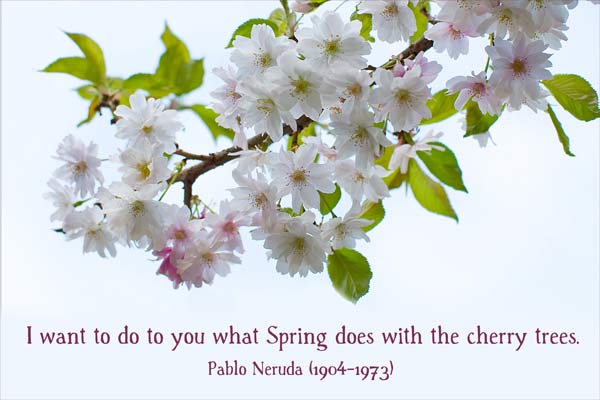
I want to do with you what Spring does with the cherry trees.

(Translated from the Spanish by W.S. Merwin)

I paired the last line of this poem with a photograph that David took of cherry blossom here in England, and together we created this image for one of our ecards:

Q0103

This image is available as a Quillcards ecard.

‘Poetry Is Like Bread’

What did Neruda think about this genre of poetry that was his lifeblood?

According to a wonderful book edited by Mark Eisner called The Essential Neruda Selected Poems, Neruda characterized poetry as follows:

On our Earth, before writing was invented, before the printing press was invented, poetry flourished. That is why we know that poetry is like bread; it should be shared by all, by scholars and by peasants, by all our vast, incredible, extraordinary family of humanity.

Last Words

In addition, towards the end of the acceptance speech that Neruda made when he received the Nobel Prize for Literature only two years before his death in 1973, Neruda had this to say about his life and his art:

I come from a dark region, from a land separated from all others by the steep contours of its geography.

I was the most forlorn of poets and my poetry was provincial, oppressed, and rainy.

But always I had put my trust in man. I never lost hope.

It is perhaps because of this that I have reached as far as I now have – with my poetry and also with my banner.

____________________________________________________________
References

Book:
‘The Essential Neruda Selected Poems’ edited by Mark Eisner, a co-publication of City Lights Books and Fundacion Pablo Neruda, 2004.

Websites:
Nobelprize.org
Wikipedia
Who2
Sarah Browning

Paper:
‘Commentary: Salvador Allende and the birth of Latin American social medicine’ by Howard Waitzkin, International Journal of Epidemiology, Oxford University Press, 2005.