Because of the topography of England, there is an artery of roads running north-south, connecting the major cities.
There are fewer roads running east-west but at a few points there are connecting arterial roads, such as between the city of Leeds to the east of the Pennines,and the cities of Machester and Liverpool to the west.
But move away from these arteries and the feel of the countryside is quite different. Here to the north east of Leeds, off the arterial roads and towards the coast, the villages and small roads have an old-fashioned look to them.
There are hedges and fences and buildings and signposts that have an air of being undisturbed. And there is a quality in the light and the style of the buildings that is particular to coastal towns and villages.
Perhaps there are things that the senses take in that one is hardly aware of. Perhaps it is the grasses that grow by the roadside. Perhaps they are cleaner; not coated with the oil of exhaust fumes. Whatever it is, there is a feeling of having stepped out of twenty-first century Britain.
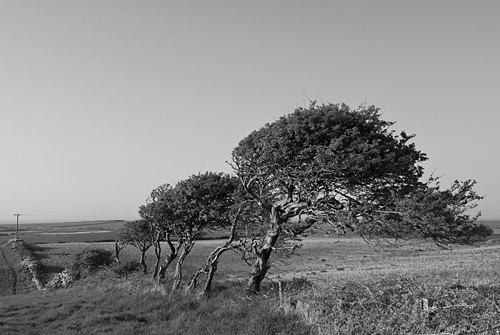
Near this line of windblown trees there is Flamborough Head, a headland that reaches a long finger of cliffs into the north Sea, and just north there is Bempton Cliffs, one of the foremost sites for seabirds in the country where kittiwakes, razorbills, gannets, puffins, and guillemots roost in their tens of thousands.