If you have half a day free in London and want to see some of the more iconic buildings in the city, you can do it at a fairly relaxed walking pace.
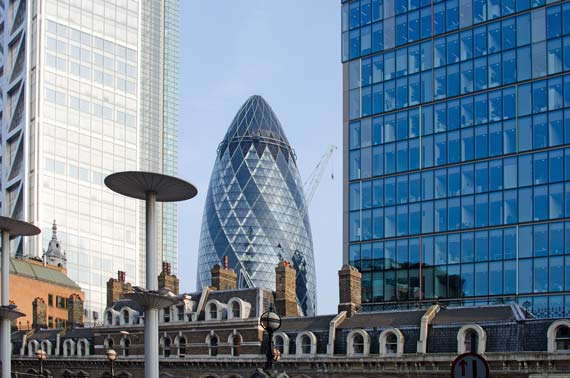
This walk begins at Liverpool Street rail station, and when you step out onto the forecourt you will see the famous ‘Gherkin’ office building peeking out from between other office buildings in this, the financial district of London.
It Was Bedlam
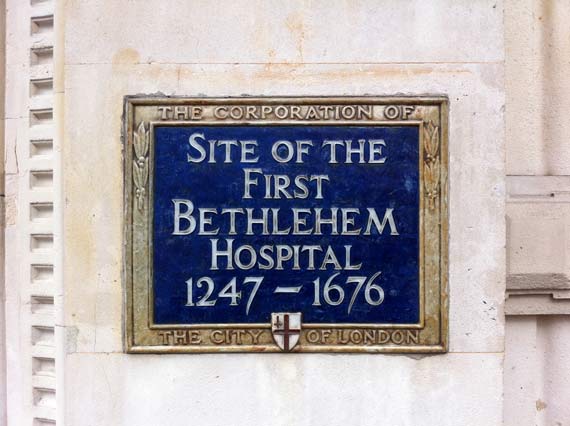
Just a few yards down Liverpool Street there is a blue plaque on the wall that commemorates the first site of the Bethlehem (or Bethlem) Royal Hospital – a hospital for the mentally ill dating back to 1247.
It is from the name Bethlem that the word Bedlam originates – a word which, of course, means ‘uproar, confusion, and wild ideas run riot’.
Heading To The Gherkin
A ten minute walk will take you to St. Mary Axe, the interestingly-named street where the Gherkin building stands. As you wend your way towards it, you will see old buildings jostling for position against new and ever taller buildings looming behind.
It is some years now since Prince Charles lamented the destruction of the London skyline and compared it unfavorably to the skyline of Paris which had been preserved against the encroachment of the modern world of the developer’s paradise. I am sure Prince Charles would be even more unhappy today.
But the world moves on, and London is a busy and vibrant city. I have read recently that Paris is said to be stagnating for the very reason that without new building, its population cannot grow.
The Gherkin And The Baltic Exchange
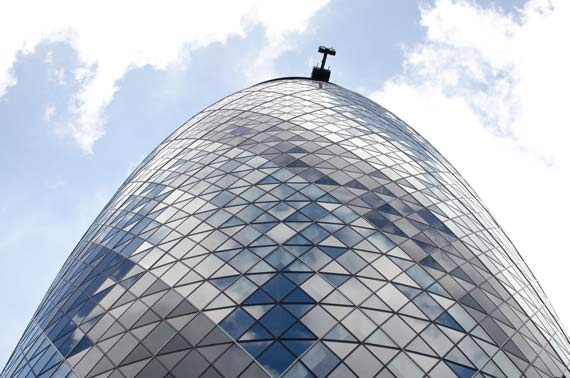
The Gherkin was built on the spot where the Baltic Exchange stood before it was blown up by the IRA in 1993. The explosion blew out the side of the building and it was decided that it was too costly to repair, so it was pulled down.
The Baltic Exchange was a fine old stone building and there is an argument for saying the blowing it up unintentionally paved the way for some of the less attractive buildings in the area to get a foothold, once the ‘Gherkin’ was built on the site of the former Exchange.
The iconic ‘gherkin’ outline is often photographed from further away in order to capture its shape, but shooting close-up gets you the contrast between the geometry of the building and the young trees growing in front of it. Looking up, there is the bulbous top of the building with the window cleaner’s crane hanging over the edge of it.
Looking up, I wonder whether the curve of the building keeps the windows more clean or less clean when it rains.

South Towards The Thames
Heading south down towards the river Thames it is easy to find your way because the streets gently drift downwards as you get nearer the river. This is a particularly interesting part of London because many of the streets are old, and their pattern has not been broken up by redevelopment.
The Monument To The Great Fire Of London
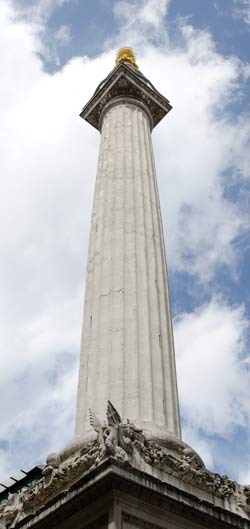
Monument Underground station was just a name to me until I saw the monument after which is was named. It stands just a few yards from the station on the corner of the quaintly named Fish Street.
The monument was erected shortly after the Great Fire Of London that raged across London for three days in 1666 and was designed to commemorate the fire and to celebrate the rebuilding of the city.
Sir Christopher Wren
You can read more about Wren in this article about his life and times when he lived temporarily in Cardinal’s Wharf while he watched the cathedral being built on the north bank of the Thames following the destruction of the first St. Paul’s Cathedral in the Great Fire Of London.
Dr. Robert Hooke
Hooke, though, has often been overlooked or ignored because he ran foul of professional jealousies during his lifetime, principally following his invention of a microscope that was very simple but very powerful. It used a tiny spherical lens, the great curvature of which gave a much greater magnifying power than any other microscope of its day.
Based on his observations, Hooke was able to see and document things that had never been seen before, and it was he who coined the word cell to describe a basic building block of life.
He could see things with his microscopes that the users of other microscopes could not see. So when he first published drawings of the organisms he had observed, he was accused of fabricating his observations.
Hooke was a real polymath and investigated many branches of the sciences. He was also an early proponent of the idea of biological evolution.
Hooke designed several buildings including the Royal Greenwich Observatory and worked with Wren on the design of St. Paul’s Cathedral – the dome of which uses a method of construction designed by Hooke.
The Wikipedia entry for Dr Hooke is well worth reading.
Another of the buildings Hooke helped design is the second Bethlehem (or Bethlem) Royal Hospital. It was built on the street known as London Wall – a short walk from the original site. The building is no longer there although there is a plaque on the wall of the Pizza Express restaurant that occupies the spot.
Subsequently the hospital moved to Beckenham in Kent, where it is today – and still called the Bethlem Royal Hospital. It is quite amazing to think that this hospital can trace its history back to 1247.
Another Bedlam
There is a village named Bedlam near Harrogate in North Yorkshire. It is believed that the name of the village originates from a Norse word for a collection of buildings rather than anything to do with ‘uproar, confusion, and wild ideas run riot’. Still, the welcoming sign to the village is rather lovely.
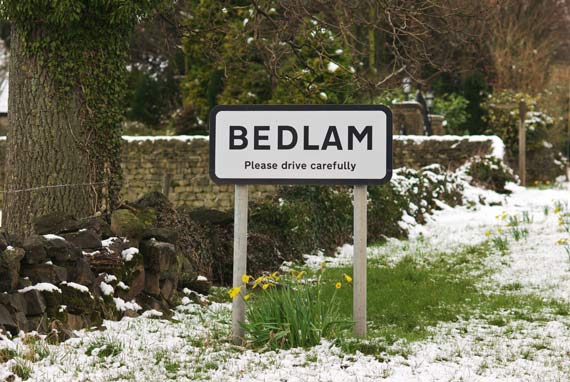
You can find this village sign as one of our ecards, here.
From Pudding Lane To Pie Corner
For some reason best known to the designers, the Monument was designed so that its height of 160 feet (49 metres) is the same as the distance from the base of the monument to Pudding Lane where the Great Fire started.
Schoolchildren are taught that the fire ran from Pudding Lane to Pie Corner. It spread so rapidly that there was a fear that it would cross London Bridge and burn through the boroughs on the south bank of the Thames. It didn’t, but the buildings on the bridge burned down.
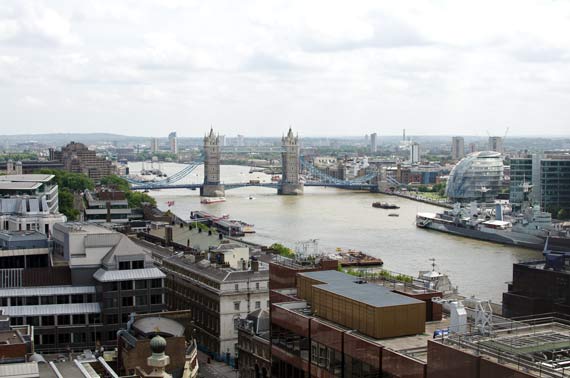
Climb the 311 steps of the winding stone staircase and you will come out onto a balcony that runs around the column and from which you can see a complete panorama of London, including a view down the Thames towards Tower Bridge.
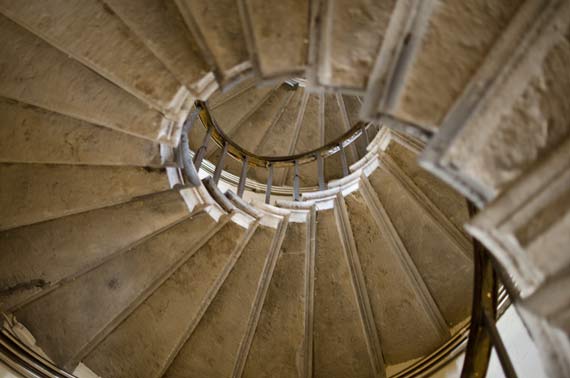
While I was up there I heard that more people had died from throwing themselves off the Monument than had died in the Great Fire. There is now a wire cage covering the formerly open area above the fence on the balcony but there is sufficient room to poke a lens between the strands of wire. So I was able to take this photo of Tower Bridge straddling the Thames.
St. Paul’s Cathedral
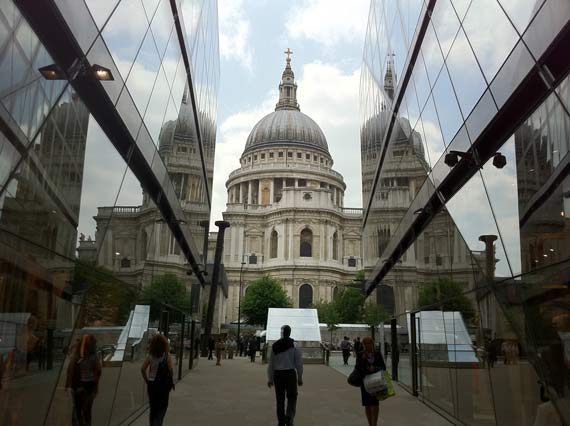
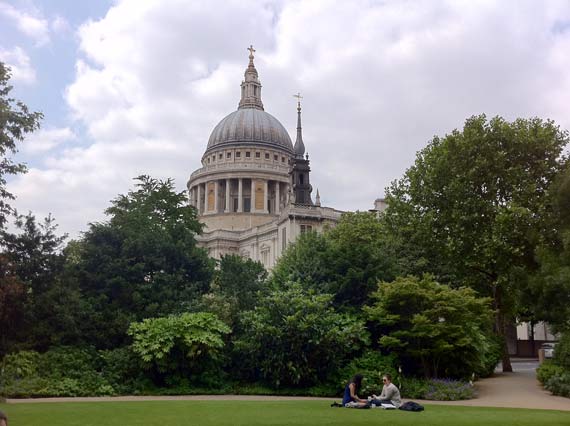
From the Monument, a walk along Cannon street parallel to the Thames brings you to St. Paul’s Cathedral.
While it is often photographed from the river or from the Millennium Bridge leading from Tate Modern on the South Bank, there are other angles from which the building reveals itself – such as these in these two photos.
A Splash Of Red
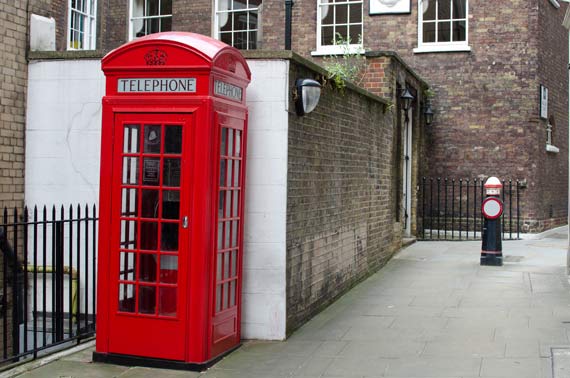
There are lots of small side streets and alleyways off the main roads that run along the Thames, and it was in one of these that I saw this splash of red of a telephone box.
Some years ago it was decided to keep the old style telephone boxes in the historic heart of London rather than replace them with the new design.
Now telephone boxes are becoming redundant as more an more people have mobile phones. It makes me wonder how long telephone boxes will remain a sight on London’s streets.
The Houses Of Parliament
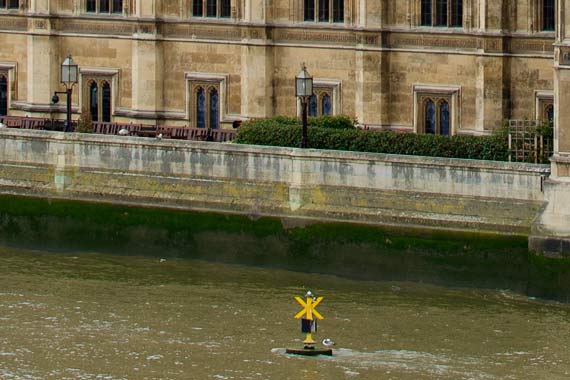
Further along the river, the Houses of Parliament stretch into the distance. It is easy to forget that that the building is built right on the bank of the river and it is still a slight shock to see the green algae on the lower walls – clearly visible when looking at the building from Westminster Bridge.


Trafalgar Square
This is the last leg of the journey walking from Big Ben up to Trafalgar Square which, when viewed from the steps of the National Gallery, looks reminiscent of London of the early nineteen hundreds. This is in part because of the alterations to the Square made under the direction of the former Lord Mayor Ken Livingstone, who had the area in front of the gallery pedestrianised.

Conclusion
That wraps up this photographic walkabout. It doesn’t include a shot of Westminster Abbey and there are other buildings that vie for attention, but it’s a sample of what London has to offer and some of the different ways of photographing the sights – and it can be done comfortably in a half day’s walk.
Technical
I used a Nikon D7000 with a Nikon 35mm f1.8 AF-S lens for all of the shots except of the plaque, which I shot with my iPhone, and the Bedlam sign in North Yorkshire – which I probably shot with a Nikon D60.