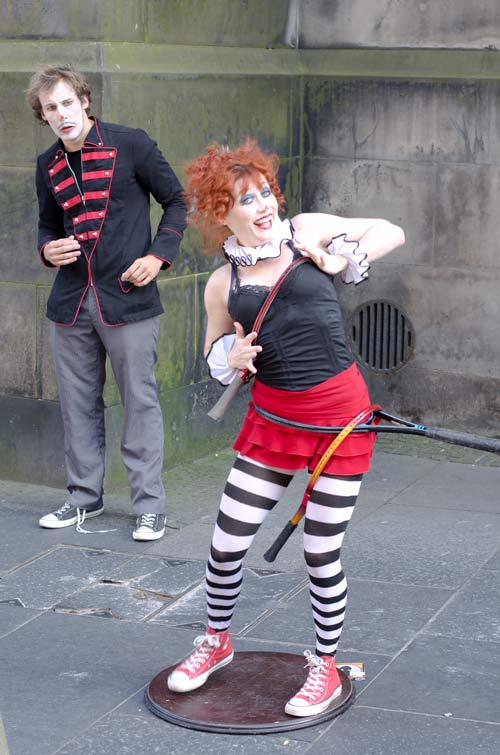
On the Royal Mile in Edinburgh this summer, this woman entertained the crowds by passing several tennis rackets over her head and down the length of her body.
Here she is entangled with some of the rackets:
The Smell Of The Greasepaint, The Roar Of The Crowd
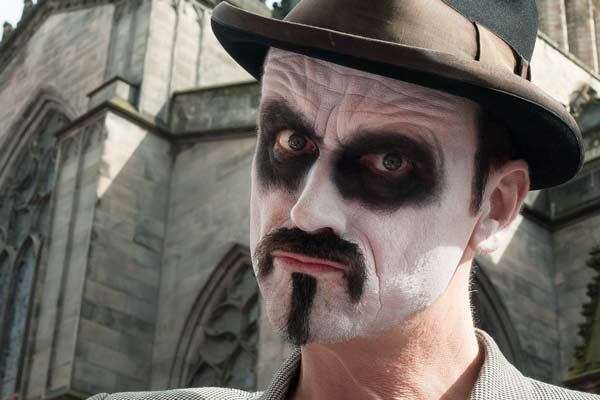
As you can see, the woman’s make-up was terrific. By and large, however, the performers this year seemed to have lost a vital piece of knowledge, which is that half the battle in capturing an audience’s affections is to get the make-up right.
Last year, I was spoiled for choice finding people to photograph.
This year I saw this gentleman who also had the right spirit:
And Now The Time Has Come
The Festivals are almost over. The Fringe has finished and everyone has packed their bags and gone home.
The press have had lots to say about the Fringe this year – some say it is a pastiche of what it once was. Some say it is better than ever. I suspect that each person has found their own Edinburgh Fringe and the best of them have enjoyed themselves.
Last year we came up to Edinburgh for the festivals and stayed more than a month. We liked Edinburgh so much that last November we came to live here.
The result is that this year we are old hands at the business of enjoying the festivals. 😉
So, here is a run-down of some of the nineteen or twenty shows we’ve seen.
Trevor Noah
We started out with Trevor Noah, a comedian who had us laughing and crying at the same time. He talked about identity and he told how when he was growing up in apartheid South Africa, his mother couldn’t hold his hand in public.
That was because he was the son of a white Swiss father and a black South African mother. So he was ‘coloured’ – paler skinned than his mother.
And for that reason – that he was a different colour than his mother – his mother was forbidden to touch him in public.
Instead, she hired a paler skinned woman to act as Trevor’s mother while she (the real mother) played the part of a maid, trailing behind.
Which was why, Trevor explained, his mother is peeking out like a jack-in-the-box in the background of the photos of family outings.
Trevor Noah is still defending his right to be a person – still fighting prejudice. And never have I liked a comedian as much as when we laughed at the stories he told.
NOLA
NOLA (New Orleans, Louisiana) is a play by the LookLeftLookRight company with four actors playing lots of characters giving verbatim testimony about being caught up in the 2010 Deepwater Horizon oil spill in the Gulf Of Mexico.
The characters spoke about the blowout itself, the size of the spill, the toxicity of the dispersants, the efficacy or otherwise of the booms designed to catch the oil, the sense or otherwise of pouring dispersants on the oil and causing it to sink rather than being mopped up, the birds and animals ruined by the oil.
I’d forgotten that eleven men were killed when the rig blew. They disappeared in a fireball of ignited gases. Some survivors jumped off the rig – seventy feet or more – and were picked up by the transfer boat that bravely negotiated a sea of burning oil and falling debris.
It was a terrific play – no easy answers, except perhaps that greed knows no boundaries.
I wrote about the Gulf oil spill at the time.
I calculated that the volume of oil spilled would have filled 14 million people. That is, if you took 14 million people and emptied them of all their innards and then filled them with oil – that’s how much oil was spilled.
I thought it would be easy to visualise – twice the population of London or New York – filled with oil.
Simon Callow – Dickens In An Hour
You probably know Simon Callow from Four Weddings and a Funeral if not from many other films and plays in which he has appeared.
The interviewer asked him a question and Callow was off – with stories of his encounters as an actor with Dickens’ plays – lots of lovely, funny stories.
And then on to his delving deeper into Dickens the man and finding someone who wanted to be made whole by an audience and who more or less killed himself through hard work – speaking at venue after venue – arguing for social and economic justice and campaigning to bring a measure of equality and relief to the poor of England.
Satire and Jonathan Swift
We listened to Dr Valerie Rumbold of the University of Birmingham, the Romanian director Silviu Purcarete, and the cartoonist Martin Rowson as they discussed Jonathan’s Swift’s classic story, Gulliver’s Travels.
Silviu Purcarete has just produced a new play inspired by Gulliver’s Travels and he had the best line in the talk when he said that having read all four of the Gulliver’s Travels books, he concluded that Swift was a pessimist who saw no redemption in man.
Later that day we saw Silviu Purcarete’s production that went under the name Gulliver’s Travels but which as the director said earlier, was ‘inspired by’ Gulliver’s Travels.
What a strange play. My favorite scene was where a judge sat down on a throne-like chair at the front of the stage, facing the audience.
He shuffled his papers importantly. He cleared his throat and shuffled his papers some more – all the time looking as though what he had to say would affect us all in a most negative way.
Then up from behind him, one of the Yahoos bopped him on the head and the judge spent the rest of the play being wheeled around comatose on a hospital bed.
(Yahoos are characters from Swift’s novel, described by the protagonist Lemuel Gulliver as being filthy, odious, execrable, and somewhat similar to human beings.)
The Cleveland Orchestra
We saw the Cleveland Orchestra – and it reminded me of this time last year when we saw the Philadelphia Orchestra.
I gained a valuable insight last year. The Philadelphia Orchestra was the finest I had ever seen. Suddenly I saw the connection between the movements – the striking and blowing and plucking and bowing that the members of the orchestra were doing – and the sound.
I don’t know why, but I had always had a disconnect between the two. But here, the musicians worked so well together that the total sound was perfection.
And so it was with the Cleveland Orchestra. I enjoyed it so much that for a couple of days afterwards I could feel how my brain had been re-wired and I was thinking in music.
A Thank You To My Wife
I can’t leave this without saying a big thank you to my wife, Tamara, who found all the gems we saw this year.