Trees in Soldiers Field, Leeds

Often, photographers try to make an image that shows the scene as near as possible to how it appeared to them at the time. Of course scenes change with light and weather, but here, in the image below, I didn’t try to reproduce the scene as it appeared to me.

Instead, I reduced the image to black and white tones, lightened the yellow wavelengths, darkened the green wavelengths and overlaid the image with a slightly warm blue tone to produce the finished image.

This tree is growing on a raised bank about twenty feet back from the roadside, overlooking Soldiers Field in Leeds, England, and the leaves were yellow in the pale Autumn sunlight.

Shooting from the roadside below, only the sky could be seen, making for a simple image. But in my mind’s eye I could see the tree covered in hoar frost, as it might be in the coming months, and that is how I developed the image.

Soldiers Field, where this was shot, got its name from the assemblies of soldiers who gathered there before being sent to the trenches in the First World War. Today the ‘Field’ is bisected by the road and so Soldiers Field is really two fields, grass covered and very big. It is not difficult to imagine soldiers and bands and civilians congregating there.

tree_in_blue

The Bronte Parsonage, Haworth, England

Behind the Parsonage in Haworth, which now houses the Bronte Museum, there is a field aptly named Parson’s Field.

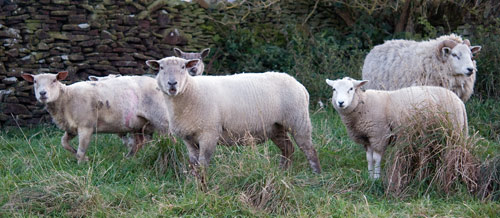
It slopes gently uphill, and as I entered the field I saw a ram and several ewes in the top corner by the dry stone wall.

As I approached, they looked up and the ram stood at the back, side-on to me, full-coated and magnificent. The ewes looked a little spooked and one of them did something I have never seen a sheep do: She pawed the ground like a bull, and pulled back her lips to tell me not to come any closer.

I took several photographs while they were deciding I was not going to come any closer, and as they ambled across the field.

Five Sheep

 
sheep_in_haworth

The village of Haworth is set in the Pennine Hills, overlooking the Worth valley, and it is in the parsonage that the Bronte sisters wrote their most famous works, including Jane Eyre by Charlotte Bronte and Wuthering Heights by Emily Bronte.

Cardinal’s Wharf, London

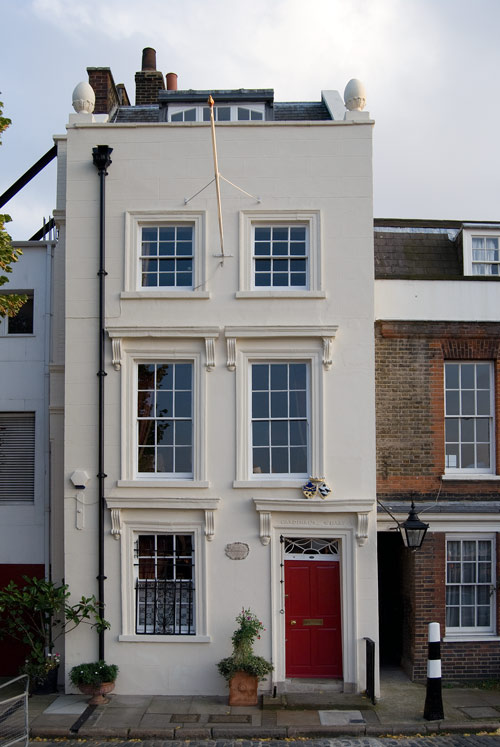
By the south bank of the river Thames in London, close to the Globe Theater and just across the river from St Paul’s Cathedral, there is pretty house, painted a creamy white.

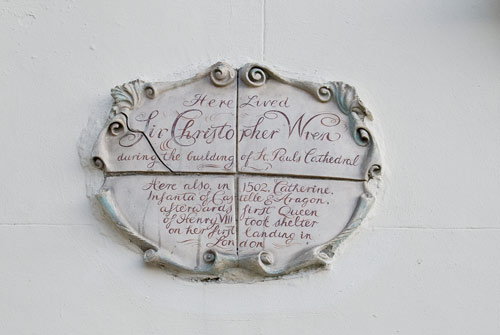
Above the door, the name Cardinal’s Wharf is written. And to the side of the building is a plaque that reads –

Here lived Sir Christopher Wren during the building of St Paul’s Cathedral.

Here also, in 1502, Catherine Infanta of Castille and Aragon, afterwards first Queen of Henry VIII, took shelter on her first landing in London.

One can easily imagine Sir Christopher Wren getting up in the morning and looking out of one of the upper windows to see, across the river, his creation rising out of its foundations as the work progressed from the laying of the first stone in 1677 to the completion of the cathedral in 1708.

Cardinal's Wharf, London

The St Paul’s Cathedral that Wren designed is the ‘new’ building that replaced the old St Paul’s that was gutted in the Great Fire of London in 1666.