The Queen’s Household Cavalry

Viewing Ceremonial Cavalry in Modern-Day London
Walking in Whitehall in central London one day several months ago, we caught sight of a troop of Queen Elizabeth II’s Household Cavalry.

There in the midst of modern-day streets that were cordoned off and guarded by police officers, we saw lines of magnificent horses groomed to a T ridden by men who were resplendent in heavy coats crossed with sashes.

On their heads they wore high, polished helmets that reflected the cold winter sun, each one bearing thick plumes made from horse hair that cascaded to the bottom of their helmets.

From King Charles II to Today
According to the Household Cavalry Museum, the Household Cavalry was formed in 1661 under the direct order of King Charles II.

Today in 2009, it consists of the two senior regiments of the British Army – the Life Guards, and the Blues and Royals.

Each day they exchange duties and the regiment that is stationed at Buckingham Palace rides down the broad avenue called the Mall and ceremonially hands over its responsibilities to the other regiment which they rides back up the Mall to Buckingham Palace.

Gloved Hands and Shining Swords
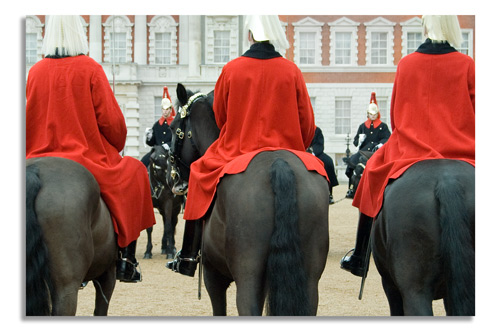
That day we saw members of the Blues and Royals, dressed in their navy-blue capes with red collars and red plumes on their helmets. We also saw their fellow members from the Life Guards, and they were dressed in red capes with black collars and white plumes on their helmets.

All of these men of the cavalry also carried shining swords in their impeccably white-gloved hands.

You can see here in this photo when these two groups were ‘changing the Guard’, as it is called:
 
life_guards

The Household Cavalry’s Two Roles
The cavalry has two roles: as a mounted regiment (on horseback), it guards Queen Elizabeth II on ceremonial occasions in London and across the United Kingdom. It’s also an essential element of the royal pageantry in England.

Its other role is as an operational regiment. There the regiment’s horses are replaced by armored fighting vehicles, and its men serve around the world, including units that are currently deployed on active service in Iraq and Afghanistan.

Along with its members being deployed in active service, the Household Cavalry also prides itself on its mission to further international peace keeping and humanitarian operations.

The Daily Ceremonial Procession To Buckingham Palace
The regiment holds its ceremonial Changing of the Queen’s Guard daily on the Horse Guards Parade which is adjacent to St. James’s Park.

After the ceremony, spectators like us on that cold winter day can watch the regiment proceed in all its pomp up the Mall to Buckingham Palace.

A linguistic footnote:
The Mall – the avenue that leads up to Buckingham Palace – has a special pronunciation in British English that rhymes with the word ‘pal’.

You can send distinctive ecards featuring our photographs by Joining Quillcards.

Lambing At Hurries Farm In The Yorkshire Dales

Newborn Lambs In Spring

In early April the fields in the Yorkshire Dales are dotted with ewes and their newly born lambs. Most ewes give birth to two lambs and they are capable of giving birth unaided.

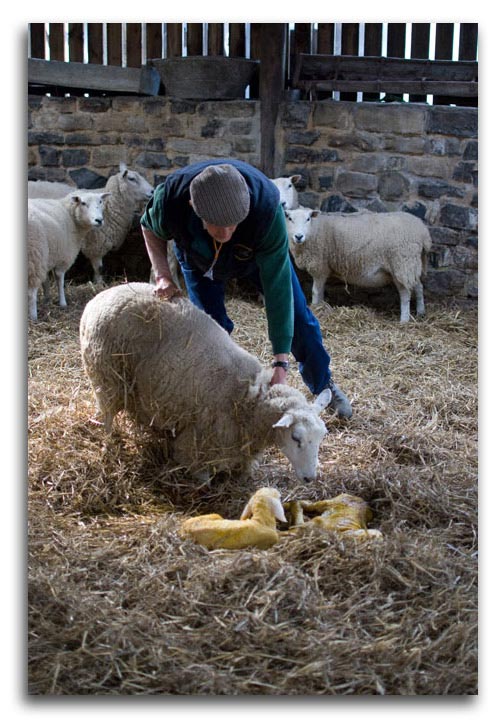
However, David Wellock, the farmer here at Hurries Farm at Otterburn in the Yorkshire Dales National Park in North Yorkshire, was on hand and this ewe hardly made a sound as he gently eased the lambs from her.

Birth

The first to be born presented headfirst with both legs in front of it, which is the ‘correct’ way for a lamb to be born.

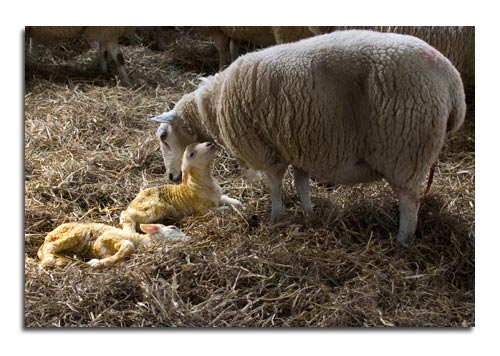
The second lamb had one leg forward and the other back like a swimmer doing the crawl, as in this first photograph. This can make giving birth a little more difficult, but soon both were lying on the straw litter, struggling to lift their heads.

ewe giving birth

ewe with newborn lambs

newborn lambs

Tottered To Their Feet

The mother licked the lambs while they tottered to their feet and both were standing and suckling within half an hour of being born.

newborn lamb, suckling

A Few Days’ Experience Changes Everything

A few days later and these lambs, also from this farm, are white and fluffy and already looking at the world with more experienced eyes.

lamb with mother

Hurries Farm

If you are interested in visiting Hurries Farm at lambing time in March and April, check with the Yorkshire Dales National Park Authority. Put Hurries into the search box and it will come up with a list and the contact details so you can arrange your visit.

The Church of the Holy Sepulchre in Jerusalem

In a small square deep in the labyrinth of streets in the Old City in Jerusalem lies the Church of the Holy Sepulchre.

The approach through the Christian Quarter of the Old City leads down a broad stone stairway and then a left turn into the square. The effect is of descending into a place that is tucked away, and is quite different from the feeling of approaching churches that are set on higher ground above the surrounding buildings.

At the end of the square and filling the whole breadth of that end of the square is the facade of the church.

There are two huge arches built into the stonework. Two large doors occupy the lower part of the leftmost of the arches.

At one time there may have been another doorway set in the second arch, but now it is roughly filled in with the same rich yellow stone of which the church is built.

It’s a strange to see a major church with its front partly filled in with a ‘temporary’ wall, like a derelict building walled up to prevent vandals entering.

There are two more stone arches in the floor above, with small windows set in them, and then the roof.

The whole building has settled down into a comfortable jumble of styles in the bits of doors and windows that continue in the buildings that fill the flanking sides of the square. It all looks very old and very beautiful.

The graffiti that is carved in the doors and on the columns that flank the doors that lead into the church is in a number of languages and scripts, including Armenian.
 
sepulchre_graffiti
 
The site of the church is thought by Christians to be golgotha, where the death and resurrection of Jesus took place, hence its importance to the various sects that administer the church, each claiming a particular part.

Inside, above the selpulchre at the heart of the church, there is a domed ceiling and at the top there is a circle through which sunlight shines down through the incense-filled air.
 
sepulchre_ceiling
 
The church is a labyrinth of corridors and stairways leading to various chapels, some of which are high above and some of which are below street level.

Below ground the air is colder and the chapels are dimly lit by candles and by candelabras hung on long chains from the ceilings.

Gordon of Khartoum
The word golgotha means the place of the skull, and in 1882 Major-General Charles George Gordon, who had become an evangelical Christian, went to Jerusalem, in what was then part of the British-controlled Palestine, intent on finding the true location of Golgotha.

He was convinced that a proper survey of the maps would reveal a skull-like shape in the landscape and after searching, he found a site further north than the church, that is now know as The Garden Tomb.

On his return to England he was asked by the British Government to go to Khartoum in the Sudan and to put down a revolt by Muhammad Ahmed Al Mahdi, the proclaimed redeemer who, according to Islamic belief, would appear at the end of days.

Gordon had had a long and successful military and diplomatic career in facing insurrections and against superior odds, of turning enemies into allies.

But at Khartoum he was killed and the legend of his stand against superior forces was taught to every British schoolboy until recently, as the heroic story of Gordon of Khartoum.

Leeds City Art Gallery
The painting depicting this hangs in Leeds City Art Gallery in England. Gordon stands at the top of the stairs. The turbaned attackers are mounting the steps and seem caught between awe for his dramatic figure and their intent to kill him.

The plaque below the painting states that it is called General Gordon’s Last Stand and was painted by George W. Joy. Below that it states that it was presented to the gallery in 1920 by John Gordon Esq. J.P. in remembrance of Captain Alec Mc D. Gordon M.C. of the Leeds Artillery who fell near Passchendaele 6 November 1917.

Footnotes

A J.P. is a Justice of the Peace, or lay magistrate who tries lesser criminal cases.

The M.C. is the Military Cross, an award created in 1914 for acts of exemplary gallantry during active operations against the enemy and at that time given only to officers of the rank of captain or below. Approximately 37,000 Military Crosses were awarded during the First World War.

Passchendaele is the name of the village near Ypres in Belgium, captured at the end of the Third Battle of Ypres, which took place during the First World War. Hundreds of thousands of men on both sides lost their lives during the battle, which lasted from July to November 1917.

You can send distinctive ecards featuring our photographs by Joining Quillcards.