Collared Doves in the Nest

Collared doves first flew in to Britain in the 1950s, expanding their territory that already stretched from Europe all the way across to Japan.

They are fairly common now in England. If you haven’t seen one, the adult bird is a smaller and more delicate than a pigeon. Its feathers are a warm grey tinged and flecked with pink and a hint of blue and it has a white and black collar around the back and sides of its neck – hence its name.

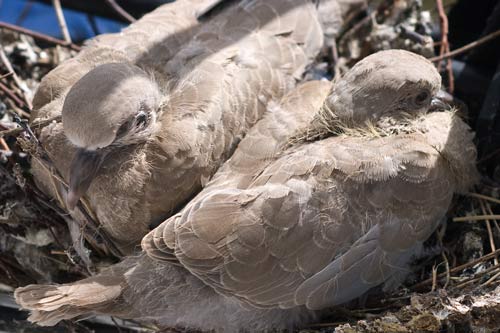
While they are now fairly common in built-up areas in England, I had never seen a pair of young in the nest until last week.
collared-dove-headThe story began last winter when my mother’s neighbor put a folded-up director’s chair out on his balcony. A few weeks ago a pair of collared doves made a nest in it. And Sonny, my mother’s neighbor, invited me to look at the young birds and take some photographs. So I set the camera up on a tripod and waited until the birds settled down.

As I looked out onto the balcony, I wondered why the birds had nested there, right in front of the window, near the swish of the curtains and people moving around inside the flat.

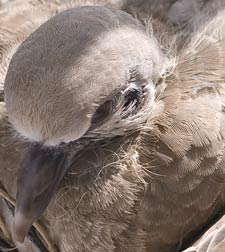
One thing about photography is that it offers a chance to look at things that are not otherwise so easy to see at leisure. But what a surprise when I looked at the shot on the computer screen and noticed the size of the beak on one of the young birds.

Adult collared doves have a demure and gentle appearance with small, narrow beaks. But the beak on this young bird was anything but small. And now I have this image of collared doves growing to maturity with the bird growing up out of its already fully-grown beak rather than the beak growing out of the bird. I can see that some of the beak will be covered by the feathers that will grow in front of the bird’s beak – but still.

And I could see the little depression where the ear is – something that is completely hidden by a tuft of feathers in the adult bird.
 
collared-dove-young

Reflections on Dijon, Mustard, and Rapeseed

What’s In A Name
No sooner did I see the name ‘Dijon’ on our map in the car as we drove to the town from Lyon in May than I could almost taste the delicious, grainy mustard for which the town is so well known. 

Having decided to take ‘the slow boat to China’ to travel from Lyon to Dijon in the eastern part of France by opting for the side roads and delightful country sights versus the far quicker autoroute, we passed mile after mile of vineyards as we got closer to Dijon.

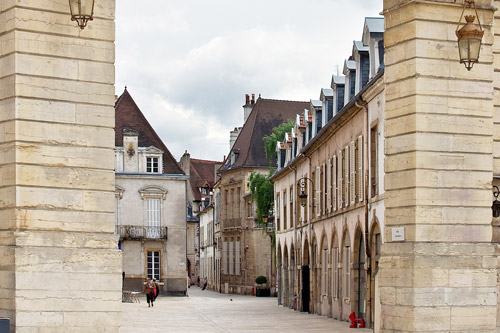
Here is a photograph of the center of this town which is the historical capital of the province of Burgundy:

dijon-town-center

New! Now you can buy a large art print of this image from Quillcards.
The print includes a quotation from Shakespeare on the subject of love.

Under the Spell
A hot spell was gripping the region, and the vineyards gleamed in the baking temperatures along the roads leading to Dijon.

The vineyards were dotted with people here and there who were tending the grapes, and we felt concern about the workers as we watched their bent figures.

The Wines of Burgundy
We read in our guidebooks that this Burgundy region was one of the premiere regions for wines. I don’t know much about wines, but of course I recognized Pinot Noir, Chardonnay, Chablis, and Beaujolais – the names of some of the world-famous wines created in the area.

‘Mellow Yellow’ It Isn’t
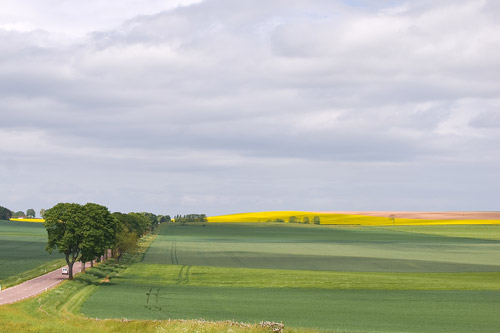
As well as seeing vast rows of ripening grapes on sturdy vines, we saw swatches of shocking-yellow rapeseed carpeting the fields as you can see in the photograph below:

 rapeseed-fields-in-france

One can also see such rapeseed crops in the countryside around our home in England at this time of the year. Whenever I see rapeseed blossoming in England or in France, I have the same reaction, time and again: I gasp at its startling, unbelievable (as in ‘un-believable’) beauty.

Van Gogh’s Genius
I immediately thought of Van Gogh’s paintings when I first caught sight of rapeseed.

When Van Gogh painted such scenes, I had reasoned before I moved to England ten years ago, surely he was exaggerating reality. 

Ah, but once I saw the color for myself as it is in nature – then I understood that it was Van Gogh’s genius that enabled him to relay such explosion of color on his canvasses.

Hunting for Mustard
Now that I was traveling in the Burgundy region close to Dijon, I wondered if mustard plants looked as vivid as rapeseed does. Living most of my life in cities and new to learning about nature, I was ignorant as to what we could find.

In fact, we didn’t see anything yellow other than the rapeseed on our travels from Lyon to Dijon, or at least what we could identify.

The Canadian Connection
So when we finally reached Dijon, we visited the Maille mustard store that has been in existence since 1777, and it was natural for us to ask where the fields of mustard plants were in the Dijon outskirts through which we had traveled.

We spoke in French and English to the amiable, friendly store employees. 

So imagine our complete surprise when theytold us where the mustard plants grow that Maille uses for its delicious mustard: None other than in Canada!

Canada, you may ask (as indeed we did too)? 

About Mustard Crops and Jean Naigeon
I have since found out from various sources that indeed 85% – 90% of the world’s mustard crops are grown in Canada, Montana, and North Dakota.

Most mustard producers purchase seeds from farming cooperatives that maintain huge quantities of seed for the mustard market.

I wonder what Jean Naigeon – credited with the recipe for Dijon Mustard more than two hundred and fifty years ago – would think about such modern ways?

Check out the latest images we’ve added at Quillcards.

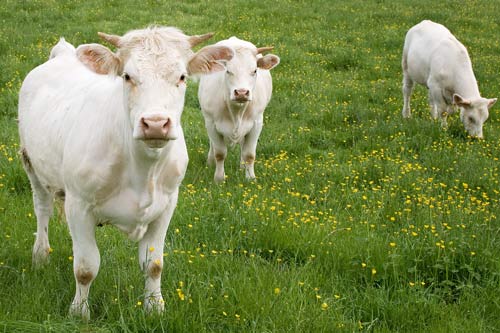
Charolais Cows near Charolle in France

charolais-cattle

Charolais Cows
On a recent trip from Lyon to Dijon, we decided to drive the slower roads rather than the autoroute.

Traveling the slower roads gave us a chance to see the miles of vineyards stretching up the gentle valley sides as we passed Beaune and Nuits-Saint-Georges on the approach to Dijon. It also gave us a chance to negotiate endless small roads that thread through Villefranche-sur-Saone, but that’s another story.

We also saw many small herds of Charolais cows and what struck us was that they were in very small herds, often just a dozen or so cows. And of course they looked so distinctive with their creamy-white bodies, so they were very easy to spot as we drove along – the color really jumps out from the landscape.

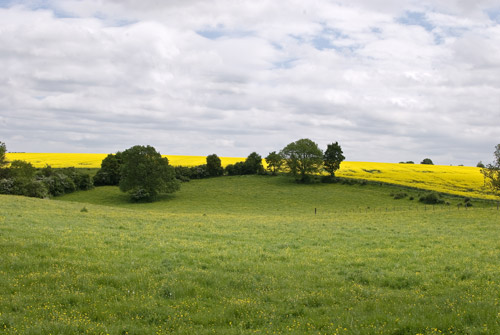
We took a trip out of Dijon a couple of days later, traveling minor roads, past undulating fields with occasional splashes of yellow from fields of rapeseed.

yellow-rapeseed-fields

Eventually we stopped by a field with a small herd of Charolais cows and found a gap in the hedge so that we could up to the fence around the field. We called out to the cows and asked them to come close. It seemed best to call in French.

“Charolais, Charolais – venez, venez mes petits.” Nothing.

We pulled tufts of grass and offered them. Nothing.

So we lobbed the tufts of grass into the field in case the cows might be interested in them, and we turned and started walking back to the car.

And then through a dip in the hedge, we could see the cows coming steadily towards the grass we had left. So we turned back and cut through the gap in the hedge as before and spoke to the cows and asked them to pose while we took their photographs.

Charolle
From the guidebook we read that Charolais cattle originally came from the area around Charolle, a small town somewhat to the west of and about halfway between Lyon and Dijon, and on our trip back to Lyon we saw signs for the town and looked at each other knowingly – for we knew about the cows that come from Charolle.

A quick search of Google shows associations of breeders in the United States, Britain, Argentina, and Australia – and probably many more countries.

But these were French Charolais, and not far from home.

the-gap-in-the-hedge

The Gap in the Hedge