Red Kites in Yorkshire

Hunted to Near Extinction
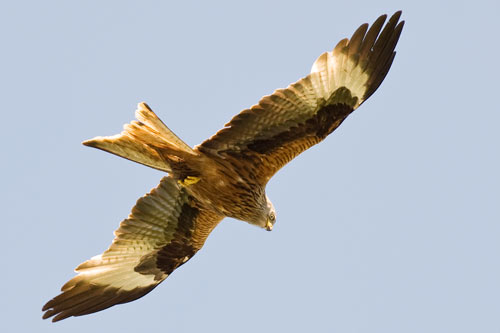
Red kites are one of the United Kingdom success stories of the past twenty years, but they were hunted almost to extinction in the nineteenth century, with just a few birds left in the wild in Wales.

red-kite-gliding

They were reintroduced into the UK 1989 at the initiative of the Joint Nature Conservation Committee (JNCC) which is the statutory advisor to the Government on UK and international nature conservation.

The JNCC worked together with the Royal Society for the Protection of Birds (RSPB) and English Nature (now replaced with a body called Natural England).

The reason I mention it is that the decision to reintroduce red kites was not just a matter of a conservation body rearing and releasing a few birds, but was considered at government level against the backdrop of what was in the best interests of nature conservation in the UK and to honor Britain’s international treaty obligations concerning wildlife.

The reintroduction of red kites has been very successful but they are still on the ‘amber’ watch list for endangered birds.

The risk is not from environmental factors, but from people. The Wildlife and Countryside Act 1981 makes it an offence to take, injure or kill a red kite or to take, damage or destroy its nest, eggs or young. But just in May of this year the BBC reported that the illegal poisoning of a red kite in the Yorkshire Dales was being investigated by police. It had eaten bait laced with the pesticide alphachloralose, which is often used illegally as a pest control.

Red Kite Facts
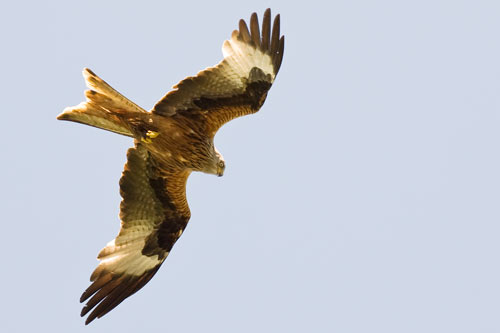
The wingspan of a red kite can be as much as five or six feet (nearly two metres), but amazingly their bodies weigh just two or three pounds (less than one and half kilos). That enables them to circle around effortlessly on thermals for hours eyeing the air and the ground looking for prey.

red-kite-folding-wings

They are not fast flyers and they are not built for overtaking birds in the air. But they can change direction quickly and catch an inexperienced juvenile crow in mid-air.

They also hunt rabbits, rats, mice, other small animals. And they eat invertebrates such as earthworms, which paints a strange picture when one imagines those claws and that beak being used to hunt a worm.

They eat carrion as well, and in the Middle Ages they were common in towns, cleaning up the streets. And for that reason they were protected. But in the eighteenth and nineteenth centuries they began to be seen as pests – hence their near extinction.

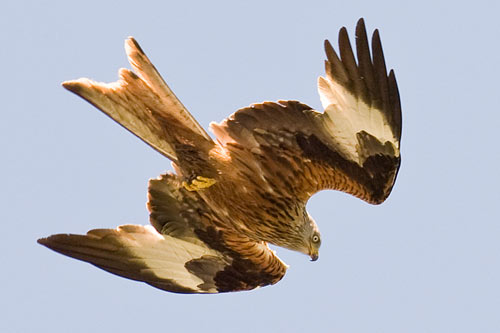
Kites have very good eyesight and when they see something that interests them, or they want to lose height, they fold their wings and swoop down, like in this series of photographs I took a few weeks ago at Harewood, a small village that surrounds a country estate near Leeds in Yorkshire.

Red kites were introduced here in 1999 and there are now quite a number of them in the area. I have seen as many as a dozen at one time, dotted about the wide expanse of sky, some just dots high in the air as they ride the thermals.

About The Photographs
These shots are crops from the central area of the series of photographs I took. I shot them with a long lens (70-200mm) but the birds were still small in the viewfinder.

I have seen red kites perch in the high branches of trees at Harewood, and one day I hope to see a red kite in a tree and have a camera with me. It always seems to be one or the other.

red-kite-with-folded-wings

Inside a Beehive

honeybee-on-honeycomb

The ‘Why’ of Beehive Design

The behavior of honeybees is fascinating and complex, and honeybees are vital to the pollination of very many crops. This makes the fact that they are under threat of extinction worldwide from colony collapse disorder (CCD) all the more serious. [ See this article Honey Bees: Nature’s Linchpin In Great Peril ]

I wanted to take some photographs of bees, so we went to see a demonstration of beekeeping. I saw the beekeeper lifting the frames from inside the hive and examining them, but I didn’t understand the ‘why’ of what I was looking at.

Then a couple of weeks later I saw a display at the apiary of the Leeds Beeskeepers Association and the reason for the design of modern beehives became clear.

Skeps

bee-skep

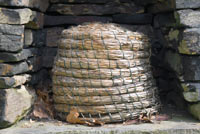
This is a traditional straw beehive, known as a skep. It is the kind of beehive that was used for centuries in England and which continued in use until well into the 1800s. You probably recognize the shape, which is found on the labels of jars of honey and used as the design for little pottery honey pots.
It is made of a rope of straw tied into a shape to mimic the shape of a natural hive that bees might look for in a hollow in a tree or between rocks.

The design varies a little, with some skeps having the entrance at the top while others have them at the bottom, but they all share one characteristic, which is that the beekeeper has to destroy the hive to get the honey out.

The Bee Space

Then in the 1850s the Reverend L. L. Langstroth noticed that bees will not bring the surfaces of two combs closer together than a ‘bee space’ – about the width of a finger – and that piece of knowledge is what determines the interior arrangement of modern hives.

Modern Hives

inside-a-hive

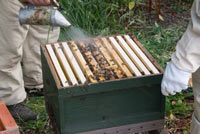
Modern hives use sheets of beeswax stretched on wooden frames. The frames are hung inside the outer case of the hive with a bee space between them. A bee space is also left around the edges of the frames so that the bees can move freely inside the hive.

To encourage the bees to start building combs as quickly as possible, the sheets are impressed with a honeycomb shape. The bees could bridge the space between the frames if they wanted to, but they generally don’t want to because they want access to the cells, so the design suits the bees and the beekeeper.

In The Frame

beehive-frame

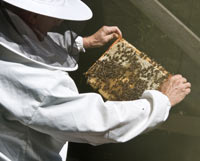
Beekeepers use a hive tool – a flat bar of metal with a hook at one end – to lever out the frames from the hive so they can inspect them. Even with the bee space design, the bees may still extend the combs beyond the end of the frame, and the beekeeper then has to scrape that off otherwise he or she won’t be able to fit the frame back in the hive.

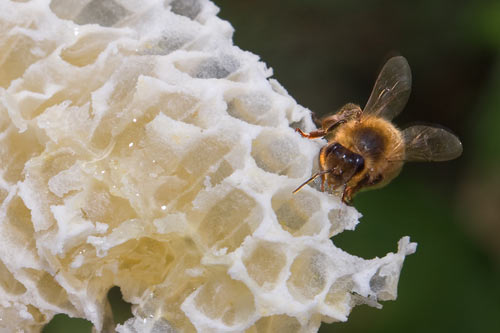
The honeybee in the photograph at the top of this article is sitting on a piece of comb that the beekeeper had scraped off a frame.

Bee Chains

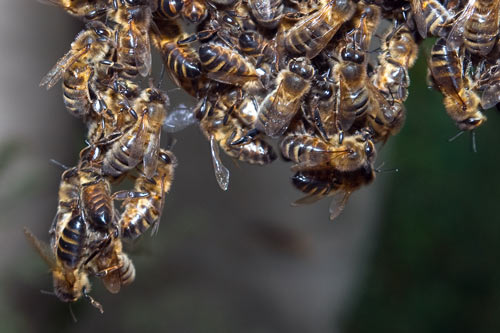
One other fact of honeybee behavior is that honeybees like the dark and when a beekeeper lifts out a frame to examine it, the bees tend to migrate to the darkest part on the frame – at the bottom. And they may hang on and form a bee chain like in this photograph.

bees-chaining

I actually missed the point when the chain was at its longest, which was about twice the length in this photograph.
 

Photographing Bees

I wanted to photograph honeybees for these articles and also for our ecards, but it is proving more difficult than I imagined.

The reason is that bees move constantly. They have four wings (with each pair on either side hooked together when the bee is at rest) and when they are out foraging for nectar and pollen, their wings are buzzing more or less constantly, and very fast.

And in the hive they are constantly fanning the honey to drive off moisture before they cap the cells with wax.

Fireworks and the Fourth of July

The Origins of Fireworks

If you get the opportunity to see some glorious fireworks this Fourth of July on this Independence Day in the USA, you are actually witnessing an invention that can be traced back to China many centuries ago.

Here’s how this particular ‘once upon a time’ story goes according to historians: A Chinese cook was working in a field kitchen one day when he happened to mix sulfur (which is flammable), charcoal (which is burnt wood), and saltpeter (which is a salt substitute).

These elements were all commonly found in kitchens at that time.

The Discovery of Gunpowder in Ancient China

As the story goes, the cook discovered that this mixture burned when it was ignited – and it was this way that gunpowder came into use.

Although historians differ about the exact date regarding this event, most people agree that the first recorded instance about this story regarding the Chinese field cook took place some time during China’s Song Dynasty (960-1279).

The Invention of Firecrackers in Far East Asia

The next stage towards fireworks occurred with the creation of firecrackers about a thousand years ago. At that time, historians claim that Taoist monks in Far East Asia who had scientific backgrounds were trying to discover a potion to grant eternal life and immortality.

Like the Chinese cook, they too discovered the flammable gunpowder mixture during their research.

Honoring the Monk Named Li Tian

However, it is claimed that a monk named Li Tian then poured this mixture into an enclosure, namely a bamboo tube. Next, he squeezed each end, attached a detonator cord – and in this ways, created a diminutive rocket that produced noise, smoke, and light. This became the first official firecracker.

So although those scientific monks might not have come up with a drink to access eternal life, Li Tian’s device with its loud and explosive sounds was pressed into service to ward off ghosts and evil spirits because it was commonly believed that such bad influences were frightened by the loud bangs of such an explosive device.

Using Firecrackers to Celebrate Life Events in China

Soon the Chinese were using firecrackers to celebrate weddings, births, birthdays, deaths, victories in battle, moon eclipses, and the New Year.

In modern times, firecrackers are used extensively for Chinese New Year celebrations. The Chinese New Year is the most important festival in China because it is at the time of the year when all family members gather together, similar to Christmas in the West.

In addtion, the Chinese celebrate the invention of the firecracker by offering sacrifices to the monk Li Tian every year on April 18th.

Marco Polo Brings Gunpowder Back to Europe

How did fireworks come into use in the West?

Although some historians claim that the Crusaders brought the black powder to Europe when they returned from their expeditions, in general it is Marco Polo who is recognized as the person who brought gunpowder to Europe during the 13th century.

Using Gunpowder for Military Purposes and Fireworks in Europe

Once in Europe, the black powder was used for military purposes (that is, in rockets, canons, and guns).

The Italians, Germans, and the English were all fascinated with using this same black powder to create fireworks.

Fireworks Lauded by Queen Eliabeth I, Shakespeare, and King James II

Fireworks also became very popular in England during the reign of Queen Elizabeth I.

In fact, Elizabeth I was so fascinated with fireworks and she enjoyed them so much that she created a position called the ‘Fire Master of England’.

William Shakespeare who lived during this period writes of fireworks in his plays.

Later in England’s history, a fireworks display was used to celebrate King James II’s coronation in 1685.

An Example of Fireworks in Present-Day England

Like the USA and other countries around the world, England still enjoys using fireworks, including to bring in the New Year.

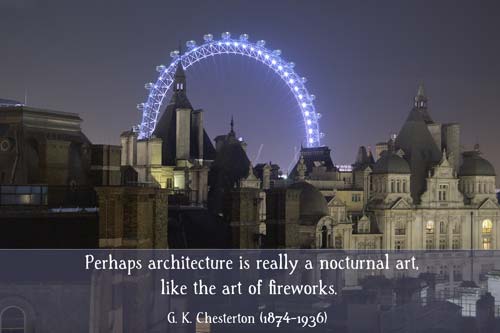
In the center of its capital of London following the chimes of the city’s famous ‘Big Ben’, fireworks for the New Year are currently fired from the London Eye.

Also known as the Millennium Wheel, the London Eye is the biggest Ferris wheel in Europe. You can see it here in one of our Quillcards ecards:
the-london-eye

Celebrating the Fourth of July

On this Fourth of July as on every July 4th since the country’s first anniversary in 1777, Americans commemorate the adoption of the Declaration of Independence on July 4, 1776, when the newly-formed country declared its independence from Great Britain.

In modern times, this national holiday is commonly associated with many public and private events celebrating the day along with parades, barbecues, carnivals, picnics, concerts, sports events, political speeches and ceremonies – and of course, with fireworks displays of all shapes and sizes throughout the country.

The American President John Adams Makes A Prediction

Even way back at the beginning of July 4th celebrations, fireworks to celebrate the day have figured in the American mindset.

In fact when independence was achieved in 1776, John Adams – one of its ‘Founding Fathers’ who had come to prominence in the early stages of the American Revolution and who had played a leading role in persuading Congress to adopt its Declaration of Independence and who would later who would later become the second President of the United States in 1797 – had this to say when wrote to his wife Abigail about how he envisaged that future generations of Americans would celebrate the day:

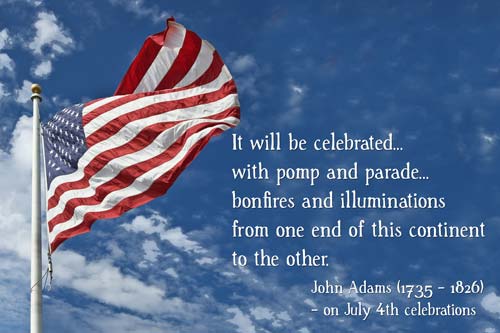
“I believe that it will be celebrated by succeeding generations as the great anniversary festival. It ought to be celebrated by pomp and parade, with shows, games, sports, guns, bells, bonfires, and illuminations [i.e. fireworks] from one end of this continent to the other,” he said.

Quillcards features an excerpt from this famous quotation in this ecard of ours:
john-adams-july-4th-quote

The Astonishing Coincidence of July 4, 1826

John Adams died on July 4, 1826. At that time, he was living on his farm in Quincy, Massachusetts. His beloved wife Abigail had died eight years earlier from typhoid fever.

Up to the time of his death, he had continued writing elaborate letters to Thomas Jefferson, a fellow Founding Father of the country whom he had first met at the 1775 Continental Congress in Philadelphia.

In fact, John Adams’ final words were about this close friend and colleague of his.

“Thomas Jefferson survives,” he said.

However, he was wrong: Thomas Jefferson had actually died on that very same July 4th at Monticello, his Virginia home, only a few hours before John Adams himself died.

That particular July 4th was also significant for another reason: It marked the fiftieth anniversary of the signing of the Declaration of Independence in which both John Adams and Thomas Jefferson had both been signatories for their respective states of Massachusetts and Virginia.

References

Who Invented Fireworks? by Venus Kelly
History of Fireworks featured in Fireworks University
History of July 4th Celebrations by David Johnson
About the White House – John Adams from The White House website
John Adams from The Jefferson Encyclopedia
Abigail Adams from Who2
The Declaration of Independence from ushistory.org
Wikipedia material on Elizabeth I, James II, John Adams, Thomas Jefferson, Independence Day, and the London Eye