Software For Sharp Close-Up Photography

If you are a photographer then, like me, you may have been put off attempting close-up photography because of the difficulty of getting sharp focus from the front to the back of the object you are photographing.

Sometimes it is desirable to have part of the object out of focus, but what do you do if you want to photograph a fly or a bee and have its head and its back legs all in focus?

Depth of Field
Depth of field as used in photography refers to how much from the front to the back of a scene is in acceptable focus. The scene further behind and nearer than what is in focus is, of course, out of focus and blurred.

We expect some things to be blurred and the way our brains are wired, we expect that blurring to show in a particular way. Because of the way we perceive reality we expect – for example – a tree in the foreground to be sharp and hills in the far distance to be out of focus.

In fact, if we saw a photograph with the tree in the foreground in focus and the hills in the distance also in focus, we would think the scene looked artificial. This is precisely because it breaks our internal rules about what should be in focus and what should not.

The nearer we get (or the camera gets) to an object, the smaller the depth of field. In other words the front-to-back distance of what is in focus, is very small. We see this when we hold a book open in front of us with the page at an oblique angle. Some of the print is in focus, but some that is only a few inches nearer or further away is not in focus.
front-in-focus

yellow-gerbera

One thing about the way our brains work though, is that with objects that are very near, we don’t have rigid views about what should or should not be in focus. Therefore, if we were to see a close up photograph of a flower that was all in focus, we wouldn’t think it looked artificial.

But the fact remains that the nearer we get to an object, the smaller the depth of field.

So what is a photographer to do if he or she wants to photograph something that is very near the camera – and wants to get everything in focus?

Small Apertures
One way is to set the aperture of the lens to the minimum possible. The aperture simply describes the hole in the lens through which light enters the camera. The size of the hole can be made bigger or smaller to suit the photograph that is being taken. Most modern lenses can be closed down to a very small hole.

But even at the smallest aperture the depth of field for objects that are very near the lens can be just a fraction of an inch. That isn’t enough to make everything from front to back of an object that is near to the lens appear sharp.

Also, for subjects that are very close to the lens, small apertures degrade the image because of the effect of diffraction. Diffraction causes the light around the edge of the hole in the lens to scatter and spill light all over the image, blurring it.

As a side note, we might wonder why lenses that can shut down to small apertures are made if they suffer from this diffraction problem? Well, for objects further from the camera the effect of diffraction is not so noticeable. Also, small apertures are useful for cutting down the amount of light that enters the camera – for example when a photographer is shooting a scene in bright daylight.

However, if depth of field is small and diffraction is a problem with objects close to the lens, we need another approach.

Focus Stacking
One way is to take several shots working from back to front, each time focusing on a different part of the object. Then combine each photograph to make one photograph with everything in focus.

It’s not as easy as it sounds because each time the camera is re-focused, the size of the object changes slightly. So what is needed is an automatic way of stacking the individual frames to produce one sharp image.

That’s where focus stacking software comes in. Feed several images in and the program creates a composite based on the sharpest plane of focus of each of the images.

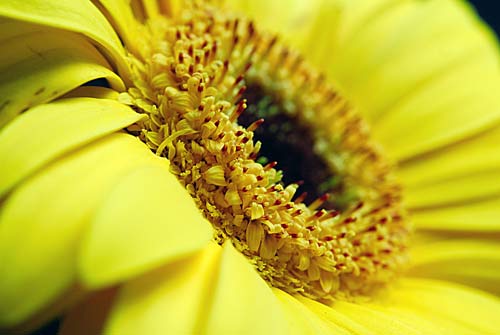
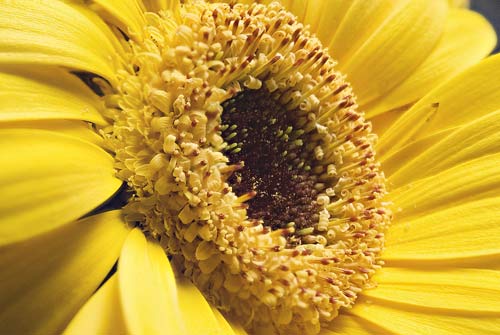
These two images of a yellow gerbera flower were both taken with a medium aperture. The first is just one photograph. The second photograph is a composite of several photographs, each focusing a slightly different distance into the image.

Focus Stacking Software
I’ve just started to use a program called ZereneStacker to produce this kind of photograph. I need to refine my technique because the program is unforgiving of small errors. But I am hooked on the idea because making close-up photographs is something I have been interested in for a long time, but until recently I didn’t know this kind of program existed. There are a couple of other similar programs I want to look into, and I’ll post the results here. If they work out well, we will add the photographs to the Quillcards ecard collection.

You can send distinctive ecards featuring our photographs by Joining Quillcards.
Giraffes At a Glance

giraffe

Fifty-Four Questions and Answers About Earth’s Tallest Quadrupeds

  1. Do giraffes ever feel blue? Well, they have no tear ducts – but people have seen them cry.
  2. Why can a giraffe stand in the hot sun all day when other animals must find shade? Because its dark patches act like radiators to take away heat: Each of these coverings on the body is surrounded by big blood vessels and criss-crossed by many more vessels, all working together to radiate the heat.
  3. How did ancient cultures regard them? We have this clue: The Egyptian hieroglyph for giraffe means ‘to prophesy’ or ‘to foretell’. Experts believe the animal was given this hieroglyph because of its acute eyesight.
  4. What have giraffes never been seen to do? These creatures have never been seen to bathe.
  5. How much does a giraffe sleep in a day? About half an hour – generally by taking five-minute giraffe naps (and you thought cats had all the fun!).
  6. Should a lion be scared of a giraffe? Yes: One kick from a giraffe’s leg can crush a lion’s skull.
  7. Who are the giraffe’s natural enemies? Lions (yes, actually they are scared of giraffes as one can imply from the previous answer, but they’re also dead set on survival); hyena, the leopard – and of course, humans.
  8. What harm have humans inflicted on giraffes? They have killed them for sport, science, or to make money (the latter by using their tails as flyswatters, good luck charms, and threads for sewing; poaching them for meat; or using their hides for various things).
  9. Are giraffes protected now from humans? Thankfully, it is now illegal to hunt giraffes in the wild. However, there are still some people who poach them illegally for meat and their hides.
  10. What is special and clever about the giraffe’s long and elegant legs? Their wonderfully functional design: Extremely solid and covered with very thick and strong skin, the firm bone of their legs supports their weight and its thick skin stops the blood vessels in their legs from expanding.
  11. Do giraffes faint easily? No, the thick skin on their legs prevents blood from collecting in their legs.
  12. So does that mean that giraffes don’t get swollen ankles? Well spotted – yes, it does mean that.
  13. What giraffe detail do astronauts copy in order to survive exploring space? By wearing Spandex spacesuits, cosmonauts similarly compress their legs like giraffes do. In this way, they avoid fainting in space.
  14. Are giraffes the tallest quadrupeds? Read the title of this article to find the answer. And what exactly is a quadruped? It’s an animal that has four feet, especially an ungulate animal (i.e., a hoofed animal).
  15. So how tall is tall? An adult male giraffe can reach eighteen feet (5.5 meters), while an adult female can get up to a very respectable 16 feet (4.9 meters).
  16. What was the record for a giraffe unfortunately shot by a hunter? A nineteen-foot-three-inch (5.9 meters) bull from Kenya.
  17. How much of a giraffe’s height is its neck? Approximately half of its height.
  18. How much on average do giraffes weigh? The average adult male weighs 2,630 pounds (1.2 tons), while the average adult female weighs 1,830 pounds (0.83 tons).
  19. What are some facts about a giraffe’s muscles? These animals have an elastic muscle that runs from the top of the head all the way down the back of their necks and then down their entire backs. The muscles act like a huge elastic band to keep the giraffe’s head up.
  20. What happens muscle-wise when a giraffe bends and raises its neck? When this creature bends its neck down, it compresses a muscle under its neck. This stretches the big elastic muscle. When it raises its neck, the big elastic muscle lifts its neck like an elastic band snapping back. Pretty neat, don’t you agree?
  21. What’s mating like for giraffes? A brief event with no obvious emotional attachment. And for the female of the pair? It’s also the beginning of a fifteen-month pregnancy.
  22. How tall is a newborn giraffe? Females bear a single calf, who is about 6 feet (1.8 meters) tall. Not bad for a new kid on the block!
  23. How do cows (female giraffes) give birth? Standing up. And the six-foot-tall baby that you just read about above is dropped on the ground and often up walking about within fifteen minutes.
  24. How does a baby giraffe recognize its mother? By her unique coat pattern, because every giraffe’s coat is like a fingerprint – no two are exactly alike.
  25. How many different general patterns can one see in giraffes? There are at least nine different patterns with varying colors that exist in giraffes. These patterns range from the traditional brown and blond splotches to a rich, reddish brown scored with fine, white lines.
  26. Are giraffes prejudiced? Hurrah for these glorious creatures: They do not discriminate based on the color of the skin of other giraffes whom they encounter, and they mate without hesitation with members who look different than they do.
  27. Anything else to recommend them? Yes, they have no territorial inclinations and they are not aggressive. Maybe we should recommend that they have representation at the United Nations, what do you think?
  28. How are giraffes in the babysitting department? Good news – childcare is often cooperative, in nurseries that groups of cows go about forming.
  29. By what age of its life does a giraffe mature? By the time it is four.
  30. How long can a giraffe live? Figures vary, from 25 years in the wild to almost 30 in captivity.
  31. What’s their gait like? Quite strange: When giraffes amble along at a slow pace, they move both right legs at once, then both of the left legs. This creates their unique rocking motion. When they gallop (up to 35 mph), it looks like all four legs appear to leave the ground at the same time.
  32. What’s the same about a human neck and a giraffe’s? Each contains the same number of vertebrae. And how many vertebrae might that be? Figured you’d ask that – seven.
  33. What’s the secret weapon that the giraffe has in its neck? A special joint that enables it to raise its head vertically and even a bit farther back if it wishes.
  34. What’s so great about having that special joint? You get to munch away on leaves that are out of the way – and that’s pretty terrific, don’t you think?
  35. How does a giraffe’s neck work when the animal bends down? It has valves in the veins of its neck to stop the blood rushing down into their brains.
  36. How does a giraffe’s neck work when it raises its neck? A collection of small veins under its brain stops blood rushing away from it – without that, a giraffe would get dizzy whenever it raised its neck.
  37. How would you qualify a giraffe’s blood pressure? As the highest known in a mammal: up to 280/180 mm Hg (millimeters of mercury) at heart level when lying flat, which is more than twice the blood pressure that we humans have.
  38. How long is a giraffe’s tail? Three feet (0.9 meters), just like a yardstick. Handy, yes?
  39. What makes giraffes unique in the animal kingdom? They are the only creatures born with horns, in the form of bony knobs on their foreheads.
  40. How does a giraffe give birth with horns protruding on its calf? The horns are not fused to the baby’s skull at birth, so the baby can slide out easily. Only afterwards do the horns fuse to the skull.
  41. What’s the size of each of the giraffe’s cloven hooves? About the size of a dinner plate – which gives one food for thought (bad pun, I agree).
  42. What does it mean that a giraffe is a ruminant? It indicates that it chews its cud.
  43. The leaves and shoots of which trees are the giraffe’s favorite? A variety of acacia and bushwillow trees. Actually, it may eat leaves from more than a hundred species, depending on what is seasonally available.
  44. What else besides leaves do giraffes have a yen for? Flowers, vines, and herbs. They have also been seen eating weaver-bird nests (with the young inside). They may chew on bones for additional minerals.
  45. What happens when a giraffe eats something with thorns? No problem: It can process such food because of its long, prehensile, muscular tongue; the thick saliva with a gluey consistency that it produces; and the special shape of its upper palate.
  46. How long is that tongue just mentioned? It can be extended up to 18 inches.
  47. How much of the day is taken up with eating for a giraffe? An average of 16-20 hours per day.
  48. Now tell me, how much food does that add up to in one day? Up to 140 pounds (63 kilos).
  49. How does the giraffe’s stomach react to that much food? It has four chambers, and the giraffe is a ruminant, which means it regurgitates its food and chews it again. This is quite like the way a dairy cow deals with food.
  50. What’s the special relationship between some acacia seeds and giraffes? Some acacia seeds only germinate after passing through a giraffe’s digestive track. Isn’t nature astounding?
  51. Compared to other animals, what is the mental prowess of these beautiful animals? People who work with them a lot disagree about this, but one expert noted that “the index of its cerebrum is 29.5 compared with 20 in wild cattle and 14 in pigs.”
  52. Are giraffes talkers? If you mean do they vocalize – yes, they do. Although they are generally quiet, they do emit hisses, snores, moans, coughs, moos, snorts, grunts, low notes, fluttering sounds that are low or flute-like sounds or whistles, and bleats (similar to those made by a calf or lamb).
  53. How did its scientific name of ‘giraffa camelopardalis’ come about? The species name of the giraffe emanates from its early Roman name where it was described as having characteristics of both the camel and the leopard (and perhaps that it was a hybrid of those two animals).
  54. Last but not least, where does the word “giraffe” come from? From the Arabic word ‘zirafah’ – which means “tallest of all”.

Bonus question:

Have you, the writer of this article, ever met a giraffe?

Yes – although we weren’t formally introduced or anything, and it was only a momentary encounter.

However, I did come face to face with the beautiful creature in question. And seriously speaking, it was an enchanting experience.

To read more about Jane the giraffe and other giraffes, check out our article Giraffes: Encounters With Nature’s Skyscrapers.

References:
Book:
‘Tall Blondes: A Book About Giraffes’ by Lynn Sherr. Published by Andrews McMeel, 1997.

TV Program:
‘Inside Nature’s Giants’, segment on giraffes. Aired in 2009 on Channel 4 in the United Kingdom.

Websites:
The Giraffe Information Society
Arkive
Wikipedia
Flickr
America Zoo
Lalibela Game Reserve

Giraffes: Encounters With Nature’s Skyscrapers

Napping Porcupines, Etc.

What caught our attention first as we entered the house that summer were the large porcupines who were snoozing, their quills at rest cascading down their necks like mohawk haircuts. Across the aisle from them, petite dama gazelles gently chewed hay beneath their feet in another pen.

As we walked further on, however, what I saw in the back inside the wooden structure was almost impossible for me to comprehend at the time.

A Most Peculiar House

That’s because we were in a most unusual house – namely, the giraffe house at Marwell Zoo in Hampshire, England.

And what was looming before my eyes only feet away from me was a large group of those splendid, graceful animals. They were strolling peacefully about their paddock having just come from the outside into the house.

Some of them started grazing from ceiling-high hay racks, and I noticed a ‘youngster’ nursing hungrily in the corner, the two little horns on his head looking for all the world like twin chef hats.

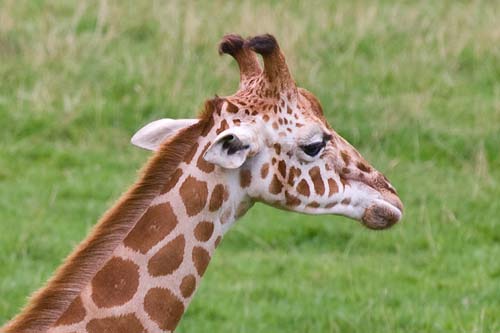
In fact, the baby that I saw that day resembled this other young giraffe whose photograph David took at Longleat Safar Park, another wildlife center located in Wiltshire, England.

As you can see, this juvenile has his own pair of twin chef hats too!

young-giraffe

Sentient Skyscrapers

As I took in more detail about the herd of giraffes so close to where I stood, I was mesmerized: There at arm’s length was a group of animate, breathing skyscrapers.

I tried to make human sense of their height, particularly as they were inside a structure with heads that nearly reached the very high ceilings.

The Art of Loping

Then by chance I noticed a teenage boy near me who was balancing on the ledge next to the paddock. He was reaching out to the animals, trying to pet them. I decided to follow his lead and so I joined him on the ledge.

Like him, I stretched on tiptoe and tried to get the animals’ attention. Soon one giraffe loped past me. Then another swung near me – close, but no cigar. A third drew near – but then it changed its mind, turned around, and bound with its long, graceful stride towards a towering feeder instead.

Jane

In a few moments, however, one of them came over to me. It bent its head way down on its immensely long neck, regarding me quietly with its expressive, dewy soft eyes right in my face.

I leaned forward cautiously to pet its velvety muzzle. Our eyes still united, it calmly accepted the gesture. Then it gently rolled out its very long, prehensile tongue, licked my hand, raised its head – and off it went to join its mates.

I stepped off the ledge, and noticed that David was talking with a couple near by. As he continued chatting, the woman came over to me.

“I noticed that you were petting Jane. We come here a lot, and that’s her name. She’s lovely, isn’t she? She’s our favorite… Don’t you think this giraffe house is wonderful?” she said.

I nodded silently in agreement, still trying to mentally process what I had just experienced.

A Distant Relative

Since our visit to that giraffe house four years ago when we first experienced such close contact with those beautiful animals, spotting giraffes in other wildlife centers has been a special delight for David and me.

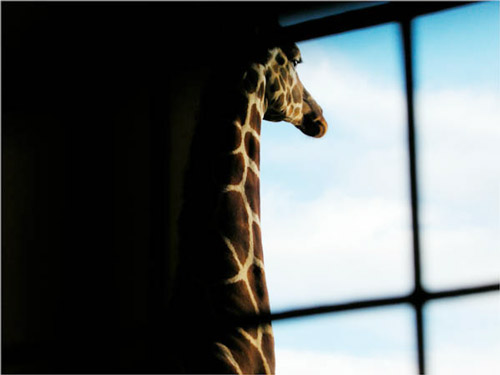
So at another zoo not too long after I met Jane, David took a photograph of a thoughtful giraffe gazing out of a window. I subsequently paired a quotation with the shot, and together we created this image for one of our ecards:

giraffe looking out

Royal Connections

Some time after we took that photograph, I thought about Jane and my experience of meeting her. So I decided to find out more about her from Marwell Zoo, and I was told at the time that she was doing well.

Then the zoo employee asked me if I knew that Jane had a regal connection, namely that she was named after Jane Seymour, Henry VIII’s third wife.

In fact, as I also learned, Jane Seymour’s brother Sir Henry Seymour owned Marwell Hall in the 16th century – which explains why that beautiful building is housed on the grounds of Marwell Zoo, where it is still in use today for various venues.

As far as King Henry VIII goes, it is also very probable that he visited Marwell. It is also thought that he may well have had a private wedding ceremony at Owslebury Church nearby, or at Marwell Hall itself.

Jane’s Fate

In anticipation of writing this piece, I contacted Marwell Zoo once again earlier this month to see how Jane was doing.

I found out, very sadly enough, that Jane died during labor last year.

“There were problems during the birth, and the calf died. Jane ended up being paralyzed in her back legs, and she had to be euthanized. She was 6 1/2 years old when she died,” Britt Jensen, a keeper at Marwell Zoo’s West Section said.

What’s In A Name

Fortunately, however, Marwell has a wonderful giraffe program and life continues there through the seven giraffes who make it their home now.

In addition, like Jane before them – most of the giraffes are named with great care after British or African royalty or some other cultural aspect.

I learned this through Bill Hall, an animal liaison officer who has worked at the zoo since 1976.

As he and a Marwell receptionist named Karen Small further detailed to me with great cheer and good humor, here’s the current line-up:

Kismet, age 11 (named in Germany which was his home before Marwell, he is the sole adult male of the herd);

Matilda, age 12 (named after Empress Matilda, who was the oldest surviving child of King Henry I);

Isabella, age 7 (named after Princess Isabella, who was King Henry III’s sister);

Makeda, age 4 (named after the Ethiopian name for the Queen of Sheba);

Kwane (just born Saturday, June 6, 2009, also the day commemorating D-Day that occurred during WWII, this newborn’s name means literally ‘born on Saturday’ in Twi, the language spoken in Ghana, West Africa);

Christa, 14 months or so (named after her father Christopher who died in February 2008 and whose last baby she was);

Tiye, age 13 months or so (named after the mother of the Pharoah Tutankhamun, Tiye’s mother was Mary and her sister was none other than Jane).

Bachelor Quarters

The reason for the very low number of giraffes at Marwell Zoo at the present time is that the zoo recently moved three young males to Folly Farm in Wales where they joined a bachelor group, Britt Jensen also explained to me.

Herd Mentality

Kismet is currently the only male on the lot, so to speak. Within the confines of Marwell (that is, not in the wild), the herd functions best with only one dominant male.

So down the road when the newborn Kwane reaches about two-and-a-half years old and his “voice breaks,” as Bill Hall put it, he [Kwane] will have to leave Marwell at that time.

Genus ‘Giraffa’

Aside from the wonderfully quirky names that unite these giraffes at Marwell, all of them are also members of the genus ‘giraffa’.

As such, naturally they share certain aspects with one another.

To learn more features and facts about these tallest quadrupds, see our article Giraffes At A Glance.

References

Websites:
Marwell Zoo
Wikipedia
AboutMyArea (Portsmouth area)
Guide to Castles of Europe

Sources:
Courtesy of Marwell Zoo –
Bill Hall, Animal Liaison Officer
Britt Jensen, Keeper, West Section
Karen Small, Receptionist