The Moors Above Haworth

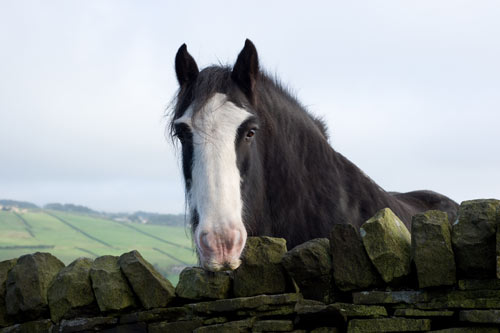
horse - Quillcards ecard

The Pennine mountain chain runs like a spine down the length of the north of England, separating Lancashire in the west from Yorkshire in the east. The village of Haworth lies on the edge of the Pennine Moors in West Yorkshire.

The main street is steep, cobbled, and lined on both sides with tall, stone-built terraced houses. They are built of millstone grit, a dark sandstone that has been made darker by the soot from open fires.

Burning coal in open fires was prohibited with the introduction of clean-air legislation forty years ago, but the soot hangs on, chemically bound into the stone of the buildings.

The dark stone gives the street a slightly forbidding air, and the steepness of the street makes the houses seem in danger of tumbling down the hill onto the new road that bypasses the center of the village.

The parsonage is at the top of the hill next to the graveyard. It has become, of course, world famous for its connection with the Bronte sisters, who lived in the Parsonage.

It is at the Parsonage that Emily Bronte wrote Wuthering Heights and Charlotte Bronte wrote Jane Eyre.

Again there is the dark sandstone, and with the tall trees that are scattered throughout the graveyard, it is not difficult to imagine the settings for the books that the Bronte sisters wrote.

Above the village the road divides, with one road cutting uphill and over the moors.

It was the first day I had taken my new camera out specifically to go shooting with it, rather than just having it along. One one side of the road was the moor and on the other side was a field overlooking the village. In the field was the horse shown above, who was very friendly.

I shot this at ISO 1000 and the lack of noise (digital grain) is amazing. Previously I would have been mentally trying to balance the competing demands of a fast shutter speed, low noise, and good color. horse-eyeIt may not seem much of a mental struggle, but it distracts from thinking about the shot itself. With this camera, high ISO shots are more or less free of noise, and the color is held very well. ISO 1000 is three and a half stops over the base ISO, and that way I could use a fast shutter speed. I shot it at 1/1250 second with an aperture of f6.3.
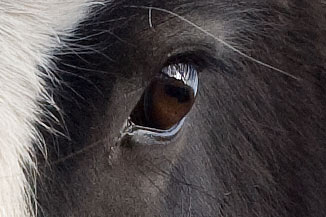
If you are not technically-minded when it comes to cameras, just know that for the moment at least, this is all one could hope for in camera performance.

When I have time, I want to do some testing and see how far one can push this camera before noise starts to be intrusive.

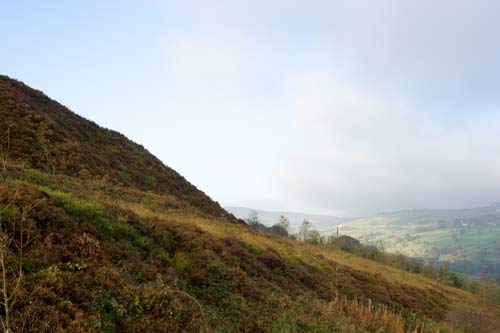
The View over the Moor above Haworth of the Bronte Sisters

On the other side of the road, the moor looks down over distant fields, and in this photograph you can see the early morning sun breaking over the hillside.
Moors above Haworth
Moors above Haworth - Quillcards Ecard

Quillcards Ecards

We will be adding more images to our range of distinctive ecards at Quillcards in the next week or two. The horse and this photo of the moor are just two of the many we shall be adding.

We’re changing the look of ecard communications.
Take A Look At Our Ecards – Featuring Photographs Like These.
Nikon D700: RAW and JPEG Files Compared

JPEG is an image file format recognized internationally by cellphones, computers, and other devices.

RAW is an image file format that is sometimes called a digital negative because it is relatively unprocessed. It is proprietary to each camera manufacturer and in contrast to JPEGs, RAW files are not recognized by cellphones, computers etc.

All digital cameras produce RAW files, but many digital cameras – particularly small point-and-shoot cameras – do not allow the user to download the RAW files from the camera.

Instead, the camera processes the RAW files into JPEGs internally, and only the JPEGs can be downloaded or extracted from the camera.

JPEGs can be produced from a number of file formats, not just RAW files. Whichever file format they start with, in the process of saving the files as JPEGs they discard pixels that are identical to others.

The software makes a note of where the discarded pixels are and rebuilds the file when it is re-opened.

JPEGs can be saved with finer or coarser compression. The coarser the compression, the less discrimination the file uses when it discards pixels, and the smaller the size of the compressed file.

Most if not all digital single lens reflex cameras (dSLRs) however, do offer the option to download the digital negative from the camera. A number of compact cameras also allow the user to download the RAW files.

The RAW files can then be processed using an external RAW conversion program.

There are several such programs on the market, including some free ones. Nikon and Canon for example, make programs for use with their own proprietary RAW files.

Photoshop™ is a RAW conversion software program. Photoshop does other thing as well, of course, but at its heart it is a RAW conversion program. It can convert the RAW images to a number of formats, including Photoshop documents (PSDs) and JPEGs.

Why do photographers bother with RAW files when they can get the jpegs straight out of the camera?

The reason is that the color palette of RAW files is finer that that of JPEGs. That is, it has finer gradations or transitions of tone and color. This gives photographers more leeway to make changes to the image.

The JPEG algorithm cannot discriminate such fine gradations of color, so in the process of compressing and saving the files, it discards some pixels that are subtly different from the ones it keeps.

Altering JPEGs can lead to posterization, which is what happens when the color loses its smooth tonal transitions and breaks up into bands of color. It does this because the intermediate colors are lost in the process of altering the image.

Why would photographers want to alter images? Well there are many reasons, but one common one is so they can adjust the exposure after the event.

That is sometimes necessary or desirable because the photographer or the camera doesn’t always get the exposure right.

Adjusting exposure to brighten up the RAW file in Photoshop or some other imaging editor is likely to produce a better final image than trying to do the same thing to a JPEG.

On the other hand, if the photographer can get the exposure right in the camera, he or she can let the camera convert the RAW file with its own internal RAW processor, and have a JPEG ready to use.

I almost always shoot RAW because I like to be able to correct my mistakes work with the original digital negatives.

This past weekend however, I used a new camera, a Nikon D700, for the first time. One of the options the camera offers is to shoot a RAW image and a fine quality JPEG simultaneously.

And that gave me the opportunity to see whether there was any difference between a JPEG straight out of the camera and a JPEG from a converted RAW file.

I didn’t alter or sharpen either image, so there was no question of the JPEG being degraded by processing.

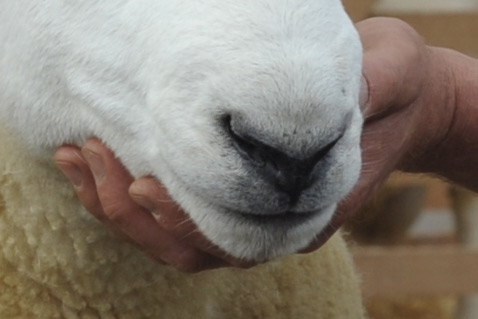
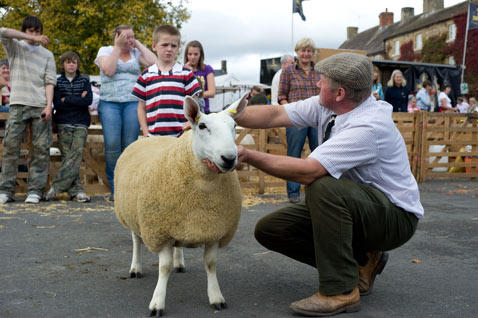
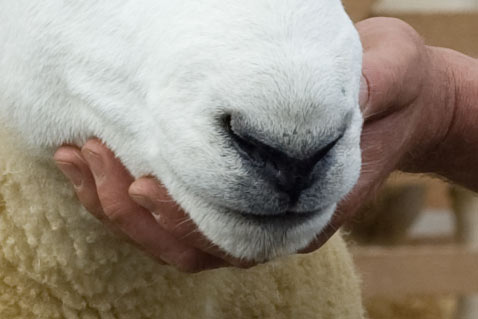
Here is the full frame of the converted RAW file. And below it are two crops from the full frame. The first is a crop from a converted RAW file and the second is a crop of a JPEG straight from the camera.

Can you see a difference in the quality? Is one sharper than the other? Is the color of one better than the other?

What do you think?

Cheviot Sheep

Jpeg from RAW file

Jpeg from camera

The full-frame image is one of a series from the Masham Sheep Fair 2009 article.

The Masham Sheep Fair 2009 in England

From the Middle Ages to the Present
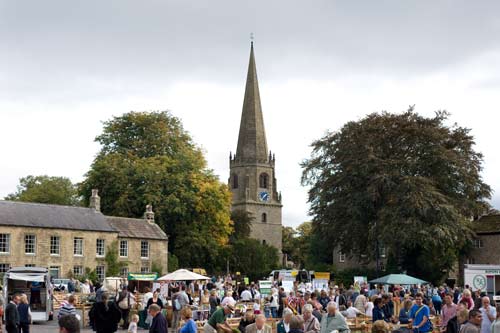
Set in the hills of England’s picturesque Yorkshire Dales in lower Wensleydale, the history of the sheep fair in the historic market town of Masham goes way back to the Middle Ages.

Cheviot sheep at Masham Sheep Fair

Wool As England’s Chief Commodity
Sheep fairs are natural in England since wool was the foundation of the wealth of the nation beginning with Norman Conquest in 1066. By the end of the twelfth century, England’s most important industry was the production of wool.

Although of course the nation’s industries and focuses have greatly changed since then, sheep farming still maintains an active presence with 34 million sheep in the UK.

Sheep On Show
At the Masham Sheep Fair this past weekend, there were many people in the village square that was chockablock with wooden pens full of different sheep breeds, many of the breeds bearing the names of regions throughout England.

The village of Masham in North Yorkshire

Different Breeds for Different Folk
There were Swalesdale, Dalesbred, Blue-Faced Leicester, Herdwick, Teeswater, Wensleydale, Jacob, Texel, Suffolk, Oxford Down, Hampshire Down, North Country Cheviots, Beltex, Bleu Du Maine, Charollais, Dorset Horn, Poll Dorset, Ryeland, Shetland, and Manx Loaghton.

The range of facial, head, and fleece characteristics and color was fascinating and wonderful to observe.

Ribbons and Such
Contests were held, ribbons awarded, and farmers and their families were there to exhibit and sell their wide array of sheep. In all, forty-five trophies were awarded over the two days of the fair.

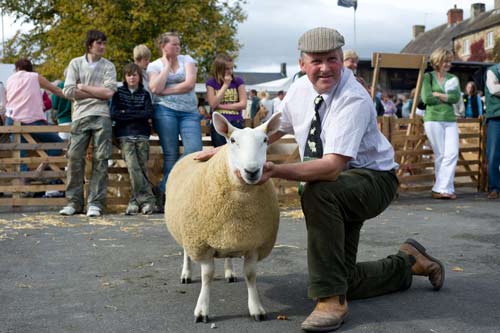
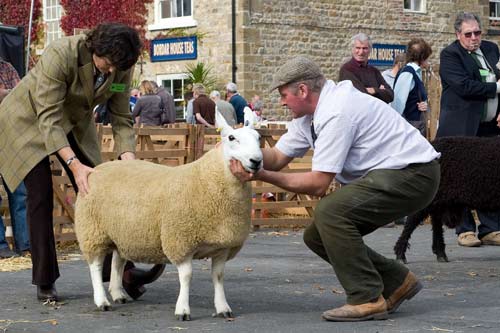
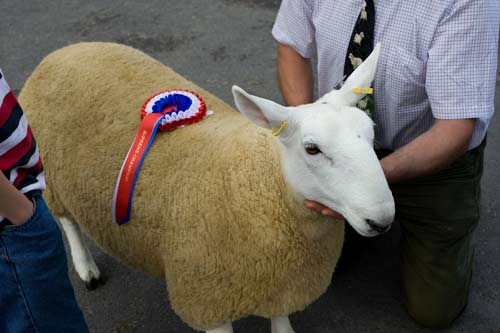
At one contest, the winner was this glorious Cheviot pictured here during the judging:

Judging at Masham Sheep Fair

A Well-Behaved Champion
A large circle of people stood and admired this sheep. We were particularly amazed at how still she stood for a considerable time. Held by the farmer but not on a leash as some other sheep were, she occasionally baahed but otherwise she was completely motionless.

I spoke with the farmer after the competition and found out this sheep is 18 months old and she hasn’t got a name yet but she will be ‘christened’ shortly, as he put it.

A Life for Lambing
This prize sheep is not fated for slaughter as so many of her kind normally are. Rather, her owner hopes she will live out her life having as many lambs as possible. He also proudly pointed out what he called her feminine curves, and how fine her two-inch thick fleece is.

And so she will be going to ‘ramming’ in a few weeks when she will be mated with a suitable ram.

Supreme Champion at Masham Sheep Fair

More Beauties From the Fair

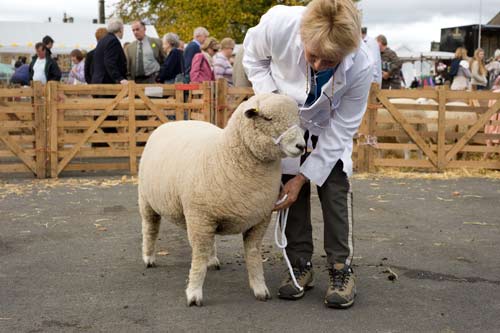
Ryeland Sheep Champion

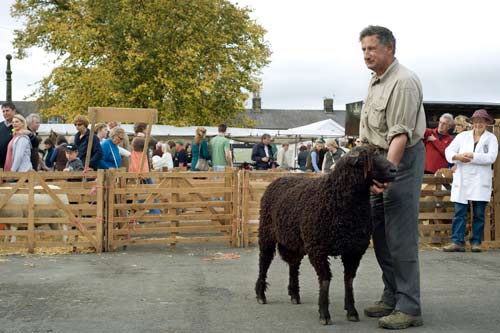
Black Wensleydale
Black Wensleydale

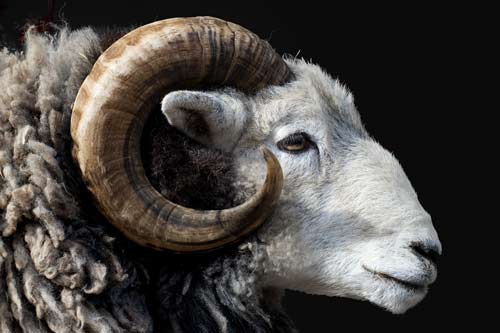
Herdwick Sheep
Herdwick Sheep

You can read more about the Herdwick breed and the part that Beatrix Potter played in ensuring their survival, in this article of ours about Beatrix Potter and Herdwick Sheep.

References
The Cistercian Monks and Sheep Farming by Professor Esmond Wright
Masham Sheep Fair Programme of Events

If you enjoyed this article, please consider leaving a comment. You might also want to send a distinctive Quillcards ecard – just follow the link.