This photograph of ours has been featured in the 2010 issue of the Yorkshire Dales National Park Visitor Guide, which is published by the Yorkshire Dales National Park Authority. The publication is distributed throughout the region and is available at tourist information offices and local libraries, as well as at the National Park centers.
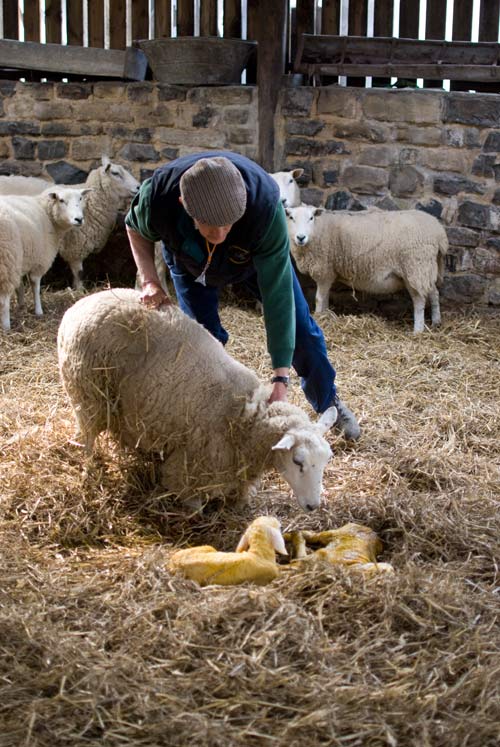
The photograph shows David Wellock at Hurries Farm in the Yorkshire Dales National Park helping one of his ewes to bond with its newborn lambs. David and Wendy Hoare run the farm where they raise Aberdeen Angus cattle as well as rearing sheep.
We saw the lambs being born only a few minutes before we took this photograph, and in fact we spent an hour or more there, taking a whole series of photographs showing the whole gentle business of birth from beginning to end.
The sheep in the background of the photograph are all expectant mothers, so the hormones in the barn are quite heady. Therefore, the farmer encourages the mother sheep to get close to her offspring so that she gets the correct smell. Then she will bond with them properly.
The ewes were all sired on the same day so the farmer knows that if he brings them all into the barn, he can watch over them all as they give birth over a very short period of a day or two.
It’s a tough and tense few days for the farmer.
The Guide In Print And Online
The National Park Visitor Guide gives details of the events taking place in the Yorkshire Dales National Park, events that include walks, talks, and courses, as well as farm visits.
As well as the print version, there is also an online version – so if you want to catch up on what there is to see and do, click the link for the details: Yorkshire Dales National Park Guide 2010.
You can read more about our visit to Hurries Farm in this article, and I suggest you take a look to get a more complete picture of life at Hurries Farm.
Check out the ecards featuring our photographs here at Quillcards.
A couple of days ago a few inches of snow finally reached us here in Leeds, east of the Penines in the north of England.
It was very misty when I finally went out and I couldn’t help but think of those oft-repeated words to photographers – It’s all about the light.
Well, there wasn’t much light around that afternoon.
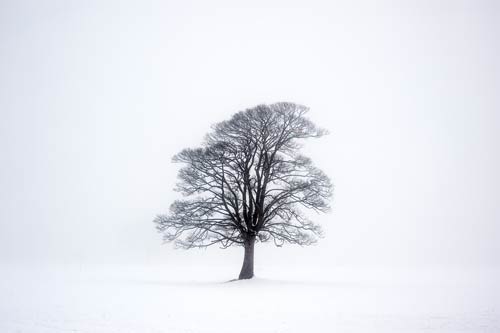
This tree is in Soldiers Field in Leeds, a local landmark where local football teams play on a Sunday, and the goalposts were all that could be seen looming out of the mist.
Save for this lone tree.
There are trees along the boundary of the field, but the field itself is an expanse of close-cropped grass save for a very few trees. On this day this lone tree was king or queen of all it surveyed.
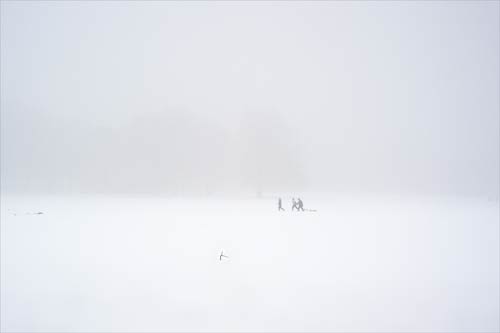
Meanwhile, off in the distance, these boys were dragging their sled across the field.
Technical
For this shot of the boys with the sled, I set the exposure compensation to +1.33 to compensate for the black cat at night problem that all cameras face – that is, knowing what they are pointed at.
The question the camera cannot answer is whether the subject is mid-grey or black or white or a mixture of light and dark tones. It’s a question I looked at in this article on digital cameras, though the question applies to film cameras also.
In brief though, the problem is that if a subject is all white and the camera doesn’t know it (which it doesn’t) then it will expose it as though it is a standard scene, which is mid-grey. So to compensate for that and make the subject brighter and whiter, the thing to do is to over expose the shot.
This is done by dialing in a positive amount of exposure compensation – in this case +1.33. Even that wasn’t enough and if I were to shoot in similar circumstances with the Nikon D700 again, I would probably try an exposure compensation of one stop more – say + 2.33.
Luckily, this was shot in RAW, so I could increase the exposure in Adobe Photoshop after the event.
New! Now you can buy a large art print of this image from Quillcards.
1. Question :
What is recorded as the most snow that has even fallen in a single snowstorm? Answer:
From February 13 to February 19 in 1959, one continuous snowstorm at Mt. Shasta Ski Bowl in California produced 15.75 feet (4.8 meters) of snow.
2. Question:
What are snowflakes and how are they formed? Answer:
Snowflakes are actually a special form of water ice. Clouds are made up of water vapor, and it is in this water vapor that snowflakes are formed.
When the temperature drops to 32°F (0° C) or colder, water changes from its liquid form into ice. Beyond that, several components affect the formation of the snowflakes. Temperature, air currents, and humidity all have an impact on the shapes and sizes of snowflakes.
In addition, particles of dirt and dust can get mixed up in the water vapor. Such particles make the snowflake heavier. They can also cause cracks and breaks in the crystal, thereby making it easier to melt.
On the individual level, each snowflake actually contains from two to 200 separate snow crystals.
3. Question:
How many different shapes can snowflakes be? Answer:
According to physicist Kenneth Libbrecht, author of Ken Libbrecht’s Field Guide to Snowflakes, there are 35 different types of snowflakes!
Furthermore, it is extremely unlikely that two snowflakes with complex shapes will ever look alike.
4. Question:
Does it always have to be at the point of freezing or below freezing to snow? Answer:
No, that’s a common misconception. That’s why even during the warmer months of March or April when the ground temperature is above freezing, there can be a layer of extremely cold air at several thousand feet. As the atmosphere warms, this layer can become unstable – and snow can result.
5. Question:
What happens to snowflakes falling in such a situation? Answer:
The snowflakes don’t have time to melt as they fall through the warmer air, and instead they become very large snowflakes that can be about 3 inches (7cm) in diameter.
6. Question:
How large was the biggest recorded snowflake that fell? Answer:
In a freak occurrence, snowflakes fell in Montana in the USA on January 28, 1887 that reportedly measured 15 inches (38cm) in diameter and 8 inches (20cm) in thickness.
A man named Matt Coleman who saw these snowflakes descend to Earth characterized them as being “larger than milkpans.”
7. Question:
Speaking of snow records, what is the largest piece of ice recorded to have fallen to Earth? Answer:
An ice block measuring 20 feet (6 meters) in length fell in Scotland on August 13, 1849.
8. Question:
What about hailstones? Have there ever been any fatalities connected with them? Answer:
Yes. There are a number of records involving fatalities connected with hailstones.
For example, on April 14, 1986, a tremendous hailstorm in Bangladesh with hailstones 4 inches (10cm) across reportedly killed 92 people. Some of the stones weighed 2.25 pounds (1 kg).
9. Question:
What was the greatest recorded amount of snow that ever fell in one winter in the USA? Answer:
95 feet (29 metres), which was the amount of snow that fell at Mt. Baker in Washington State during the winter of 1998-1999. That measurement is almost the height of New York’s Statue of Liberty.
10. Question:
What prompted the composer Jules Styne and the lyricist Sammy Cahn to create the classic Christmas song, ‘Let it Snow! Let it Snow! Let it Snow!’? Answer:
Well, it definitely wasn’t the weather since it was written in July 1945 when Hollywood was sweltering from one of its hottest days on record.
However, because of its seasonal references to snow and as one of the best-selling songs ever since it first became a popular hit sung by Vaughn Monroe in October 1945, it is generally considered a Christmas song.
Yet despite its upbeat, festive feel, it was intended as a love song and it never mentions Christmas.