Binoculars, Magnifying Glass, And A Piece Of Rope

Dancer In Udaipur - A Quillcards Ecard

It Is Getting Harder To Travel Light
There was a time when I would have been happy to leave my camera at home and let my senses do the recording. Now a camera, lenses, and a laptop are all fighting for space in my pack.

For all that, the guiding principle I have always followed – it is probably in my nature – is to travel light.

Llama Carrying Only Straw

Travel Light
I remember being proud of how little my pack weighed as it went on the scale at the airport check-in at the start of my year-long trip to South America.

Just eight-and-three-quarter kilos (nineteen-and-one-quarter-pounds) – and that included a down jacket and a sleeping bag.

Boots
However, it didn’t include a spare pair of boots and I was sorry about that when I left my only pair to dry by an open fire one evening in the wilds of northern Colombia.

I recovered the boots just in time to heat-weld the sole back on to the uppers by the dying embers of the fire.

That mistake was compounded by the fact that I was on a continent where shoe sizes stopped one size below my nine-and-one-half English shoe size.

It was quite some time before I found a store in Quito in Ecuador that sold my size…

However, I still hold that low weight is one of the most important things one can take on one’s travels.

It makes everything so much easier – from putting your pack in an overhead rack on a bus rather than on the roof, to changing plans, scooping up clothing, and getting on the road quickly.

How Many Bags
I also believe in ‘one bag’. Not two bags or three – not even little ones – unless the little ones can fit in my main pack.

One bag means just one bag to look after.

Gear - From The Rarely Used To The Often Used

But How Many Time Have I Used That
I have some great pieces of gear that I don’t ever recall using more than a couple of times, such as the fold-flat can opener you can see in the photograph and which I always take with me.

Great idea and weighs next to nothing. Which is probably why I have such a hard time leaving it behind.

So what items have proved their worth time and time again?

Three Great Pieces Of Gear
From all the things I have taken on my travels, I would say the best of all are mini binoculars, a magnifying glass, and a length of rope.

Binoculars
Seeing just about anything through binoculars – from animals and birds to just plain and simple crowds of people – makes carrying the weight of them definitely worth it.

And what you are looking at doesn’t have to be far away. Something that you may not have thought of is that looking though binoculars at an exotic bird that is just 20 feet away can turn a great experience into a phenomenal one.

Magnifying Glass
Picture a lazy afternoon somewhere on your travels. You spy a piece of crystalline stone on the ground or a recently expired insect on the window sill. That is where a magnifying glass comes into its own and a whole new world opens up.

I have a soft spot for this particular magnifying glass – the one in the photograph above. It is Russian, and I bought it in a street market in Tallin in Estonia shortly after the break-up of the Soviet Union.

That was the time when everything from military-grade night vision binoculars to periscopes were on sale in markets across Eastern Europe.

Rope
A piece of rope two or three millimetre thick and long enough to tie down a pack or hang up a pair of jeans. That is something that always goes in my pack.

As you can see, I have bought several lengths over the years…

The last time this item of gear earned its place in my pack was when my wife Tamara and I were cramped into a sardine can of a bunk on an overnight bus journey from Bundi in Rajasthan to Delhi.

Our packs were at the end of the bunk and I tied them against a stanchion to keep them off our legs. That turned our sardine can into a somewhat more cosy sardine can.

Of course, a piece of rope is useful for tying your pack onto all kinds of modes of transport…

Tie Your Pack Down

Always Carry A Compass
I can’t leave the subject of gear without mentioning that I always carry a compass on my travels now.

However, I didn’t some years ago when I wandered into a forest in southern Mexico and then lost my bearings.

That was when in my mind’s eye I recalled the map of the area that I had pored over before I left home, and realised that the forest was the size of Wales.

For one awful moment I imagined the worst – that I might never find my way out.

A Forested Hill
After trying to get my bearings from the sunlight peeking through the trees, I climbed a forested hill and found that I was standing on the rim of an extinct volcano. Far down below an Indian boy was fishing, or at least he was until he saw me.

With a shout of ‘gringo’ to someone behind him, he disappeared into the trees.

For a while I stood staring down at the perfectly circular lake below me, and at the beautiful blue of the water, wondering how I was going to find my way back to civilisation.

Meanwhile a part of me was wondering how the fish got into the lake in the first place.

The Path Less Traveled
Eventually I made contact with some field workers walking across a scrubby area and they guided me to a path that ran past a terribly poor Indian village and from there it was just a long walk back to the road-head.

A compass would have saved me from all of this time spent wandering around the forest, but then I may not have seen the tiny striped piglets scurrying about that I saw in that Indian village.

Which is not to say that I would ditch the compass and trust to luck in a similar situation in the future. Travel may be a balance between risk, adventure, and safety, but a compass is a small item that packs a big punch when it is needed, so it always goes in my pack.

And You?
What items do you consider to be essential? What are you favorite pieces of gear? I’d love to hear.

Have You Seen The Snowdrops

Snowdrops
Snowdrops

These snowdrops came out a few days ago. I saw them one day and intended to go out to photograph them the following day. However, the best-laid plans can go awry, and the next day it snowed.

The snow was swept away by the rain the next day and so I went to visit the spot again.

I didn’t worry that the snow would freeze and kill them, because snowdrops are hardy enough to withstand freezing. On the way I wondered though whether the snow would have flattened the little flowers.

They were fine, however, and I was able to photograph them.

William Wordsworth described snowdrops in his 1820 poem of that name:

“…I see thee bend thy forehead, as if fearful to offend.”

And Mary Robinson described them in similar terms in her 1791 poem,

“…why droops so cold and wan thy fragrant head?”

Peter Pan and Tinkerbell
I don’t see them that way though. I don’t see them hanging their heads, but rather they remind me of the costume that Peter Pan wears or the dress that Tinkerbell wears in the novel Peter Pan – or at least in the Disney film version.

The hems of their costumes seem to have been cut in a zig-zag with an exaggerated pair of pinking shears.

In chapter three of the novel, J.M Barrie describes Tinkerbell as a fairy who mends pots and kettles.

Tinker
The derivation is from tinker – someone who works with tin. And of course, the word tinker is used to describe those wandering people of Irish origin living mostly in Ireland and Great Britain and who traditionally made their living from mending pots and pans.

It makes me think of the ‘You little tinker’ as a way to tell off a child who misbehaves.

Children’s Rhymes
Then there is the counting rhyme: tinker, tailor, soldier, sailor, rich man, poor man, beggar man, thief.

We used that rhyme and also one that involved holding out a fist with the thumb uppermost while someone went around the group counting One potato, two potatoes, three potatoes, four. Five potatoes, six potatoes, seven potatoes, more.

Either rhyme ended with ‘You’re it.’

Pinked
When I was making the caption for this last image, I wondered whether pinked was perhaps a word that described the kind of edge made with pinking shears. And indeed it is.

The Merriam-Webster Dictionary describes pink as meaning ‘with a saw-tooth edge’ and mentions that it comes from a Middle English word meaning to thrust, as in he pinked his opponent’s shoulder with his sword.

All good useful stuff to help ward off the still dark February evenings.

Snowdrops With Pinked Edges

To send the snowdrop image as an ecard, click the image at the top of this article.

Using MarkDown In MarsEdit For MadMimi Emails

I have just been watching one of Don McAllister’s screencasts from his series of very useful tutorials at ScreenCastsOnline on how to get the best out of your Mac.

This week’s show is about John Gruber’s Markdown and about various text editors that can use it.

What Is Markdown?
Markdown is both ‘plain text markup syntax’ and a software tool that converts plain text markup to HTML.

In plain English, it is a simple way of writing an article that contains the code to make text that displays with formatting and that can also be displayed as a web page.

For example, it can make bold text and italic text, as well as headings and links.

MarkDown is built as a plug-in for the Moveable Type blogging platform and as a script that is built into various text editors.

About Text Editors
Text editors are small programs that run on your computer.

That means that you can use them to write an article for the Web and save the article as a draft on your machine. Then you can come back to it later, work on it some more, and then publish it online.

And all the HTML formatting needed to enable the article to be read by web browsers is already built in.

I could write HTML coding in a text editor, but – and this is a crucial ‘but’ – Markdown text is easy to read, whereas HTML code is not. This is a major attraction of Markdown.

But Why Do I Need Markdown?
Many blogging platforms enable you to write articles with a Visual Editor. This blog uses the WordPress platform, and it is very easy to write and edit posts directly in this blog using the built-in Visual Editor.

That means that I can write text and format it to make headings, bold, and other kinds of text formatting – and I can see all the formatting without having to see the HTML, which is tucked in the background.

So When Is MarkDown Useful?
Well, until I saw Don McAllister’s screencast I didn’t think I had much use for MarkDown.

Therefore, I had never really looked at the code syntax.

However, when I saw the MarkDown code today, I recognised it as the code that MadMimi uses to make its email newsletters.

This is relevant to us because use MadMimi for our email newsletters.

Until today, I thought the markup language in MadMimi was its own proprietary language.

Working Offline
Being able to work on email newsletters offline is very useful to us because it opens up a whole new dimension for composing newsletters with MadMimi.

And using easy-to-read Markdown, makes it even more attractive to use.

Now we can write drafts in a text editor on the computer without having to work directly on the Web in MadMimi.

Text Editors
As I said, there are a number of text editors that can use Mardown syntax.

One free one is Notational Velocity and I am experimenting with using that at the moment.

I am also trying an alternative fork development of this program, called Notational Velocity Alt which has a separate preview window that I like. That means that I can see the markup in one pane and the formatted text in another pane.

MarsEdit
However, my preferred editor is MarsEdit.

In fairness, it is much more than just a text editor. MarsEdit also can send articles directly to a number of Web platforms, including WordPress.

Madmimi (like Notational Velocity Alt) has a preview pane in which the formatted text can be viewed when the Preview pane is set to Markdown.

This makes it very easy to see and check formatted text ready to paste into Madmimi.

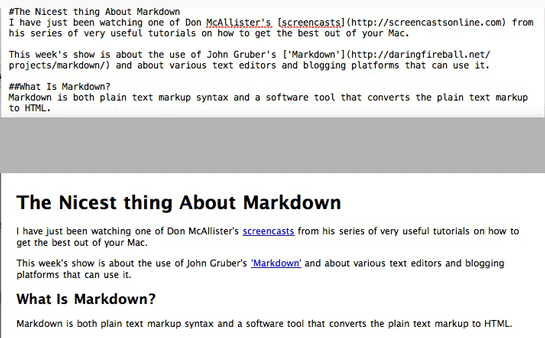
Here in this screen grab you can see an earlier draft of this article written in Markdown and shown in formatted text in the Preview pane.

You can see that the formatted text at the bottom is easy to read, but so is the Markdown text at the top.

Markdown Code and Format Preview

Conclusion
It is much more relaxing to work in a text editor because we can just turn on the editor, type something, save the draft and put the article on one side.

Then when we are satisfied with our draft, we can paste the Markdown-formatted text into MadMimi.

Then all we have to do is check that everything looks OK and then send out the newsletter!


Our Email Newsletters
We hope you have enjoyed this article and gained some benefit it.

If you would like to sign up to receive our email newsletters with information about updates to Quillcards and articles on a range of subjects from environmental matters to technical topics, just complete the form below.