Angelic Visions from It’s A Wonderful Life to The Angel Of The North

Clarence Odbody in It’s A Wonderful Life

Ah, Frank Capra’s 1946 Hollywood movie ‘A Wonderful Life’: Nothing like snuggling down to watch it during the winter festive season yet one more time.

And no matter how many times I have done so – I always wait in anticipation for Clarence Odbody to make his appearance.

As you may well know, Odbody played by the actor Henry Travers is a guardian angel who has been assigned to save George Bailey, the lead character played by James Stewart.

Angel Second Class

“Ridiculous of you to think of killing yourself over money!” Odbody says to Bailey when Bailey asks him who he is. Then tells Bailey that he was sent to save him when he tried to commit suicide by jumping off a bridge in town into icy waters.

As the snowflakes cascade down thick and fast outside, the two of them are resting in a little wooden hut trying to dry off themselves and their soaking clothing.

Bailey frowns and growls in response to Odbody’s admonitions about his trying to take his life due to money problems. Then he asks Odbody in amazement how he knows such personal facts about his life – and just exactly who he is.

“Clarence Odbody, AS-2,” Odbody responds.

“Odbody AS-2. What’s that AS-2?” Bailey asks somewhat disapprovingly.

“Angel Second Class,” Odbody responds chirpily.

Earning One’s Wings

Bailey asks for an explanation about this and says sneeringly after hearing Odbody’s explanation,

“Well, you look about the kind of angel that I would get. Sort of fallen angel, aren’t ya? What happened to your wings?”

“I haven’t earned my wings yet, that’s why I’m an angel second class,” Odbody responds, standing there in his damp, long ruffled shirt that men wore as in the 19th century – an odd site indeed to the 20th-century Bailey.

Turns out that the angel Odbody lived and died during that previous century, so the garb is certainly in keeping with how he was dressed at the time of his death.

Seeing Angels, 21st-Century Style

Speaking of angels that one can see during the holiday season, I’m here to recommend an angel of a highly different sort to visit at any time of the year.

I am referring to the Angel Of The North.

You can see its red-rust silhouette high above the trees while traveling in northern England on the A1 near Gateshead near Newcastle Upon Tyne.

You can also see its location on this nifty map that my husband David put together:

The first time we saw the huge structure, we were on our way to Scotland and we didn’t have time to stop to have a closer look at it.

However, we made a promise to stop on the way back south to take a closer look which is what we finally did.

175 Feet From Wingtip to Wingtip

It’s quite a long detour off the highway to get to the grassy hillside where the Angel stands.

And its outline is mighty different than that of the human-turned-angel Clarence Odbody.

Weighing 200 tons and from wingtip to wingtip it is 175 feet (54metres), the Angel of the North is an astonishing vision standing on a hilltop against the skies as you can see here in our photo:

Angel Of The North With People

Aside from the sheer enormity of the structure, close up you can see that the welded steel from which the Angel is constructed is more than two inches (50mm) thick.

And of course, there is that lovely, autumnal rust-red color.

Gormley Revisited

The internationally acclaimed sculptor Antony Gormley who created the Angel of the North also made this figure that we saw at the Scottish National Gallery Of Modern Art Gallery One (formerly known as the Dean Gallery) here in Edinburgh where we live:
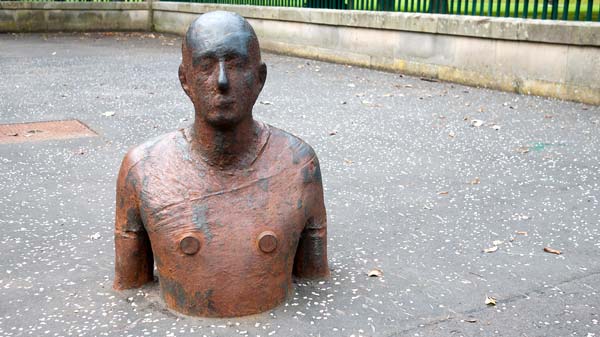
Antony Gormley Man Half Underground
Antony Gormley – Man Half Underground

To read more about Gormley and his sculpture in Edinburgh, you can check out my husband David’s article I Spy Modern Art In Edinburgh.

Standing On The Site Of An Old Coal Mine

Back to the Gateshead area, during the early 1990s: Through a commission of the Gateshead Council and the backing of the Gatehead Council’s Art in Public Places Panel who wanted to mark the site of coal mining in the area, an artist was sought to create something special to mark the spot.

The artistic image was to be undertaken to commemorate the work and times of the miners of the Team Colliery who worked at the site from the 1720s onwards.

Mining continued throughout the centuries, and in fact it was only discontinued on the site not too long ago during the late 1960s.

Weathering Steel

In 1993, a shortlist of international artists was drawn up and by the next year Gormley was selected to make his proposed creation.

By September 1997, work had begun on the foundations of the Angel by Thomas Armstrong (Construction) Ltd. according to Gormley’s design. And by February 1998, the Angel was completed.

The Angel was fabricated from 200 tons of weathering steel, which is a special kind of steel alloy designed to eliminate the need for painting. This steel creates a stable, rust-red appearance when exposed to the weather.

The Angel rises 65ft (20m), and its wing span of 175ft (54m) that I noted here previously is almost as wide as that of a jumbo jet!

Angling To Embrace

The Angel’s wings themselves are not planar or flat. Rather, they are angled 3.5 degrees forward.

Why was this done?

The sculptor Gormley explained what motivated this choice of his:

The effect of the piece is in the alertness, the awareness of space and the gesture of the wings – they are not flat, they’re about 3.5 degrees forward and give a sense of embrace.

You can see more of what this enveloping gesture feel like through this close-up image of ours:

Angel Of The North

Wondering As Jimmy Stewart’s Character Did

Like Jimmy Stewart’s character George Bailey who was dubious about Clarence Odbody’s mission to save him and get his own wings in the bargain, some people were similarly wary of the Angel of the North at first.

This resulted in some controversy in British newspapers, including a campaign called “Gateshead stop the statue” along with a local councilor named Martin Callanan who was especially opposed to the project.

However, just as Bailey was eventually won over by Odbody – these days the Angel is considered by many to be an outstanding, iconic landmark for the Northeast of England.

Personally speaking, we thought it was jaw-droppingly striking and beautiful in its own very particular way.

A Steel Angel Viewed By 33 Million Every Year

The Angel is one of the most viewed pieces of art in the world.

As the information plaque at the bottom of the hill leading to the enormous seraph says, this piece of art is “seen by more than one person every second, 90,000 every day or 33 million every year.”

Gormley On His Angel

What is it about angels that appeals to something deep in us?

Gormley had this to say about his Angel of the North creation:

People are always asking why an angel? The only response I can give is that no one has ever seen on and we need to keep imagining them.

The angel has three functions – firstly a historic one to remind us that below this site coal miners worked in the dark for two hundred years, secondly to grasp hold of the future expressing our transition from the industrial to the information age, and lastly to be a focus for our hopes and fears.

Others on Gormley’s Creation

A controversial statue, here are what several people have said about this otherworldly winged statue of Gormley’s:

Antony’s huge talent has produced a piece of public art unique in the history of this country, and in time I think it may only compare with the Eiffel Tower and the Statue of Liberty. I think it is one of the masterpieces of 20th-century sculpture.

              (Lord Gowrie, chairman of the Arts Council, on the day the Sculpture was erected on site.)

I think it is probably the emptiest, most inflated, most vulgar of his (Antony Gormley’s) works. Gateshead is a self-inflicted wound. Bomb it, then you will change it. It is an awful place – most of the North is awful.

              (Brian Sewell, Art Critic for the London Evening Standard)

I think the greatest thing for the Angel is that Brian Sewell has classed it as rubbish, which must mean it’s good.

               (Eamonn McCabe, Picture Editor, The Guardian)

Flash Gordon with wings and the feet of the Beast from the Black Lagoon.

               (M. Fiddes, of Scotswood, in the Evening Chronicle)

It is a witness to life at the end of the 20th century. The car is a human body isolated in a bubble, not communicating with anyone else. The Angel is trying to ask, is that all we can be?

               (Lord Gowrie)

Maybe the Angel of the North will embrace travellers with those wings and tell them that, wherever they live, here is homecoming.

               (Beatrix Campbell, The Guardian)

Odbody’s View Of Things

Homecoming is a major theme in It’s A Wonderful Life, of course – and so after trials and tribulations, all turns out well in the movie for George Bailey, his wife Mary (played by Donna Reed), and their passel of children.

In this celluloid vision of angel wisdom, Clarence Odbody as Bailey’s guardian angel gives Bailey this advice and thanks as an inscription in a copy of Tom Sawyer, the 19th-century novel that Odbody had on him when he jumped into the waters to save Bailey earlier on in the story:

Remember no man is a failure who has friends.

Thanks for the wings!

Love, Clarence

This One’s For You

Way to go, Clarence, I say, that’s wonderful advice indeed – and it’s also our way here at Quillcards to wish a wonderful holiday season to one and all.
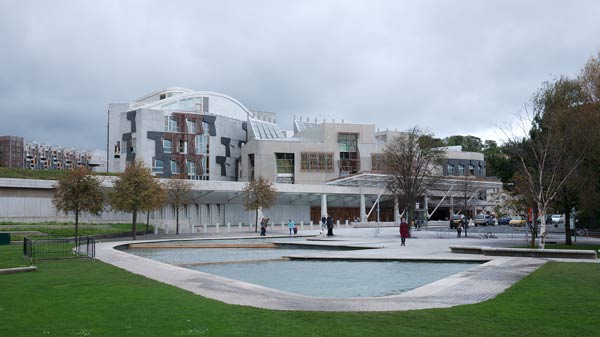
The Scottish Parliament Building

The New Scottish Parliament

Wouldn’t you think that there has been a parliament continuously since Scotland became a country many centuries ago?

It’s a natural question to ask – and indeed the first recorded reference to a meeting of the Scottish parliament dates from 1235 and the first permanent meeting place for the parliament was established in 1632.

However, in the late 1600s Scotland made a huge blunder when it chose Panama as the setting for its colonial expansion. Scotland was already in trouble financially, and establishing a colony abroad seemed like a good idea.

After all, Spain, Portugal, the Netherlands, and of course England had tried and succeeded at it.

And Scotland didn’t want to be left further behind in the heady days at the end of the 17th century when the European world was snapping up colonies all around the globe.

Unfortunately, the Panama isthmus was a terrible choice for Scotland’s venture. It was cut off from the rest of Latin America by the Darien Gap (still a treacherous swampy area today) and trade was a failure while disease was widespread. The Spanish who were busy claiming Latin American for themselves weren’t too friendly either.

The Scots had originally secured investment for the colony from international backers but when England leaned on the backers to withdraw, the Scots turned to their own people to raise the capital.

When the venture failed, the investment was lost and Scotland was more or less bankrupt.

At which point England kindly offered to pay off Scotland’s debts in return for political union.

When I first learned of this jewel of history, I thought of the analogy of a forced marriage with the aged groom paying off the beautiful bride’s debts in return for her hand in marriage.

The Act Of Union

Whatever the truth of the way the union came about, by 1707 England and Scotland became the United Kingdom and that was the end of the Scottish Parliament for the best part of 300 years.

The situation changed with a referendum in 1979 that set the scene for the UK Parliament to devolve power to a Scottish Assembly.

The first elections to the Scottish parliament were held in 1999 and in September of that year the first Bill was presented to it.

Constitutional Arguments

Because the Scottish Assembly was created under devolved powers that issued from the Parliament in Westminster, it does not have power over areas such as foreign policy and defence.

And there are constitutional arguments about whether the United Kingdom parliament could withdraw the legislation that has given Scotland its Assembly.

The argument runs that because the Scottish parliament was created by devolved legislation its power could be taken away under the principle that that which has been devolved may be reclaimed.

Frankly, I cannot see many Scots standing for that argument, and it seems to me that the likely direction is for further devolution.

Time will tell…

The Cost Of Building The Parliament

In 2003, Lord Fraser of Carmyllie QC was appointed to find out what went wrong with the project to construct the new building designed to house the Scottish Parliament.

He was appointed to find out how the cost rose from the 1997 estimate of somewhere between £24 million and £44 million to its eventual cost of £430 million in 2004.

The Site

Several locations were originally suggested for the new building, but eventually the Parliament was constructed on a piece of land at the bottom end of the long street at the other end of which is Edinburgh Castle and the Royal Mile.

The Palace of Holyrood, where the Queen lives when she is in Scotland, is also at the bottom of this street.

And the new Parliament building is directly across the street from the palace.

I can just imagine someone in Holyrood peering from behind the net curtains, and looking across at the Parliament as it was being built and lamenting the blot on the landscape. Or perhaps not.

Actually, there is something very fitting about the home of the constitutional monarch being located directly opposite the elected parliament. It’s a kind of checks and balances building arrangement with the monarch and the elected representatives facing one another.

Arthur’s Seat

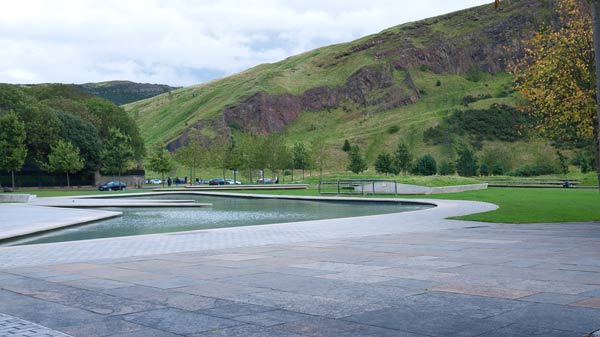
However they are arranged, the Palace of Holyrood and the Parliament building are both dwarfed by Arthur’s Seat – the main crag of a small range of hills that together form the bulk of Holyrood Park.

Arthur’s Seat is 800 feet (250m) tall and is the remains of a volcano, now long extinct and covered in grass.

It is usually dotted with the tiny figures of people walking to the top – as we did a year and a half ago now.

And it is just a short distance from Holyrood House and the Parliament.

Scottish Parliament  Building - The View Towards Arthur's Seat

The Conclusion Of the Enquiry Into The Cost Of The Building Works

Lord Fraser concluded that the original estimate for the cost of building the Parliament was unrealistic given the very complex design envisaged by the Catalan architect Enric Miralles.

Miralles did not live to see the building work completed as, sadly, he died of a brain tumour in the year 2000, aged only 45.

Scottish Parliament - The View From Across The Pond

Opinions On Architecture

To take a slight detour on the subject of architecture, this summer we went to several events at the Edinburgh Book Festival.

One event that we went to was entitled Architecture In The Ruins given by two critics of architecture – Miles Glendinning and Owen Hatherley.

In its own words, the event:

sets out to excavate the architectural wreckage created by an age of greed. It provides a coruscating attack on an era of iconic buildings and ‘signature’ architecture.

Owen Hatherley has travelled up and down Britain looking for bad architecture.

I was heartened when he had a few choice words to say about the soulless buildings that have sprung up in the center of Leeds (where Tamara and I are living now).

He illustrated his talk with slides and I remember how he ridiculed the kind of building that is covered in fake balconies only inches deep that are supposed to add special status value to poorly designed blocks of flats.

He railed against Councils that sold development sites to developers for pennies. The developers then built monstrosities with fake appeal and small rooms that sold at inflated prices.

Signature Architecture

The attack on ‘signature architecture’ struck a chord with me.

Signature architecture means the kind of building that shows off how talented and individual the architect is, but which produces a building that bears no relationship to the environment in which it is situated.

And that is a fair criticism to level at the Parliament building.

Things I Like

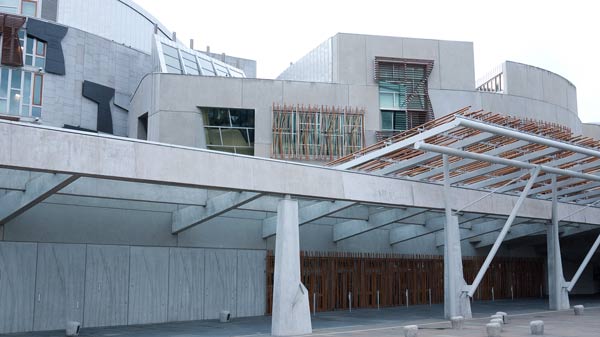
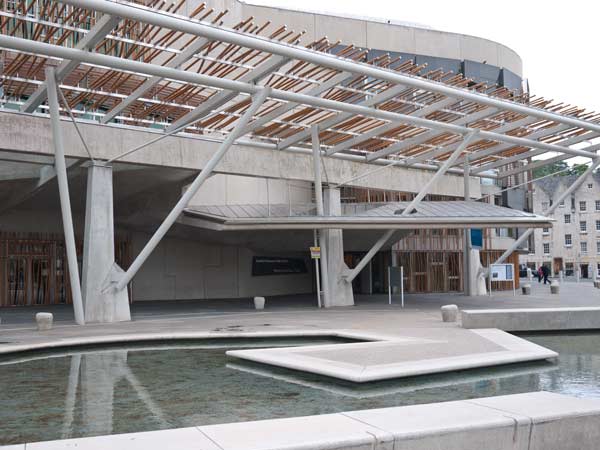
There are a lot of things that I like about the building. For instance, the colors are very attractive. The metal and concrete are light in color but the metal has been brushed so that it isn’t blindingly shiny.

The building is low and made up of lots of interacting elements, so it doesn’t just sit there like a lump that repels all comers.

Instead, its low and scattered profile seems fitting for a parliament that is supposed to represent the people rather than lord it over them.

And there is lots of repetition of detail that ties the whole building together.

You can see the repeat pattern near the windows in the photographs below. The pattern is supposed to echo the lecterns at which representatives speak. And I can see that acting as a reminder to MPs that their job is to take part – to speak and argue and agree.

Sketches Of Spain And Mexico

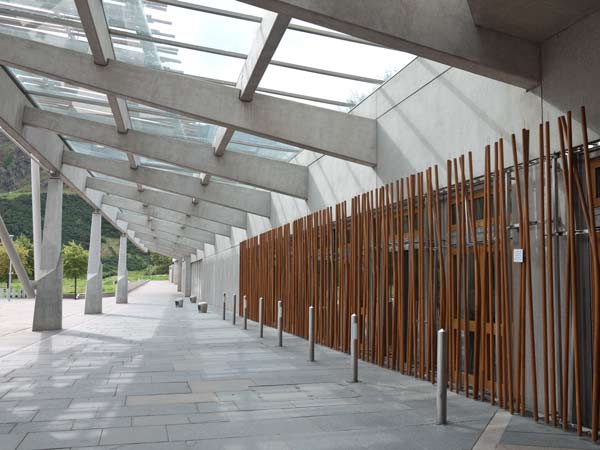
But the fact is that parts of the front are covered with wooden sticks about two inches thick that have nothing to do with Scottish architectural styles.

They reminded me instantly of a Mexican hut. In my mind’s eye I ‘saw’ a connection with the Catalan heritage of the architect. From there I quickly imagined Miralles on vacation as a teenager in the south of Spain or in Mexico, admiring the rough peasant huts with branches and twigs covering the verandahs out front.

Still, I don’t object to the idea of there being a connection with peasant huts because the parliament building is a building for representatives of the people to meet and discuss matters. Better that than something grand and superior.

If you detect my ambivalence, you are right. I like the building and at the same time I think the wooden sticks are faintly ridiculous. But I like the ridiculousness of it. It raises a smile and perks me up.

I could happily go to look at the building again. It is pleasant. Perhaps that is the bottom line.

Scottish Parliament  Building - The Ship Of State

Scottish Parliament  Building - Rustic Roof

Scottish Parliament  Building - Rustic Windows

In The Debating Chamber

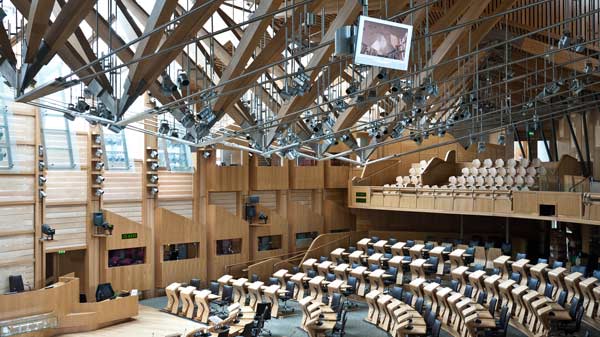
The inside of the building gets my vote. The first thing I noticed is that the seats in the debating chamber are not arranged in two sets of opposing rows like in the House Of Commons in London. Instead the seats are arranged in a collective circle around the speaker.

Of course, the politics may be just as divisive and wasteful as Westminster politics, but the debating chamber, at least, does not encourage it.

Conclusion

So that is my take on the Parliament building. It attracts many visitors and there are free tours of the smaller committee rooms.

Tamara encouraged me to be as enthusiastic as she was to take the tour and I am glad we did. She was right – it’s a great way to see parts of the building that casual visitors are unlikely to see otherwise.

Scottish Parliament  Building - The Debating Chamber

The Forth Rail Bridge

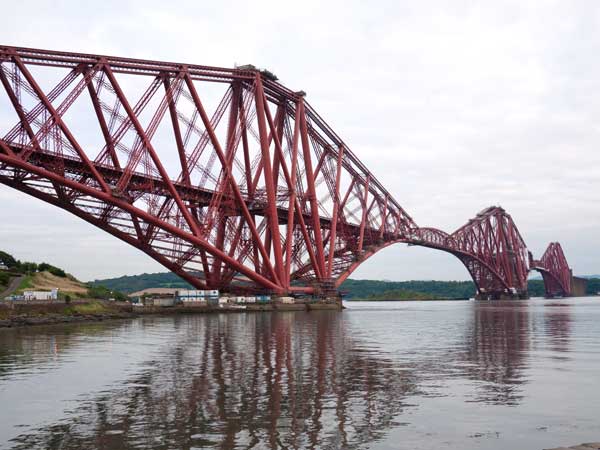
photo of forth rail bridge viewed from north queensferry

This is the rail bridge over the river Forth. On the southern shore, on the far side across the water in this photograph, is Edinburgh.

Note: You can find the ecard of this image in the Urban Landscapes category of Quillcards. Just head over there and then navigate to the images on page two of that category.

To the east (to the left of this photo) is the North Sea – just a few miles away.

There is a saying in Britain that something ‘is like painting the Forth Bridge’, which means that a task is a never ending.

The saying comes from the fact there is so much steel in the Forth Rail Bridge that the task of painting it is continuous and never ending.

The painters start at one end and by the time they get to the other end, the end where they started needs to be painted again.

There is even a 1930s British Pathe Film news item showing painters painting the bridge, with a voice-over describing how the work must go on (and on, and on).

A Modern Solution To An Old Saying

Time moves on, and now painters are halfway through painting the Forth Rail Bridge with a glass flake epoxy coating that will last for decades and put an end to the continuous painting efforts.

It is not just a matter of repainting. There were concerns that the thick glass flake epoxy wouldn’t stick unless the steel was sandblasted clean, and with over 50,000 tons of steel, six and one half million rivets, and a surface of two and one half million square feet (230,000m²) to cover, sandblasting would have taken rather a long time.

There were also concerns that the paint wouldn’t flex enough in the hostile weather conditions of the River Forth. The bridge twists and turns in the wind, and heats up and cools down during the day and night.

Leighs Paints who produce the new paint, set up a flex-bed to investigate whether the glass flake epoxy would stick and the result was that the paint held despite the flexing. Sandblasting was also found to be unnecessary and so the task of painting the bridge could get under way.

Six years later the painters are halfway through the task.

So it looks like it’s the death knell for ‘It’s like painting the Forth Bridge’.

Why There Is So Much Steel In The Forth Rail Bridge

The bridge was built not only to be strong but also to look strong.

That is because in 1879 – not many years before the Forth Rail Bridge was built – the bridge over the Firth of Tay near Dundee collapsed during a gale taking a train and its 75 passengers and crew to the river below.

The passengers and crew all died. However, the North British Railway Company (who owned the train and the Tay Bridge) eventually recovered the train from the depths and put it back to work.

I have this image in my mind of a barnacle-and-seaweed-encrusted engine blowing ghostly smoke from its stack and it makes its way in the dead of night over the new bridge over the river Tay.

A Public Outcry

The effect of the Tay Bridge disaster was that there was an outcry, and the public demanded that any new bridges be safe beyond question: Hence the amount of steel in the Forth Bridge.

Now looking up at the Forth Bridge from the northern shore, everything is quiet until a train comes through. Then the steel screeches and groans until the train suddenly appears high above, heading north.

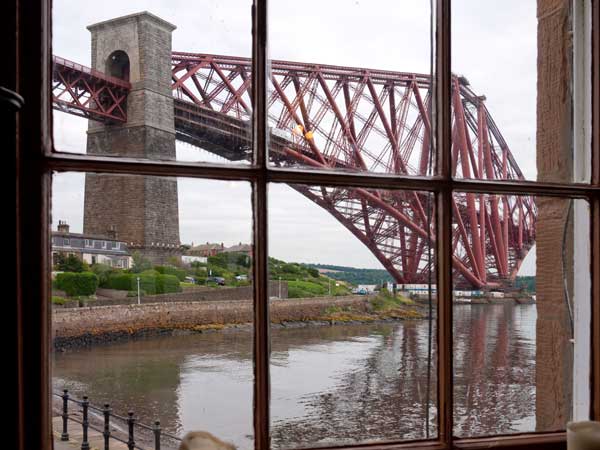
Down below there is a small collection of houses and a public house, and this is a view of the bridge through the pub window.

It seems such a strong statement on the landscape, don’t you think, to have this view outside the window.

photo of forth rail bridge seen through pub window

Up Close

Walking up a small road that overlooks the shore, the stanchions of the bridge are hidden and the girders seem like something from The War of The Worlds.

photo of the forth rail bridge from beneath at waters edge on the north queensferry side

The Forth Road Bridge

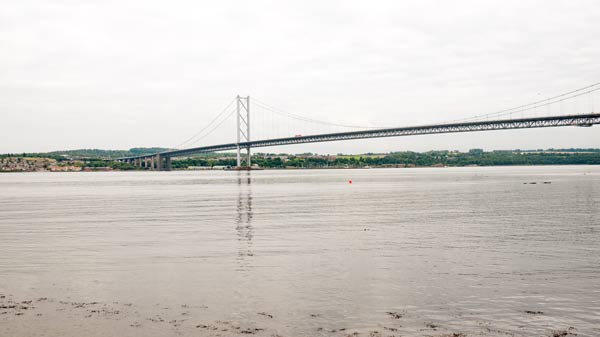
In comparison, the road bridge a thousand yards upstream is a distant sliver of concrete that shoots across the Firth.

It’s far enough from the rail bridge that there is no traffic hum. It’s so strange. Just across the water is Edinburgh, but here it feels like a loop out of time, peaceful and slowed down.

photo of the Forth Road Bridge

The Firth Of Forth

A firth is the Scottish word for an estuary. It derives from the Norse word fjord, and geologically speaking the Firth Of Forth is a fjord.

It is tidal as far as Stirling, 30 miles, (50km) to the west, which accounts for the importance of the bridges across the Forth that save the westward deviation on the road north to Perth and beyond that to the Highlands.

The Firth Of Forth is designated a Site of Special Scientific Interest and the islands in the firth are home to many tens of thousands of seabirds.

Bass Rock in the Firth is world famous for its colonies of gannets, puffins, guillemots, razorbills, kittiwakes, eider duck, peregrine falcons, and grey seals, with bottlenose dolphins sighted off the island.

It is for this reason that the Grangemouth oil refinery about 20 miles west of Edinburgh is so closely monitored. The refinery is operated by INEOS Group Limited and the last oil spill was in 2008.

Like with most of the world today, there is a ticking time bomb of technology behind the pleasant views across the Firth Of Forth.

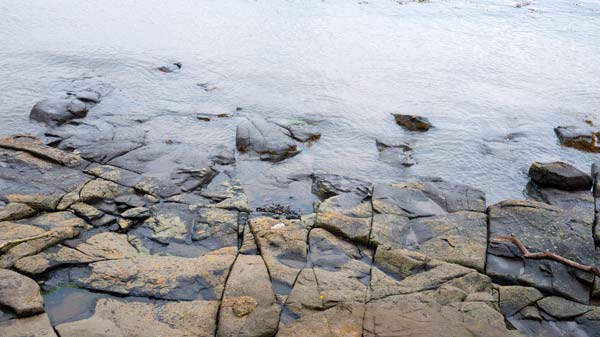
photo of the shore at North Queensferry by the Forth Rail Bridge