A Good Reason To Use Instagram Embed

Instagram is a smartphone application used by millions to upload photos to the Instagram community site that you can view on your phone or on the Web.

Facebook bought Instagram a while ago and now, hot from the press on the The Instagram Blog comes the following:

Today, we’re excited to introduce web embedding for Instagram content and bring you an easy way to add Instagram photos and videos to the stories you want to tell.

Now, when you visit an Instagram photo or video page on your desktop web browser, you’ll see a new share button on the right side of your photo (just under the comments button). Click the button to see the embed code. Copy the block of text it gives you and paste it into your blog, website or article.

Use Instagram Embed To Get More Exposure From Instragram

If you are on the web, if you have a blog, if you have any way of embedding the embed code onto a page where your stuff appears, then you can get more exposure for your Instagram images with the embed feature.

Or looked at the other way around – get more exposure for your blog by being able to display your Instagram photos.
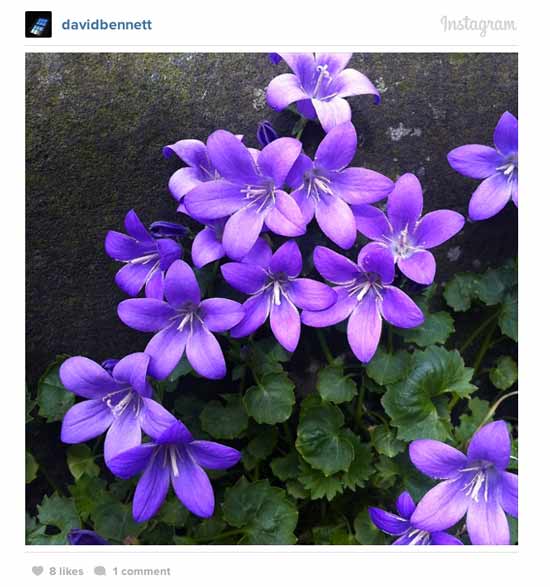
insta

Important For WordPress.com Bloggers

Note that the Instagram embed code uses iframe code.

WordPress.com blogs do not allow iframe code and will strip it out if you try to embed an Instagram image and you will not see anything.

Note: See the update at the end of this article. WordPress.com blogs allow the normal oEmbed and Instagram photos now show up in the body of posts.

No Pinterest Pinning

Because the images are within an iframe, another thing you cannot do is to pin the images in Pinterest.

If You Like These Images

I joined Instagram in November 2010 and have used it regularly ever since then.

Naturally therefore, I am glad to be able to take advantage of the opportunity to use the hew embed feature to put some of my images here on the Quillcards Blog.

If you like these images, please feel free to click through to Instagram and like them 🙂

Hover over the word ‘Instagram’ and it will change to ‘View On Instagram’ and you can click that.

Update 14 July

I have taken out the other three photos and just left one of them. I found that the call on the image isn’t always as quick at rendering as the rest of the page – and so it leaves a big gap on the page when there are several images.

However, I have also found that inserting just the URL (rather than the iframe) does make the image itself linkable, rather than just the word Instagram above the image.

In fact with the non-iframe method, the word Instagram above the image disappears completely and only the image is shown. What’s more, the image is clickable and goes straight through to Instagram.

I have to figure out why the image displays smaller than the default 612px size. I suspect it is something to do with the Media settings on this blog (Settings > Media) and the ‘allowed’ sizes for rendering that Instagram enables.

I have also learned that pasting the URL in on WordPress.com blogs now works. Thanks due to JenT from GammaGirl following it up with the WordPress support staff.
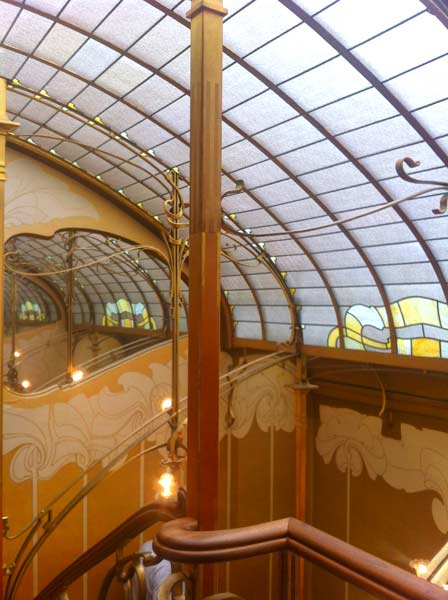
The Horta Museum – Brussels

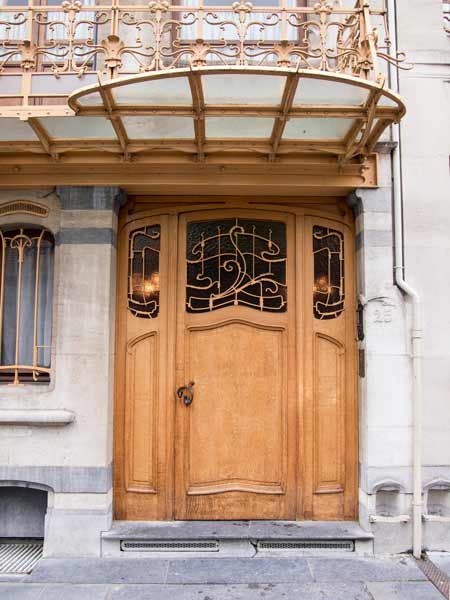
Door At The Horta House - Brussels
Door At The Horta House – Brussels

Victor Horta was a Belgian architect and a leading figure in the Art Nouveau (New Art) movement – a movement that mushroomed all over Europe starting in the 1890s.

The Horta museum in Brussels is housed in what was Horta’s house and studio, which he designed in the Art Nouveau style.

He had the house built over a three-year period – from 1898-1901 – and he lived and worked there until 1915.

He then sold the house and the studio separately in 1919 and they were eventually bought by the city of Brussels in order to create the museum.

Placing the events in history, Horta had the house built at a time when the whole of Europe was enjoying the flowering of Art Nouveau, and he sold the house a year after the end of a world war that left bits of splintered bone over half of Belgium.

Well, whatever I might try to read into the dates, Wikipedia tells me that Horta…

…left Belgium for London in February 1915 and attended the Town Planning Conference on the Reconstruction of Belgium, organised by the International Garden Cities and Town Planning Association.

Unable to return to Belgium due to the war, at the end of the year he decided to go to the United States, where he gave a number of lectures at universities including Cornell, Harvard, MIT, Smith College, Wellesley College and Yale and, in 1917, became Professor of Architecture at George Washington University, and Charles Eliot Norton Memorial Lecturer.

Inside The Horta House

The house is built over several floors, and there is a wonderful staircase which you can see in this photograph, that winds itself up to the top of the house. It feels light and delicate.

There are lots of little landings leading off this way and that – giving the house a free-spirited, whimsical feel. It is reminiscent of Escher – as though the staircase would wind itself up and off to somewhere impossible.

Inside The Horta House - Brussels
Inside The Horta House – Brussels

Organic Goes Out Of Fashion

After the First World War the curvy, organic shapes that typify Art Nouveau were out of fashion. Taste moved to something more straight-lined and geometric.

When I think of that, it makes me wonder whether it was a just simple change of taste and fashion, or whether it was the all-too-organic war that people wanted to forget and the technological dream of the future that they wanted to embrace?

Whatever the spur to the change of taste, Horta designed the Palais des Beaux-Arts in Brussels in the 1920s in a much straighter, more geometric style.

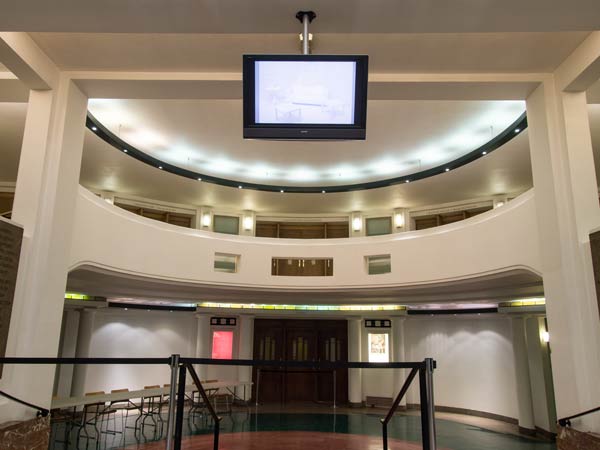
We went to the Palais des Beaux-Arts (known locally as BoAz) for an exhibition of the drawings of Watteau, and while we there I took the opportunity to take a couple of photos of the interior – not very exciting, but the light was low.

The Lobby Of The Palais des Beaux-Arts - Brussels
The Lobby Of The Palais des Beaux-Arts – Brussels

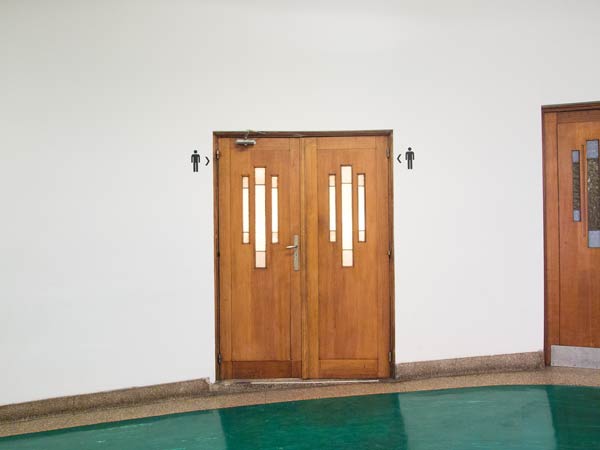
I liked the entrance to the toilets, and I would have grabbed a shot of the urinals in the gents if I had had more time to prop the camera somewhere. It’s rare that I am struck by the beauty of a urinal, but the way the stall curved around a wall that sloped gently downward was very sympathetically done.

Toilet Door Palais des Beaux-Arts - Brussels
Toilet Door Palais des Beaux-Arts – Brussels

The main hall (which I didn’t photograph) was something else again – very spare and big and empty, and a bit unloved.

The Exterior Of BoAz

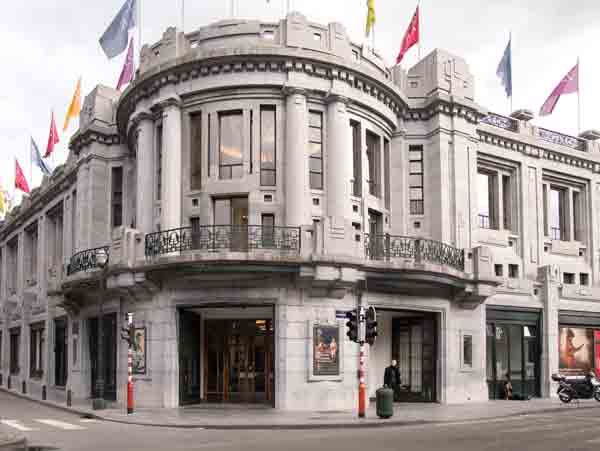
The exterior of the Palais des Beaux-Arts is in the same pale stone that features in quite a number of buildings in Brussels – and very strong and irresistible it looks. I can’t help but think the appeal had something to do with a psychological wish to build something that looked as though it could resist destruction.

Here is a shot of the building and also a close-up of the balcony.

Palais des Beaux-Arts - Brussels
Palais Des Beaux-Arts – Brussels

Detail of the Palais Des Beaux-Arts - Brussels
Detail of the Palais Des Beaux-Arts – Brussels

Getting To The Museum

It’s easy to get to the Horta Museum by public transport. It’s in the Ixelles section, south east of the centre of the city.

Take tram #92 from Place Stephanie and get off as near as you can to Avenue Americain, which is a street to the left of the tram route.

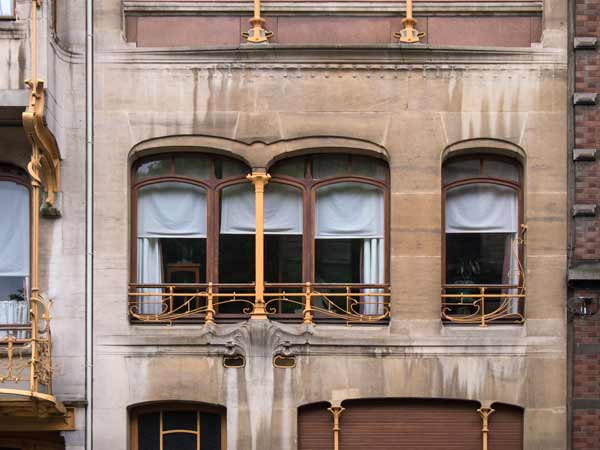
The Horta House is down the street on the right and easily recognised by the yellow metal struts of the balconies.

It’s open from 2pm to 5pm. Expect to wait in a queue (line) along the street because the house is popular and only 45 people are allowed inside at any one time.

The reason they only allow 45 people at one time into the building is because of the strength (the possible lack thereof) of the building. However, when we were climbing the stairs to the upper floors I gave the bannister a thump to see whether it would shiver or flex.

The bannister did not give an inch and the stairs themselves felt rock-solid despite the numbers tramping up and down them.

So given the very open, light, and airy feel to the building – and the thin metal struts that make up the structure – I would say that Victor Horta was a first class engineer as well as a wonderful architect.

You have to park all your belongings when you get into the museum – no bags, no outer coats, no umbrellas. The cloakroom has a haphazard arrangement for keeping different people’s bags separate from their neighbour’s bags.

The man who took our bags pushed them into a cubbyhole and separated them from someone else’s bags by cramming a piece of paper between the two. It worked out OK though, and we got our bags back at the end of our visit.

Window In The Horta House - Brussels
Window In The Horta House – Brussels

Brussels – Hiding In Plain Sight

This is the second of two articles. Here is the link to our article entitled Brussels – Hiding In Plain Sight.

Puffins And Razorbills

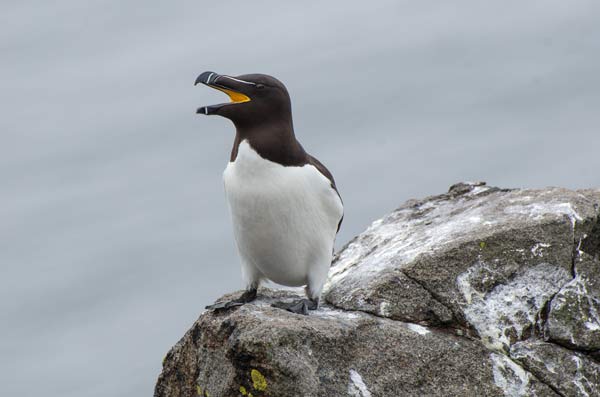
Razorbill On The Isle Of May

A couple of days ago I was looking through the photos from our visit to the Isle of May last year when I decided to take a look at a couple of shots that I had not processed.

They were photos of razorbills. I had to photograph them against the backdrop of the open sea, which meant that the camera set the scene optimally but the birds looked very underexposed and the faces were just dark shadows.

If I had set exposure compensation – see my article on exposure compensation here – I might have produced a better RAW image. Be that as it may, I recall that I opened the images up in Photoshop, but I don’t think I tried very hard to optimise them.

Enter Photoshop CS6

I opened the images up again a couple of days ago, and they were easy to process. Perhaps it is because I have an updated version of Photoshop. Certainly, the tools in Adobe Camera Raw are very good for optimising images.

Razorbill On The Isle Of May - Close-Up
Razorbill On The Isle Of May – Close-Up

Seeing the razorbill’s beak close up makes me realise that they have a somewhat similar appearance to the puffin’s beak, with the markings on the side of the upper part of the beak.

It’s not so surprising because they are both part of the same family of auks.

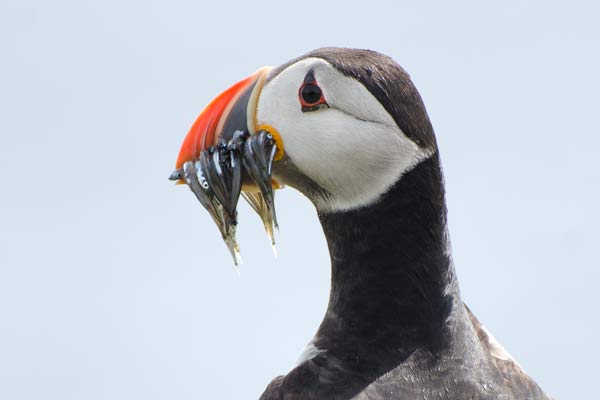
Razorbills and puffins don’t compete for the same food, however. Puffins eat sand eels, as you can see in the photo below – while Razorbills (which are quite a bit bigger) eat juvenile cod, sprats, and herring.

Puffin On The Isle Of May

You will find these and more than fifty other images of birds in our Bird Ecards.