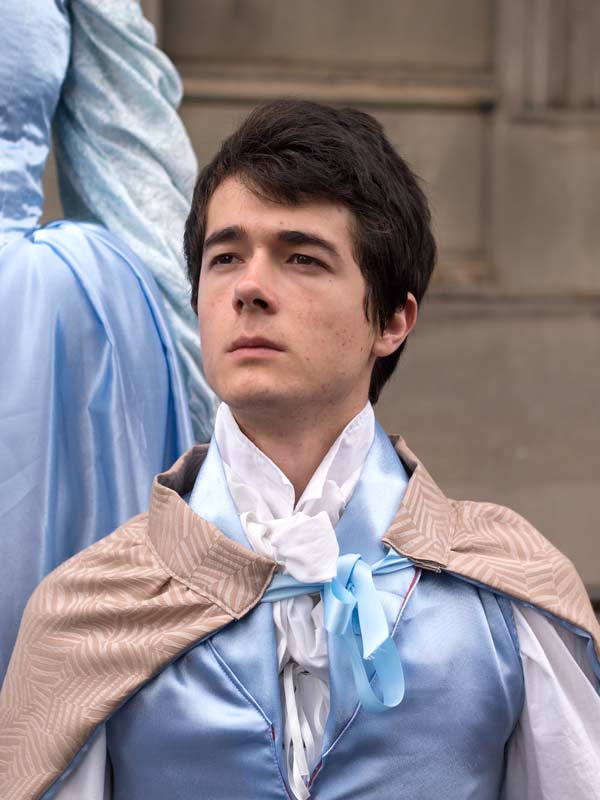
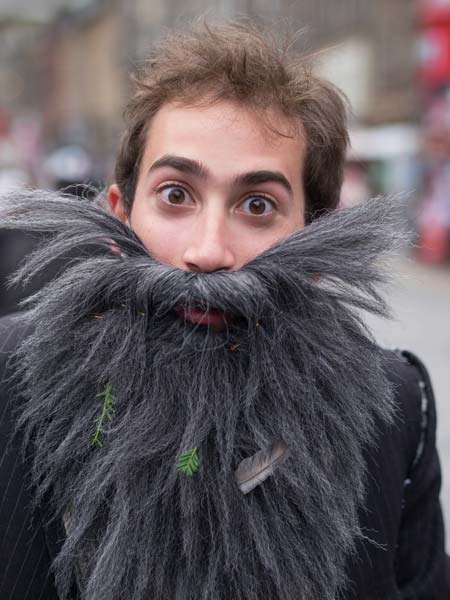
Actors from Lovers’ Vows hamming it up on the Royal Mile in Edinburgh today for the Edinburgh Fringe Festival.
Mansfield Park
In Jane Austen’s novel Mansfield Park there is a part where the younger characters, left to their own devices by the absence of the master of the house, decide to put on Elizabeth Inchbald’s play Lovers’ Vows.
Some of the characters object, believing that Sir Thomas would disapprove of the subject matter of the play, which includes adultery. But they decide to go ahead, drawn in by the opportunity to flirt and show their affections.
Then Sir Thomas unexpectedly arrives home in the middle of a rehearsal…
Lovers’ Vows
Charlotte Productions present Lovers’ Vows – Jane Austen’s Mansfield Park re-imagined for the stage.
‘Selfishness must always be forgiven you know, because there is no hope of a cure.’ In chapter 14 of Jane Austen’s Mansfield Park, the bored young people amuse themselves with some amateur dramatics. Join us as we look behind the curtain of the rehearsals; with Sir Thomas away, a play to perform, and so many charming gentlemen in the house, the strict rules of society might not be quite so easy to maintain.
…the Fringe enjoyed a record-breaking 2,695 different shows staging 42,096 performances in 279 venues by 22,457 performers from over 47 countries..
To kick off this year’s festival, some of the theatre companies were out on the street hamming it up for passers by and handing out flyers.
In keeping with previous years, we aim for the visually appealing.
So in good Fringe style we start coverage with a low key, restrained image of Plato, as played by Sam Ereira, a cast member in the DEM Productions production of A Theory Of Justice.
We shall be posting regularly from the Fringe – with photos – so look out for more articles.
You can sign up to receive them by email – see the sign-up box at top right on this page.
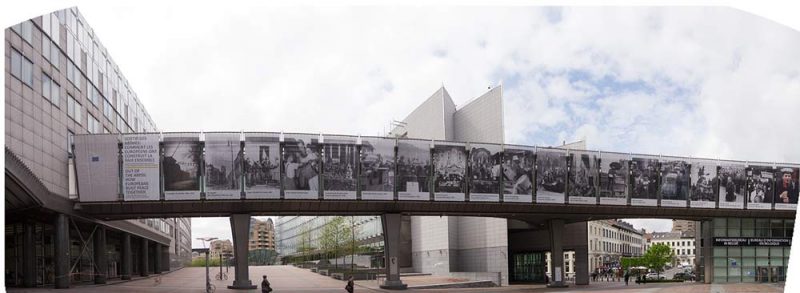
This frieze is in a sweeping arc above the concourse that leads to the European Parliament in Brussels.
It was designed by Larkin Zahra as his entry in a competition to publicise the European Union being given the Nobel Peace Prize in 2012 for transforming Europe from a continent at war to a continent at peace.
At the time he won the prize, Zahra was 23 years old and living in his hometown of Zebbug in Malta. He has a Bachelor’s degree in European Studies from the University of Malta and a Master’s in European Public Affairs from the University of Maastricht in the Netherlands.
Significantly, Zahra won the competition on a public vote on Facebook.
He was invited to the opening ceremony in Strasbourg (not Brussels – see this article about the rivalry) where he was called to the podium by Martin Schulz, President of the European Parliament, who said:
Next to me, you can see a young man, Larkin Zahra. This is the young man who won our competition organised before the Nobel Peace Prize award ceremony. For the Nobel Peace Prize we thought to invite young people all over Europe to send us their proposals, the question being: What are your thoughts, spontaneous feeling for this honour and decoration for the European Union? And Larkin was the winner and we became friends during the last 3 days. Isn’t it so?
Zahra replied:
My quote was that my grandparents would have said peace in Europe would be a dream. My parents would have said it is a process, and I can say that, thanks also to the EU, it is my everyday reality.
The Thread That Links The Images
The thread of the frieze is the move out of the abyss towards freedom, democracy, and prosperity.
The concourse at the European Parliament is a doubly-fitting place for the exhibition because it is named after Simone Veil, who is a survivor of the Auschwitz-Birkenau and Bergen-Belsen camps.
She is a French lawyer and politician who was the Minister of Health under Valéry Giscard d’Estaing, and has served as a President of the European Parliament and member of the Constitutional Council of France.
The frieze actually proceeds in a semicircle, but when I processed the individual images in Photoshop, it flattened out the perspective in the process of stitching several photos together to make this panorama.
And I didn’t take photographs the whole way around – there are a few scenes at the end that I didn’t get. Perhaps next time.
The frieze is entitled:
Out of the abyss: How Europeans built peace together – a prize recognising 60 years making peace in our continent.
The scenes then proceed:
Looking into the gates of Auschwitz, with a caption that reads ‘The depths: Auschwitz, 1940-1945’
Ruined buildings, and a caption that reads ‘The depths; War destruction in Warsaw, 1945’
A soldier being greeted by civilians, and the caption ‘Hope: Liberation for many, 1944’
A boy, a woman, and a man, and the caption ‘Hope: Postwar homecomings’
A crowd before a building, and a caption ‘A way forward: Creation of the European Movement, 1948’
A border post in Germany, and the caption ‘Still divided: Border control 1948’
Four European leaders and behind them a flag that reads L’Europe – and a coption that reads ‘Political leaders: For once they agree, 1950’
A view around the table, and a caption ‘Project for peace: Schuman declaration 1950’ (Schuman was the French foreign minister who guided and promoted the declaration).
Railway workers on a train with flags, and the caption ‘On the ground: European Coal and Steel Community in action, 1951’
A worker in a steel works, and a caption ‘Peace and prosperity: Industrial boom, 1955’
Civilians hoisting a flag on a tank, and the caption ‘Desire for freedom: Hungarian revolution, 1956’
Civilians on the street listening to a news broadcast, and the caption ‘Self-determination: Cyprus Independence, 1960’
A man holding an umbrella looking over a barbed wire topped wall, and the caption ‘Cold War: Berlin wall, 1961’
A man riding a motor bike at what looks like some kind of presentation – and a caption that reads ‘Working together: Worker mobility, 1964’
Cars in an assembly line, and a caption ‘Prosperity grows: Economic development, 1965’
A crowd and a banner, and the caption ‘Yearning for a better future: Prague Spring, 1968’
The German chancellor kneeling, with a crowd behind him, and the caption ‘Facing the past: Willy Brandt kneels in Warsaw, 1970’
A crowd with banners, and the caption ‘End of dictatorship: Democracy in Greece, 1974’
A sailor holding a flower, and the caption ‘End of dictatorship: Carnation revolution in Portugal, 1974’
Whither Democracy?
Fascism in Greece, state surveillance all across Europe, minorities such as the Roma under threats of violence in Eastern Europe, populist versus conservative national governments in Europe: No one is quite sure how golden the future is in the European Union.
Of course, we know that compared to some countries around the world, any of the EU countries is heaven.
But history is a fluid state, and what seems protected and entrenched in one decade can be torn apart in other.
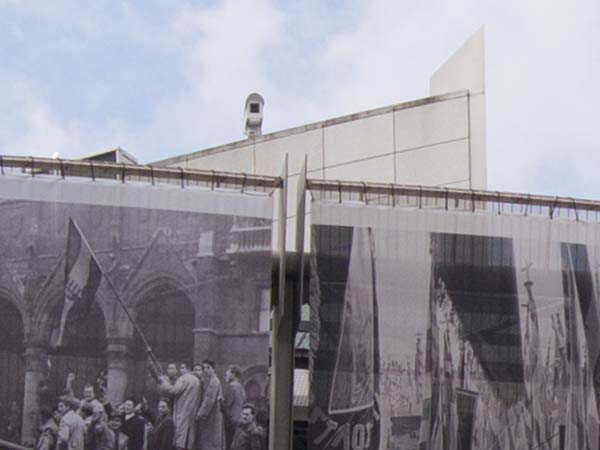
We have to ask, for example, for whose benefit are the surveillance cameras above the frieze on the concourse of the European Parliament? Do they protect the citizens or protect the state against the citizens?