When will Spring come?
When will the nights pull back and the days start to get longer?
When will we see the sun?
When will the grey, grey days go away?
When will the wind stop?
When will we be able to walk out without layers of clothing, without thinking of the struggle to get to the post office, to the shops, to the bus?
We’ve had almost no snow. You can see it on the hills – and you can always see the hills from almost anywhere in Edinburgh, even from the city centre.
But there has been no snow. Just a flurry or two scattered through the winter months. But nothing that has settled.
Snow is an ambivalent creature. It’s all white and welcoming, but then it turns to slush. As pure as the driven slush, as the actress Tallulah Bankhead said of herself.
Of course, in some places (I am thinking of the time I spent in Finland) the air is so dry that the snow settles and remains crisp and white for months.
And apparently the snow was knee deep in Edinburgh for months, just four years ago.
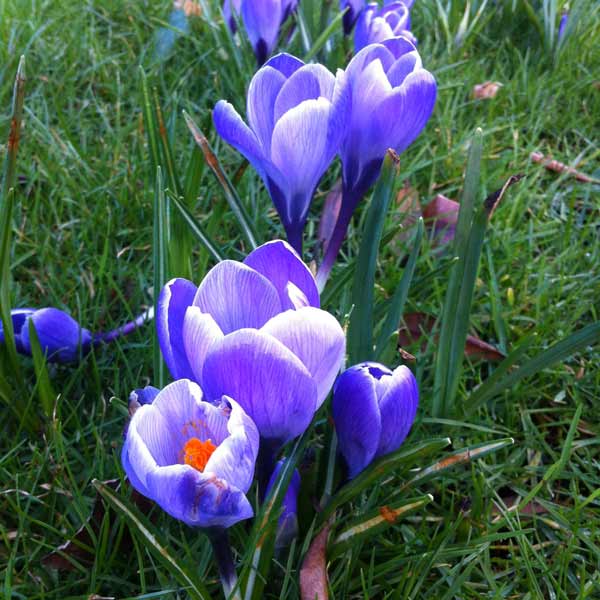
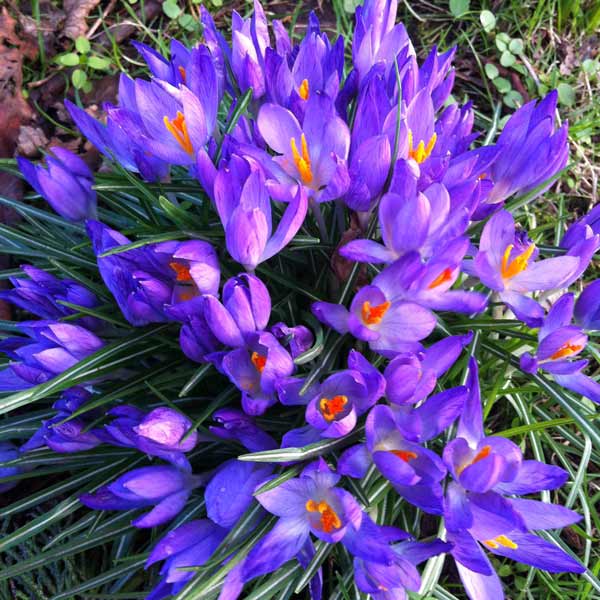
But not this year. So it has been a bit of a slog to reach these lighter evenings and some sunny days. But now the crocuses and the snowdrops are out and the sun is shining.
It is so easy to see how epic poetry and drama arose in human consciousness – the struggle through the dark and the bursting into the light – it’s all there with the seasons. It’s almost all there with each day in the changeable Edinburgh weather…
Crocuses
But now it is here.
Early signs of Spring are here.
It’s a gorgeous day and the sun is here.
Longer days are here.
Crocuses are here:
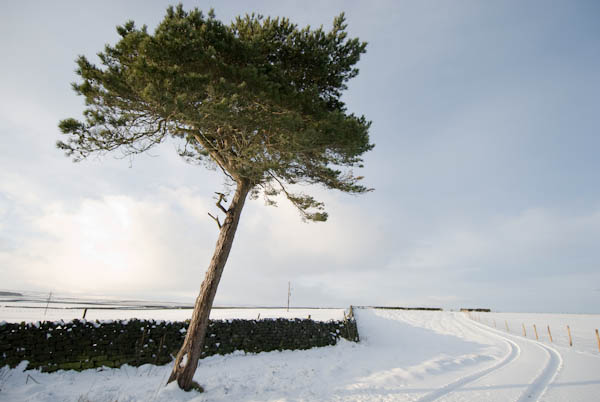
A Reminder Of Snow
So what is snow like? The scene fades from the memory so quickly I can hardly recall what it looks like or feels like. I have to dig into it to remember it.
The crunch of boots and the sudden ‘give’ as the crystalline structure loses its fight against my weight and I drop, just a fraction, into the snow.
The tiny highlights as the sun (the sun??) glints off the snow.
The sheer brightness as I look up and out and over the blanket of snow. (Who first described thick snow as a ‘blanket’, I wonder?)
The snow in this photo here isn’t Edinburgh snow.
It is a scene from high on the Yorkshire moors a few winters ago. It’s one of the ecard photos from the Landscape category at Quillcards.
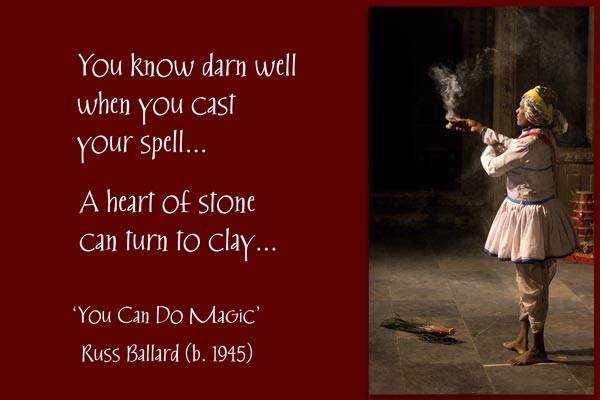
An element of love is the allure and enchantment of it all, which is why we featured this folk dancer in his exotic costume with eddies of smoke rising from his incense burner in the dark of the night in this ecard from our Valentine’s Day collection.
We photographed him when he was performing as part of a fabulous folk program that we saw in Udaipur in Rajasthan during our travels in northern India four years ago.
The essence of his appearance so conjured up the magic of love in our heads that we teamed up his image with lyrics about the particular spell that love casts.
A Special Day For Lovers, Courtesy Of Geoffrey Chaucer
Love will surely be in the air tomorrow when Valentine’s Day is celebrated.
But when you think about love all over the world, the question that came to my mind was this: How did Valentine’s Day come to be associated as a special day for lovers?
Actually, this Christian feast day that has pagan roots was not linked as a romantic day for couples until the 14th century.
According to the UCLA medieval scholar Henry Ansgar Kelly, author of Chaucer and the Cult of Saint Valentine, it was the 14th century poet Geoffrey Chaucer who first linked St. Valentine’s Day with such romance.
He did so when he composed his poem called Parlement of Foules (Parliament of Fowls in modern-day English).
It was the poetic tradition at that time to associate such an occasion with a feast day, and so in his poem of about 700 lines Chaucer linked the royal engagement in 1381 between England’s Richard II and Anne of Bohemia with the mating season of birds and with St. Valentine’s Day as a special day for couples with these two lines:
For this was on St. Valentine’s Day,
When every fowl cometh there to choose his mate.
This was the first reference to the notion of St. Valentine’s Day being a special day for lovers.
Another First, This Time For Love Poetry
Speaking of Chaucer and poetry, one can read lots of cooing about love for Valentine’s Day. And so I wondered: Quite apart from Valentine’s Day, what is the origin of love poetry?
It turns out that it comes courtesy of the same people who in around 3500 B.C. invented writing: Archaeologists claim that the oldest surviving love poem is Sumerian. Written on a clay tablet, the poem is believed to have been recited by a bride of King Shu-Sin who ruled Sumeria during the 3rd century B.C.
Archaeologists called the poem Istanbul #2461 (so much for romance, eh?), and it starts like this:
Bridegroom, dear to my heart,
Goodly is your beauty, honeysweet,
Lion, dear to my heart,
Goodly is your beauty, honeysweet.
Love Poetry At Quillcards
Our Valentine’s Day ecards at Quillcards include images with partial quotations from love poetry. We also feature quotations that are the complete sayings, i.e. they are not taken from a longer poem.
What follows here are some of these ecards.
And in honor of the amorous and affectionate spirit of Valentine’s Day and to get the full sweep of meaning of the writers’ poems – when we focus in this article on a card with a partial quotation from a longer poem, we will include the complete poem from which it was taken.
Middle Ages Revisited
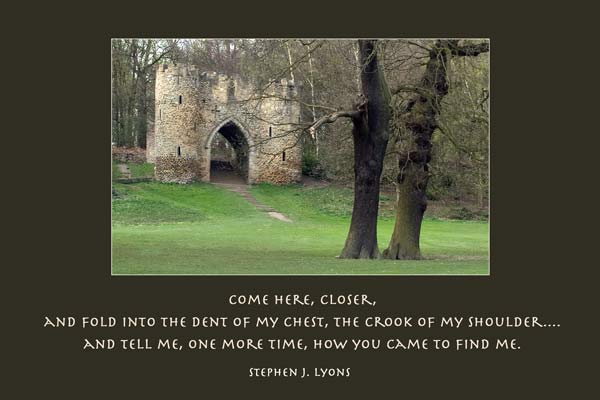
With a tip of the hat to Chaucer as he was the first to pair Valentine’s Day with romantic couples, here is our photo of the castle folly in Roundhay Park in Leeds, West Yorkshire in England.
One of the biggest city parks in Europe, Roundhay Park has more than 700 acres (284 hectares) of parkland, lakes, woodland and gardens that are now owned by Leeds City Council.
It’s a wonderful park, and one that David and I loved to go to when we lived in Leeds. Royalty owned it until 1872 when Prince Arthur solemnly reopened it as a public park for all people.
So it figures that that this castle folly is on the park grounds. Especially popular on 18th century estates, follies were created to represent mythical, classical, or medieval buildings and places and they also gave the wealthy landlord a way of displaying just how rich he was.
We were taken by the romantic Arthurian (as in King Arthur, that is) look of the place and we chose a quotation from this poem called Remembering by Stephen J. Lyons:
REMEMBERING by STEPHEN J. LYONS
Come here, closer, and fold
into the dent of my chest,
the crook of my shoulder.
In the open window the
candle betrays the wind’s
summer breath and the
night settles down around us.
Don’t move, not now,
let’s be still, hold this moment
before we open our bodies,
and tell me, one more time,
how you came to find me.
Eyelids Closed, Cheeks Faintly Blushed
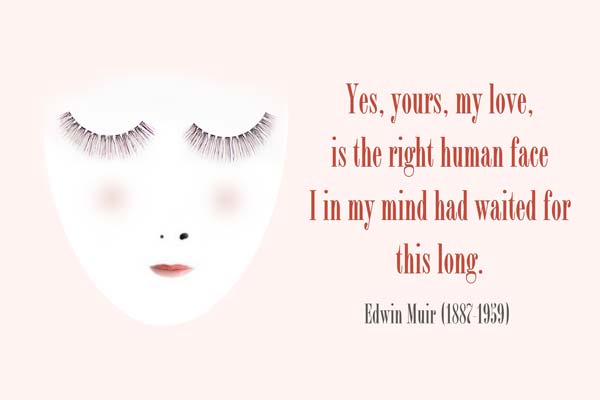
A very different image from the stone edifice of that folly is modern sketch of ours of a female face with eyes downcast with a bit of a tinge of color in her cheeks and lips.
Here’s the original poem by Edwin Muir from which we took the featured quotation:
THE CONFIRMATION by EDWIN MUIR
Yes, yours, my love, is the right human face.
I in my mind had waited for this long,
Seeing the false and searching for the true,
Then found you as a traveller finds a place
Of welcome suddenly amid the wrong
Valleys and rocks and twisting roads. But you,
What shall I call you? A fountain in a waste,
A well of water in a country dry,
Or anything that’s honest and good, an eye
That makes the whole world seem bright. Your open heart,
Simple with giving, gives the primal deed,
The first good world, the blossom, the blowing seed,
The hearth, the steadfast land, the wandering sea.
Not beautiful or rare in every part.
But like yourself, as they were meant to be.
Short But Ever Sweet
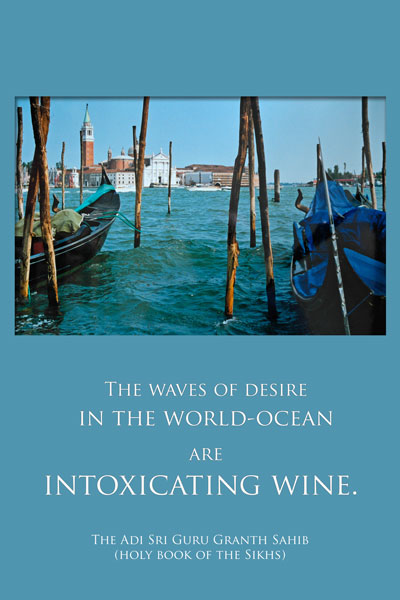
Some of our Valentine’s Day cards have short romantic sayings that are complete in themselves: They are ‘feng shui’ types of tiny mini poems, if you get my drift.
Here are three examples of the number we have on offer, beginning with this 11-word saying from the Holy Book of the Sikhs that we have paired with a photograph that we took in Venice:
This is a second example, a quotation (unfortunately anonymous) that I think packs a wallop into only nine words:
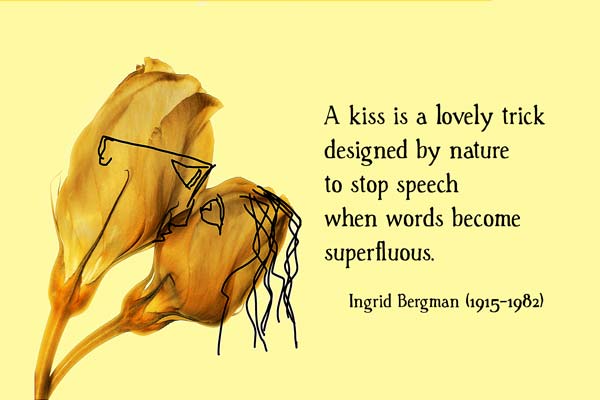
And here’s the third example, a delightful comment that the actress Ingrid Bergman made about what a kiss is that we have put with our sketch of a couple drawn on two lisianthus flowers:
The Bard, Of Course
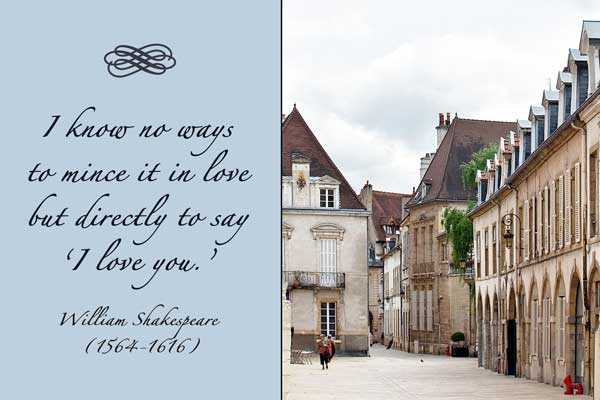
Words of love in the English language owe a delicious debt to William Shakespeare, of course.
Put alongside a photo that we took of the old town center of Dijon, France, the quotation is taken from his play Henry V:
Speaking of love and Will, I found this quotation in a sweet little volume from The Arden Shakespeare series called Book Of Quotations On Love. Compiled by Jane Armstrong and published by Thomson Learning, I bought it at the bookstore of the marvellous Shakespeare’s Globe Theatre in London which describes itself in its website as being “a unique international resource dedicated to the exploration of Shakespeare’s work and the playhouse for which he wrote, through the connected means of performance and education.”
An Homage To Rock
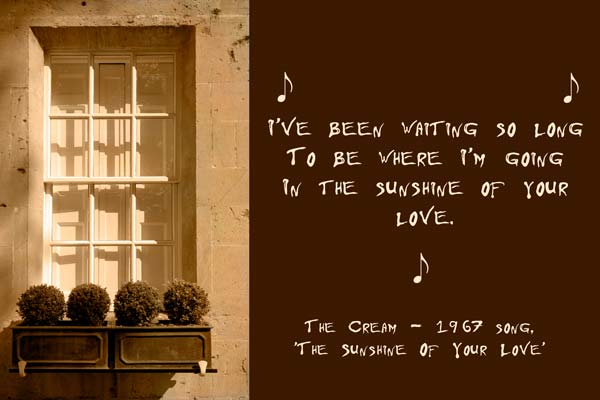
Middle-aged that we are, this card above from our Valentine’s Day collection features an evocative quotation from the Cream’s song ‘The Sunshine Of Your Love’, an old favorite song of ours.
We’ve also inserted a hint that it’s an old memory of ours by coupling it with a sepia-toned version of a photo that we took on a street in London:
Pablo Neruda, A Master of Love Poetry
The Chilean poet-diplomat Pablo Neruda led a life suffused with poetic and political activity, a prolific writer who also won the Nobel Prize for Literature in 1971.
Neruda’s astonishing love poems read equally well in translation from the Spanish, like this Love Poem XIV from his ’20 Love Poems And A Song Of Despair’ translated here by W.S. Merwin:
LOVE POEM XIV by PABLO NERUDA
Every day you play with the light of the universe.
Subtle visitor, you arrive in the flower and the water.
You are more than this white head that I hold tightly
as a cluster of fruit, every day, between my hands.
You are like nobody since I love you.
Let me spread you out among yellow garlands.
Who writes your name in letters of smoke among the stars of the south?
Oh let me remember you as you were before you existed.
Suddenly the wind howls and bangs at my shut window.
The sky is a net crammed with shadowy fish.
Here all the winds let go sooner or later, all of them.
The rain takes off her clothes.
The birds go by, fleeing.
The wind. The wind.
I can contend only against the power of men.
The storm whirls dark leaves
and turns loose all the boats that were moored last night to the sky.
You are here. Oh, you do not run away.
You will answer me to the last cry.
Cling to me as though you were frightened.
Even so, at one time a strange shadow ran through your eyes.
Now, now too, little one, you bring me honeysuckle,
and even your breasts smell of it.
While the sad wind goes slaughtering butterflies
I love you, and my happiness bites the plum of your mouth.
How you must have suffered getting accustomed to me,
my savage, solitary soul, my name that sends them all running.
So many times we have seen the morning star burn, kissing our eyes,
and over our heads the gray light unwind in turning fans.
My words rained over you, stroking you.
A long time I have loved the sunned mother-of-pearl of your body.
I go so far as to think that you own the universe.
I will bring you happy flowers from the mountains, bluebells,
dark hazels, and rustic baskets of kisses.
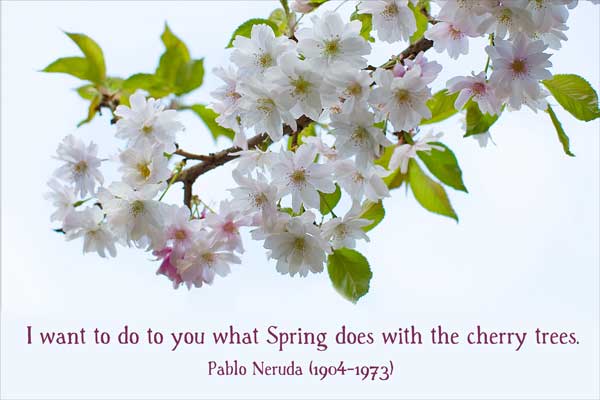
I want to do with you what spring does with the cherry trees.
As you can see, we have teamed up those jaw-dropping, sizzling final two lines of Neruda’s poem with our photo of a branch of sunshine-soaked cherry blossoms.
Writing this right before Valentine’s Day in the depths of winter as I am here in Edinburgh so north in the UK, those divine final lines of Neruda’s writing and the vision of those sprightly cherry blossoms are such a much-needed tonic.
Valentine’s Day Greeting Cards
Did you know, we make a range of Valentine’s Day cards available at our sister site at Flying Twigs. We supply customers in the UK and some other countries. Check the FAQ page to see whether your country is on the list of countries to which we ship.
The Dreaming Spires Of Oxford – A Quillcards Ecard Image
And that sweet city with her dreaming spires,
She needs not June for beauty’s heightening.
Matthew Arnold… inspector of schools, poet, and social critic who warned of, among other things, the dangers of sensationalist journalism and supernatural religion.
The quote about dreaming spires is from his poem Thyrsis. It is a long poem – 1863 words over 240 lines and 24 stanzas.
The lines about the dreaming spires are on lines 19 and 20 at the end of the second stanza.
Arnold wrote the poem as an elegy to his friend and fellow poet, Arthur Clough, who died aged 42 from malaria he contracted in Italy.
In the poem, Arnold describes Clough as Thyrsis, an archetype shepherd-poet of Ancient Greece.
And he describes how he and Clough explored the countryside around Oxford when they were students and he reflects on what happened to their ideals after they left university.
As to what happened to Arthur Clough and his ideals… well he devoted years of his life as the unpaid secretarial assistant to Florence Nightingale so that she could pursue her work in improving hygiene in hospitals.
Here are the first two stanzas of the poem:
How changed is here each spot man makes or fills!
In the two Hinkseys nothing keeps the same;
The village street its haunted mansion lacks,
And from the sign is gone Sibylla’s name,
And from the roofs the twisted chimney-stacks–
Are ye too changed, ye hills?
See, ’tis no foot of unfamiliar men
To-night from Oxford up your pathway strays!
Here came I often, often, in old days–
Thyrsis and I; we still had Thyrsis then.
Runs it not here, the track by Childsworth Farm,
Past the high wood, to where the elm-tree crowns
The hill behind whose ridge the sunset flames?
The signal-elm, that looks on Ilsley Downs,
The Vale, the three lone weirs, the youthful Thames?–
This winter-eve is warm,
Humid the air! leafless, yet soft as spring,
The tender purple spray on copse and briers!
And that sweet city with her dreaming spires,
She needs not June for beauty’s heightening.
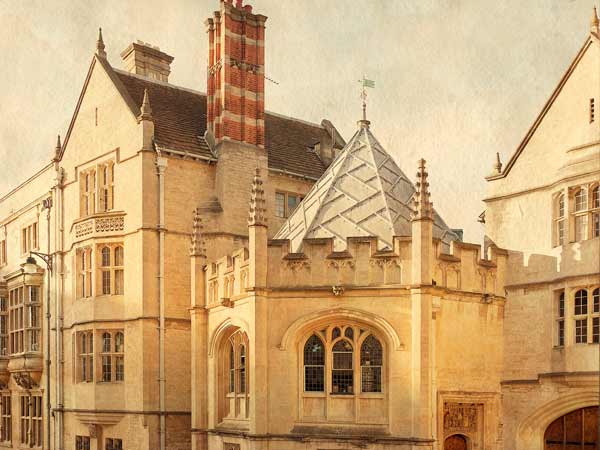
We took the photo of the dreaming spires on a trip to Oxford a few years ago, and you can find the photo in the Cities and Buildings section of The Constructed World theme at Quillcards.
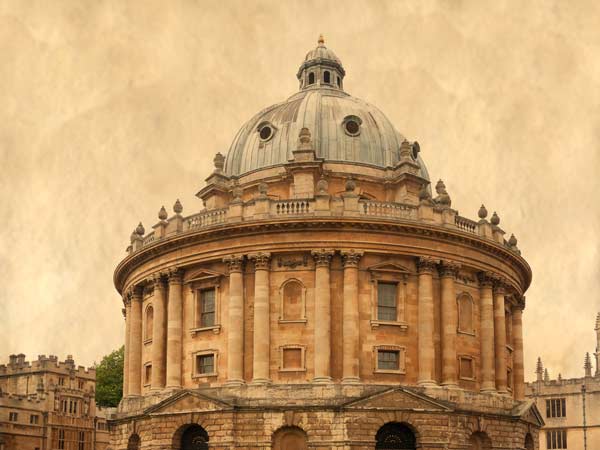
You will also find this photo of The Radcliffe Camera there. The Radcliffe Camera is part of Oxford University and was built to house the Radcliffe Science Library. Quite something, isn’t it.
[The word ‘camera’ is Latin for ‘room’]
The Radcliffe Camera in Oxford – A Quillcards Ecard Image