Saint Petersburg Diary – Part Three

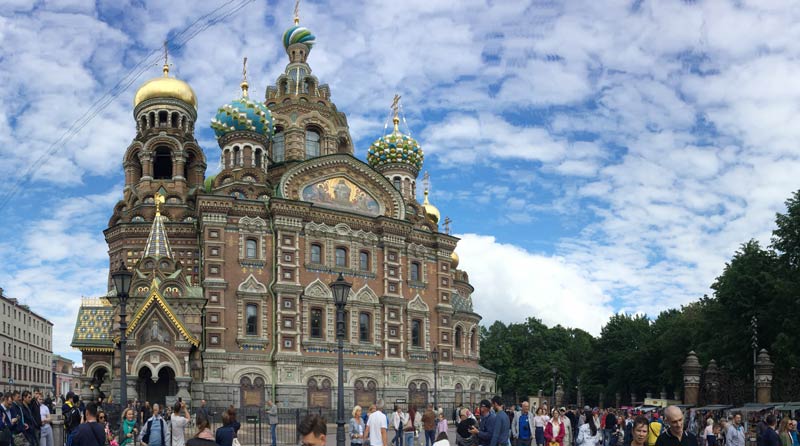
The Church of The Spilled Bloodin Saint Petersburg marking the scene of the assassination of Alexander II

We queue for tickets and go into the Church of The Spilled Blood. There’s a monument inside marking the spot where Alexander II was assassinated.

As I explained in Part I of this diary, assassins threw a bomb at his armoured carriage and succeeded only in hurting some people who were nearby. Alexander got out of the carriage to see what was going on and the second bomb killed him. And now there is this church to mark the spot.

We wonder what caused him to get out of the carriage. The reports suggest that he just didn’t think he could be hurt. We wonder whether the contemporary reports are accurate. Did something else happen?

Every surface of the interior of the church is decorated with highly-coloured scenes made from tiny pieces of marble.
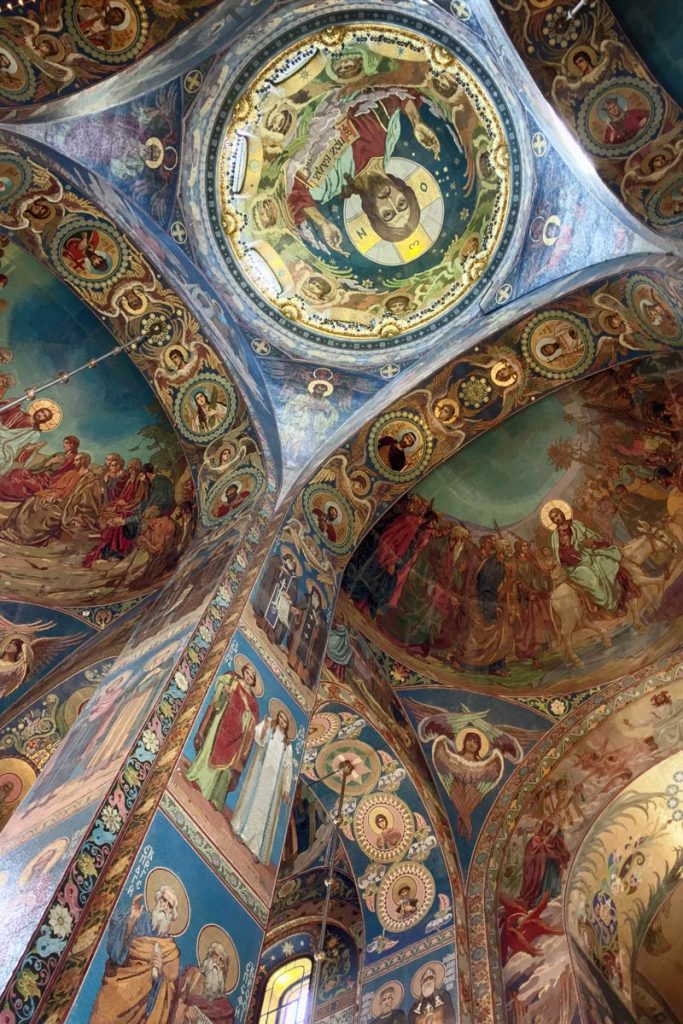
interior of the church-of-the-spilled-blood-in-saint-petersburg

Anna Akhmatova Museum

We go to the Anna Akhmatova museum (more about Anna Akhmatova to follow in a later post) where this image is on a wall in the alleyway leading to the museum.

The alley itself gives a flavour of how not everything in Saint Petersburg is well renovated. We think it is not a matter of care but of a lack of money.
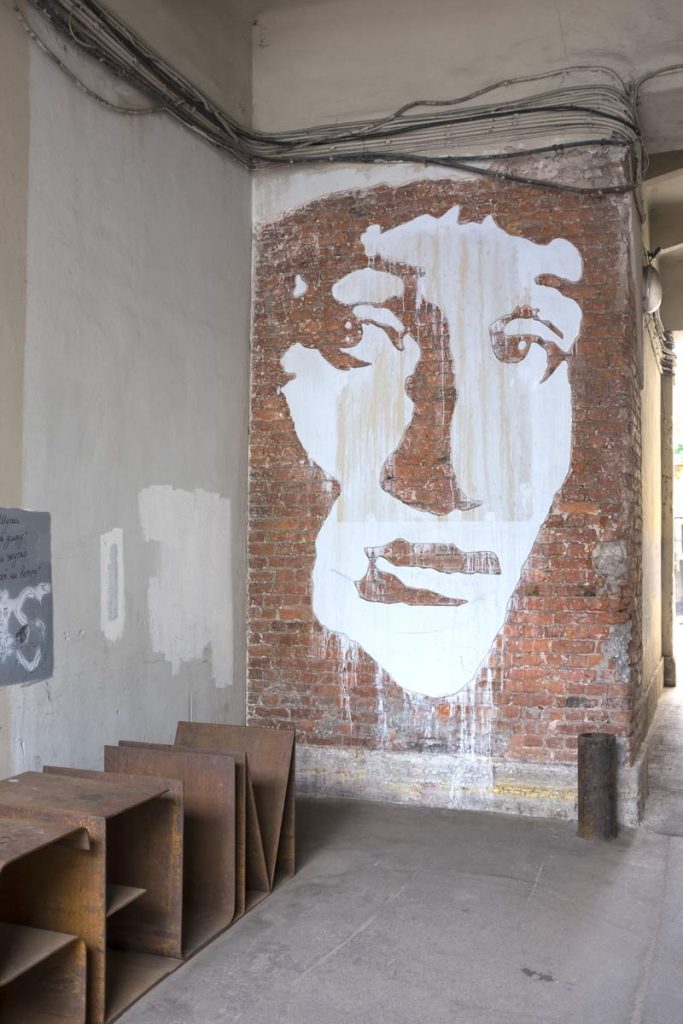
image of Anna Akhmatova on the wall of the alley leading to the museum in Saint Petersburg

The Museum of Russian Political History

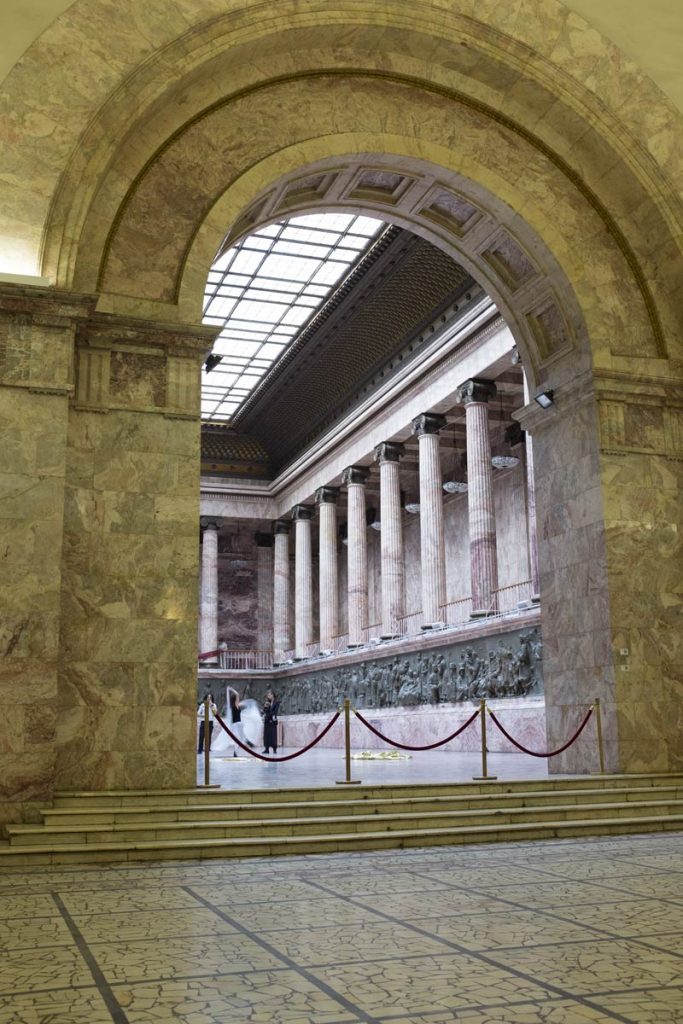
And then to the Museum of Russian Political History. The layout is more imaginative and impressionistic than we imagined such a museum would be.

The room in this photo covers the period of the Alexanders leading on to the Russian Revolution.
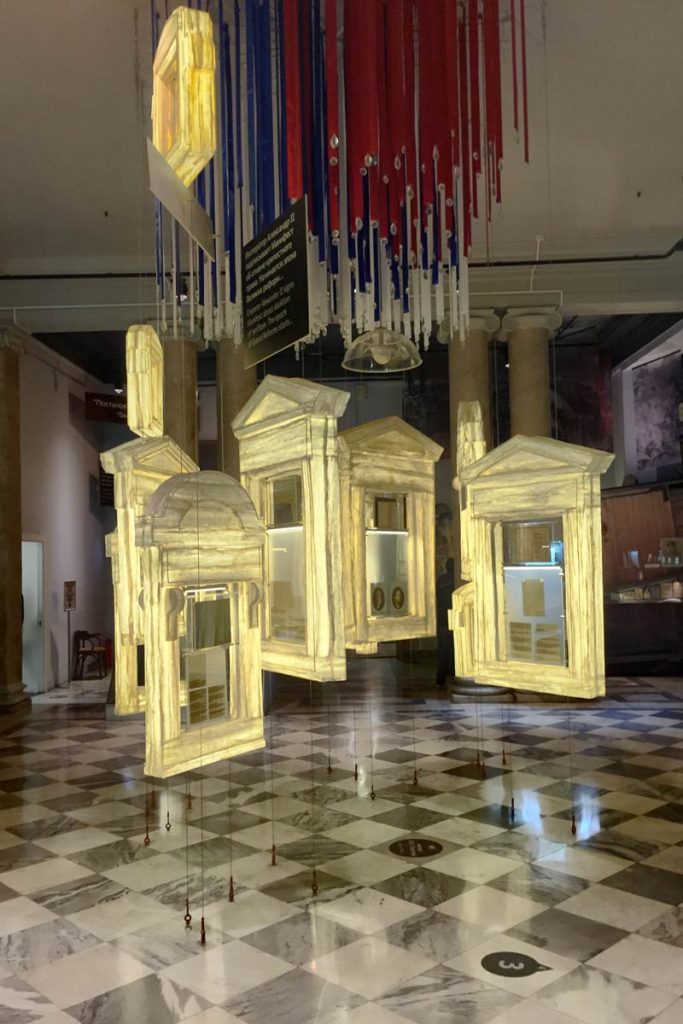
room in the museum of political history in Saint Petersburg

It is a State museum and we expect the criticism (if any) of the Stalinist era to be mild. In fact, it is highly-critical.

I take scans of the descriptions written on the walls, and convert the text to readable text so that I can post it here. At the entrance to the rooms covering the Stalinist era there is this:

The Soviet Epoch: Between Utopia and Reality 1917-1953 – Dear Visitor!

The hall you entered is a labyrinth, a kind of corridor of power, in which almost no room is provided for human freedom. We suggest you to pass it in order to compose the ‘portrait’ of the Stalin’s political regime, defined by historians as totalitarian.

During Stalin’s epoch the Bolshevik’s policy was characterised by ultimate centralisation of management, dictatorship of the Communist party and its ideology and complete disparity between slogans and reality.

Radical reforms in economy and society were carried out with repressive methods, corresponded by unacceptable
rates of growth of standards of life and almost total ignorance of all human rights.

Museum exhibits and images of those times life provide an understanding of the essence of Stalin’s rule, of its objectives and methods. The State’s directives interfered in personal lives and subordinated them to a firm control of culture and social life. Witnesses of the past will show you how people treated the decisions and actions of the authorities and, most importantly, how they lived in those conditions.

Both the utopia of a ‘happy future’ and ‘reality-heroic’ and the tragic simultaneously-intertwined closely, creating ‘the Soviet style of life’.

Journey along the labyrinth will show you that the gap between declared ideals and practice became wider with every period of the USSR development.

The more became this gap, the more massive became the intervention of ideology in all spheres of life.

Stalinism both before the second world war and up to Stalin’s death in 1953 was based on preventive terror and repression as well as excluding any forms of pluralism in ideology and policy.

Viewing the exhibition will be accompanied with songs, which at that time were sounding every day. Major, stately and lyric – they stated heroics of the daily-life of building socialism and the actual achievements of Soviet people, but at the same time thrust on people the image of life different from reality.

The Recent Past

We absorb the criticism of Stalinist Russia and expect that the modern era will be treated more kindly. But no, there are equally critical words for the 1990s.

21st September 1993
Moscow. President of the Russian Federation Boris Yeltsin issues a decree ‘On Gradual Constitutional Reform’, suspends the Supreme Soviet of the Russian Federation and calls for elections to the new legislative body, the State Duma. The Supreme Soviet considers Yeltsin’s move as a coup-detat…

Yuri Nesterov, a delegate at the 10th (Emergency) Congress of People’s Deputies of Russia on September 23, 1993, claims in his speech that the barricade that divided the society into advocates of economic reforms and advocates of a law-based democracy has grown higher today. This incongruous and at the same time tragic barricade represents a new wound that will take a long time to heal.

16th June 1996
The first round of the Russian presidential elections. Pre-election spin technologies are applied on a mass scale. Big business and oligarchs pay for the presidential election campaign ‘Vote or Lose!’ Boris Yeltsin’s rating grows from 5 to 35%…

Gennady Zyuganov, one of the presidential candidates, writes in his memoirs (1996) that few were expecting such a total ‘brainwashing’ from the mass media or fierce pressure from the local governments. The ruling regime succeeded in implanting a barrier of fear in millions of Russian voters making them indifferent to the Communist Party’s call for redeeming basic social values: justice, honesty and solidarity.

It is strange to be in Russia and read that “justice, honesty and solidarity” are left in the dust of history.
Chizhik-Pyzhik in Photos

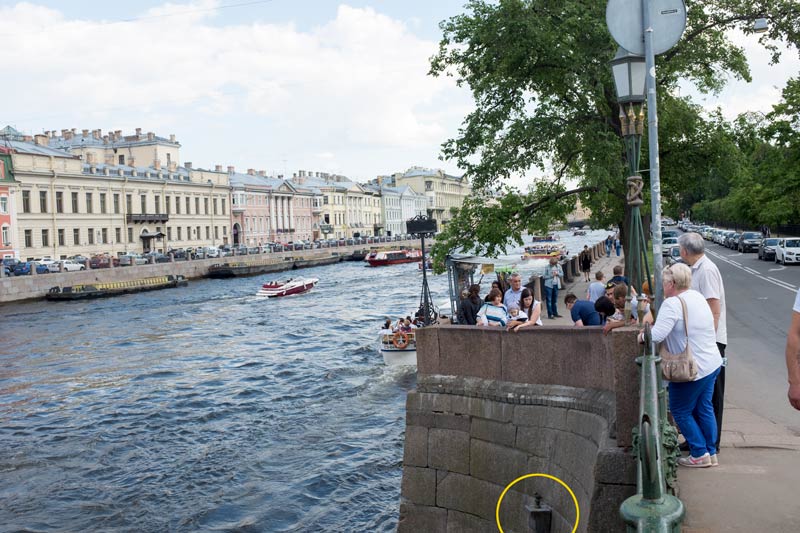
Chizhik-Pyzhik - tiny statue of a bird on a pedestal built into the stonework of the riverside near the Pantelejmonov bridge that crosses the River Fontanki in Saint Petersburg

Chizhik-Pyzhik is a tiny statue of a bird.

It is on a pedestal built into the stonework of the riverside near the Pantelejmonov bridge that crosses the River Fontanki in Saint Petersburg.

I’ve highlighted it in yellow on the photo above.

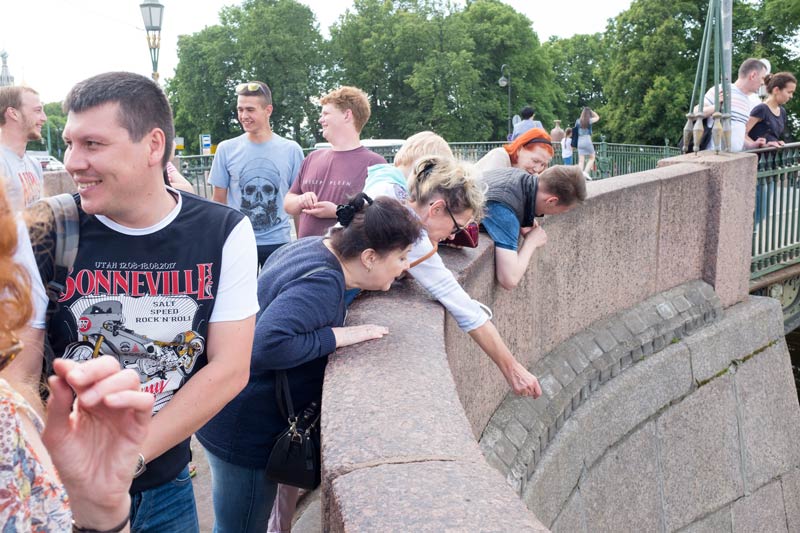
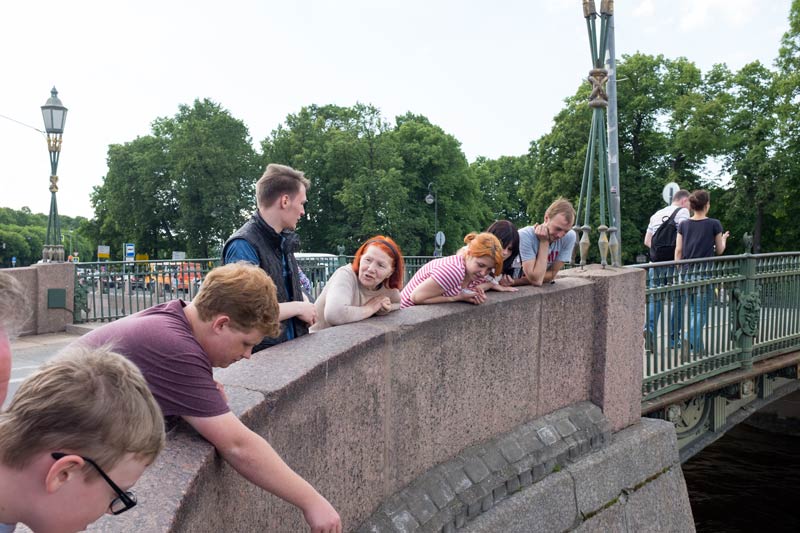
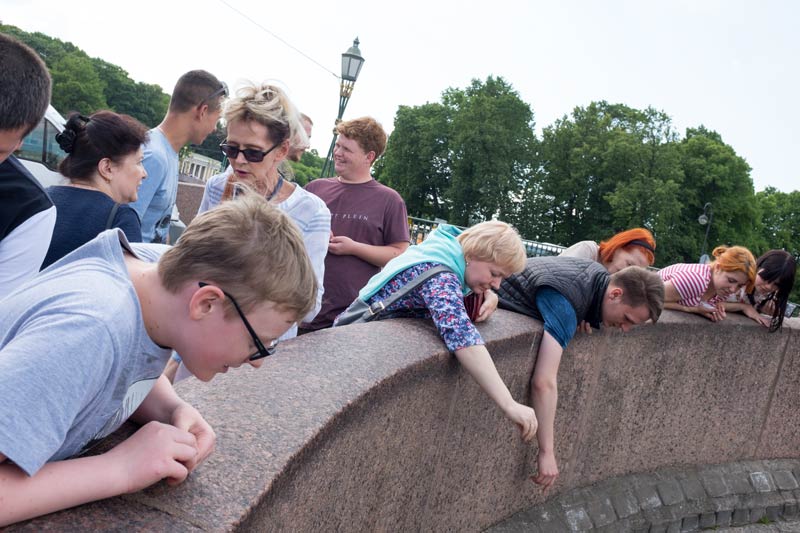
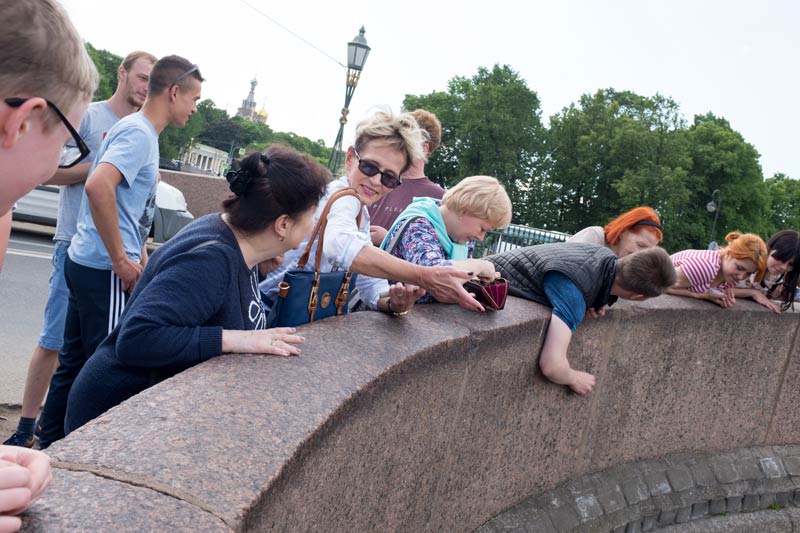
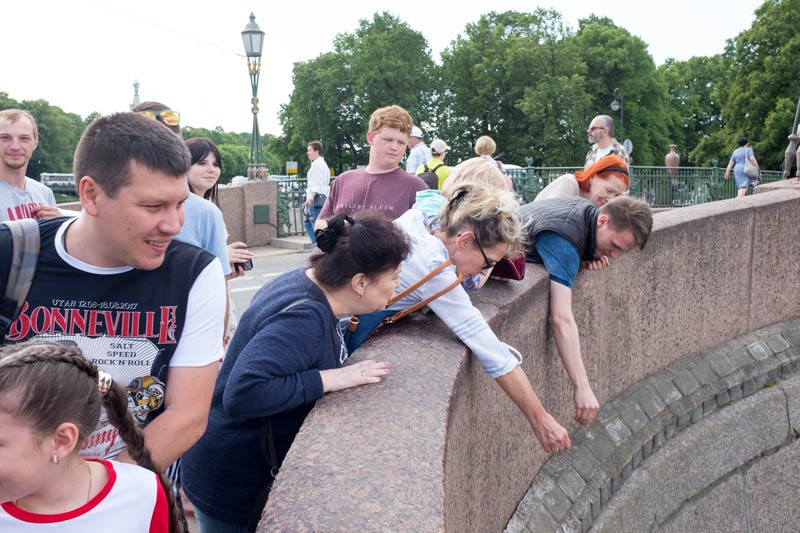
Locals like to throw small coins onto the platform near the bird’s legs in the belief that if the coin lands on the platform, their wish will come true.

The origin of the name Chizhik-Pyzhik is lost in the mists of time, but one story says it comes from a song sung by the law students at the then nearby Imperial School of Jurisprudence. The school dress was yellow and green, which is reminiscent of the colours of the siskin (chisik in Russian).

So – here are Russians enjoying themselves throwing coins onto Chizhik-Pyzhik’s platform.

Chizhik-Pyzhik - tiny statue of a bird on a pedestal built into the stonework of the riverside near the Pantelejmonov bridge that crosses the River Fontanki in Saint Petersburg

Chizhik-Pyzhik - tiny statue of a bird on a pedestal built into the stonework of the riverside near the Pantelejmonov bridge that crosses the River Fontanki in Saint Petersburg

Chizhik-Pyzhik - tiny statue of a bird on a pedestal built into the stonework of the riverside near the Pantelejmonov bridge that crosses the River Fontanki in Saint Petersburg

Chizhik-Pyzhik - tiny statue of a bird on a pedestal built into the stonework of the riverside near the Pantelejmonov bridge that crosses the River Fontanki in Saint Petersburg

Chizhik-Pyzhik - tiny statue of a bird on a pedestal built into the stonework of the riverside near the Pantelejmonov bridge that crosses the River Fontanki in Saint Petersburg

Chizhik-Pyzhik - tiny statue of a bird on a pedestal built into the stonework of the riverside near the Pantelejmonov bridge that crosses the River Fontanki in Saint Petersburg

Saint Petersburg Diary – Part Two

ethnographic-museum-in-saint-petersburg

Continuing from Part One of our Saint Petersburg Diary…

We go to the Ethnographic Museum where the first thing is to get through the door. It is massive and heavy and gives way onto this main corridor – lovely, as you can see.

We spend hours there looking at rare photos, costumes, and things from cultures from one end to the other of mother Russia.

The people of the north as as different as you can imagine from the people of the south or of the east. One floor has the history and culture of Jews in Russia.

We wonder whether all these peoples have moved towards a culture of modern mediocrity in the 21st century. Perhaps we should journey all the way across Russia to find out.

main-corridor-inside-the-ethnographic-museum

Tamara wants to buy the guide to the museum and a guide to the history of the Jews in Russia, but the bookshop in the museum is closed. It closes well before the museum’s closing time. It is closed the next time as well when we make a special trip to the museum to buy the books.

It becomes a running joke between us. Will the shop ever be open? On the third or fourth try the shop is open and Tamara buys the books.

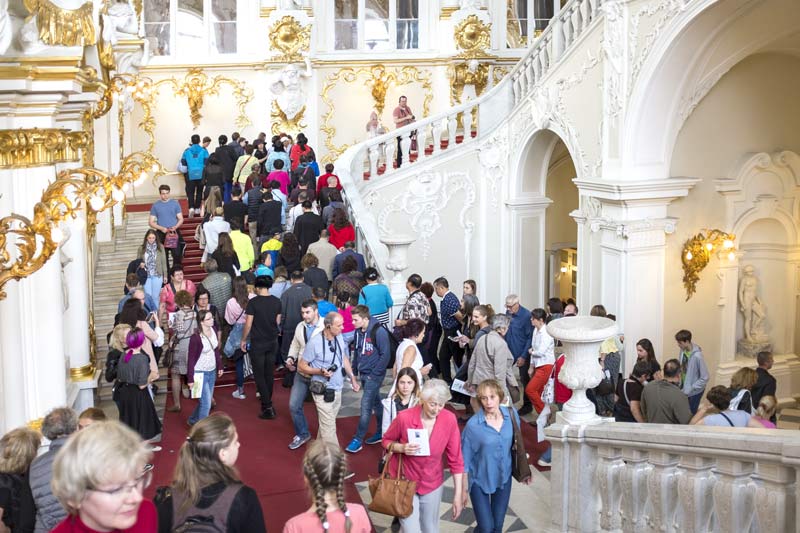
The next day we go to the Hermitage in what was the Czar’s Winter Palace. We climb the Jordan steps. I stand back on a corner of the staircase and find myself in a family group having my photograph taken along with the rest of the family. Tamara laughs to see me trapped in among this family, a foot taller than everyone.

I imagine the family back home after its holiday, showing the photos and someone asking who the tall man at the back is.

Jordan staircase Winter Palace Saint Petersburg

The Jordan Steps in the Winter Palace in Saint Petersburg

Once up the steps there are endless grand, opulent rooms packed to bursting with snaking lines of tour groups but empty of things. At every doorway there is a crush of groups going this way and that trying to pass each other.

At one end of a palatial room there is Alexander Nevsky’s tomb in dark stone and black metal – the sole exhibit in the room.

This is not a museum with exhibits, it is a former palace. We really should have read the guide book more carefully, because the Winter Palace is just that – a palace. It is rich and sumptuous, but more or less empty.

What do the tour groups see as they rush with their eyes fixedly on their tour leaders as they snake through the palace and then back to the cruise ships in the harbour? They have the photos to prove it.

It is a crazy scene, filled to bursting with people.

Standing Where History Was Made

We go into a small dining room off one of the grand rooms. There is no one else in it but there are signs saying not to touch anything. In 1917 it was occupied by the Provisional Government that formed immediately following the abdication of Tsar Nicholas II.

It is into this room that the Bolsheviks came and simply arrested the Provisional Government. It is eerie to stand in a room where world history was made.

Later we learn that the Bolsheviks had captured the Peter and Paul fortress across the river Neva and turned the guns of the fortress on the Winter Palace and shelled it. That must have added authority to their claim when they burst into the dining room to carry out the arrest.

Art, Give Me Art

We go to the cafe in the palace. It is set off from a corridor on the ground floor amid swirling tour groups. It seems that the whole world must have passed here.

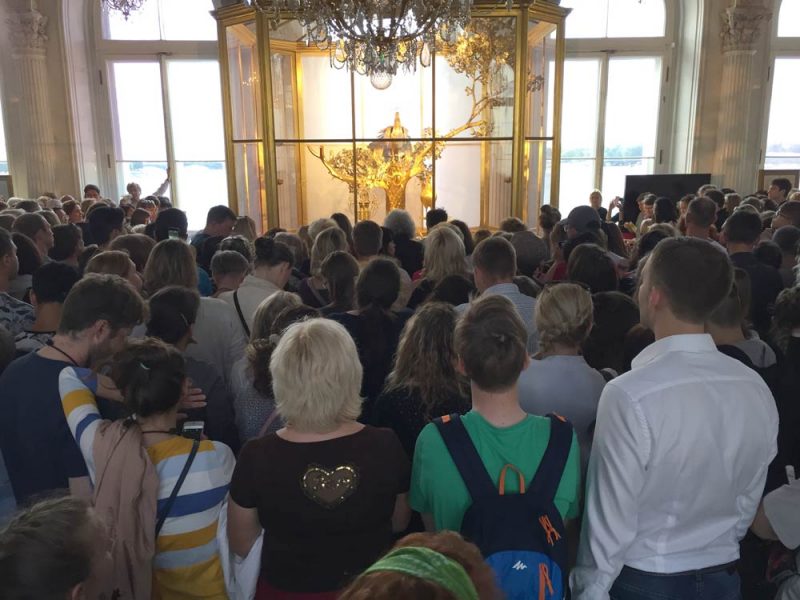
We ask directions to paintings by Flemish artists. They are in a wing of the palace far from where we are. On the way we make our way through a crowd waiting for a clock to strike.

In the Winter Palace in Saint Petersburg - hordes of tourists waiting for the clock to strike

We reach the Flemish paintings. Bruegel and others are badly hung with poor lighting, high up and impossible to view properly. What a mess.

We find a better room with wonderful Rembrandt paintings.

portrait by Rembrandt

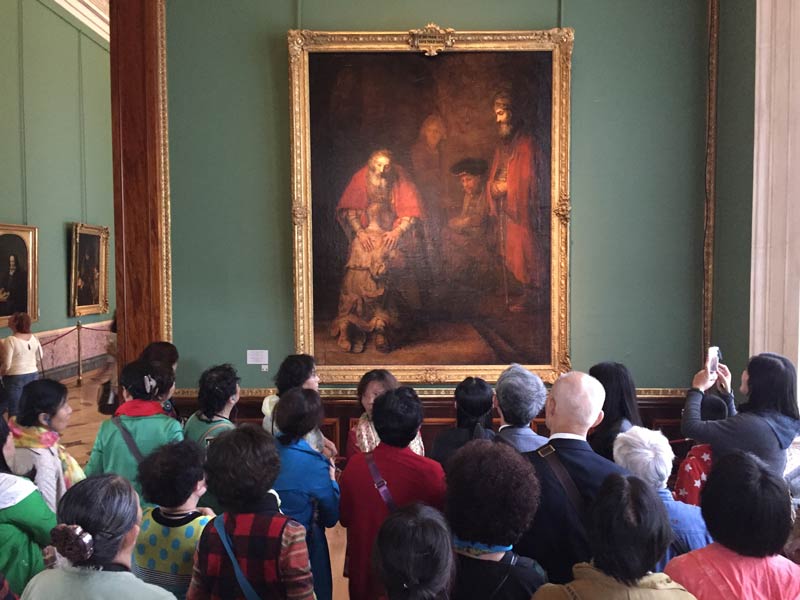
We wait for a group to pass so we can see Rembrandt’s The Prodigal Son. It’s a favourite of the tour group leaders and as one group moves on another speeds in. We get near the painting by gatecrashing a tour group.

tour group in front of Rembrandt's The Prodigal Son in the Hermitage in Saint Petersburg

The Great Choral Synagogue

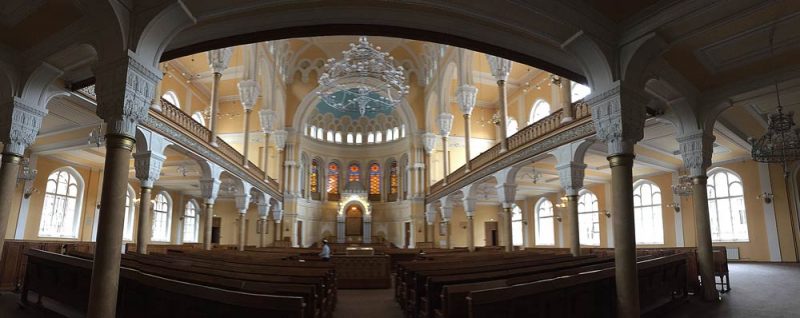
We go to the Great Choral Synagogue. This is ‘our’ section of town, not a foreign cultural experience.

The Great Choral Synagogue in Saint Petersburg

In the synagogue shop Tamara buys a set of Russian dolls featuring Chagall paintings.

Prince Igor at the Mariinsky

That night we go to see the opera Prince Igor at the Mariinsky Theatre. Quite a lot of people are dressed stylishly. We have good seats (bought beforehand in England) with a good view of the stage.

We are in the dress circle and I imagined that would be raised higher up above the stalls. In fact, we can almost lean over and touch those seats. It is an unusual experience that feels like we are back in time when things were more intimate.

We talk to the man in the seat next to us. He is from Ulyanovsk and has seen the opera five times but never live. He tells us that Prince Igor had its premiere here in the Mariinsky. It is a two-hour flight from Ilyanovosk to Saint Petersburg but a day and a half by train because there is no fast train from Ulyanovsk to Moscow.

The opera is strangely different, with lots of people on stage and a weighty performance that is both strange and moving.

Not everyone is so taken with the opera, judging by people in the stalls who are looking at their cellphones during the performance. The lights of their phones show up with little rectangular lights in the darkness.

Saint Isaac’s Cathedral

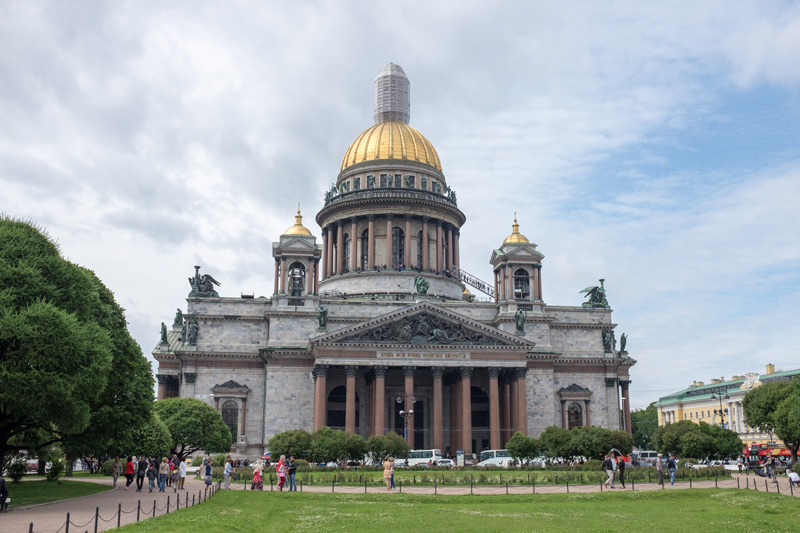
We queue up for tickets outside the cathedral. I direct queue-jumpers to the line behind us. Russians in front of us are somewhat bemused at me directing people. When I smile, they come to life as though they previously thought we were in another dimension.

saint isaac's cathedral in Saint Petersburg

Nabakov’s House

We visit Nabakov’s house which near Saint Isaac’s Cathedral. Nabakov came from a wealthy family. The family owned and occupied the whole house and the house is in a good area and the rooms are wood-panelled. We learn that Nabakov discovered a blue butterfly in Albany when he was in the USA. It is named after him.

The young woman at the desk, Alina, shows us one of the rooms that have not yet been restored. The panels are stained and the ceiling is missing in parts. Alina tells us the house was in disrepair for years and it is a long job to renovate it. We ask her how Nabakov is regarded in Russia today. She said he is highly regarded now that censorship is less than it was – they have Fifty Shades Of Grey, for example.

She explains how when Nabakov was teaching in the USA, he translated Eugene Onegin into English and scoured advertisements in magazines to get idiomatic expressions that his students could relate to. She uses this example to explain how proficient Nabakov was, to be able to use idioms in a foreign language with precision.

Tamara pointing at the plaque on the wall of Nabakov's house

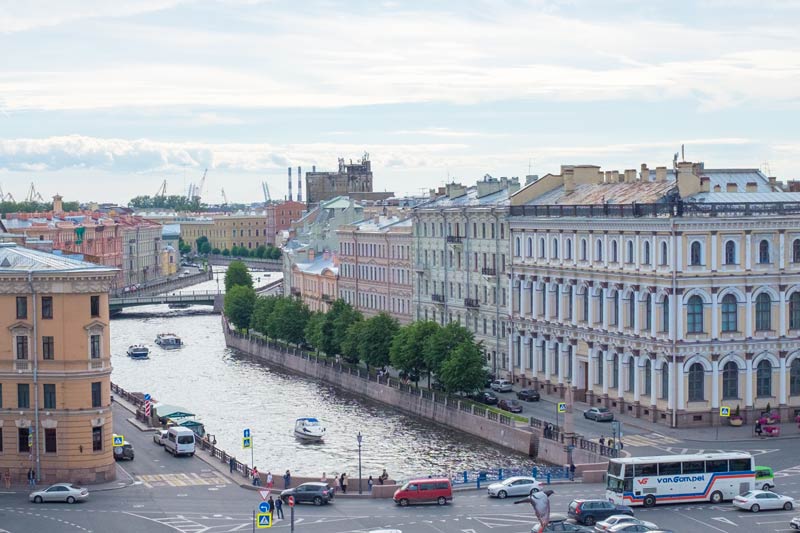
Back on the street and opposite Saint Isaac’s cathedral, Tamara spots the Lotte Hotel. She thinks it might be Korean. We ask and it is indeed Korean and we are invited in and given a special tour of the atrium dining room and up to the sixth floor (as yet unopened) and the roof terrace for a view over the canals and the cathedral.

We learn that John Quincy Adams, when ambassador to Russia, stayed in the building that is now the hotel, and that Gogol lived there.

view from the roof terrace of the Lotte hotel in Saint Petersburg

The Dostoyevsky Museum

The next day we go to the Dostoyevsky Museum, which is really just his apartment. It is an ordinary apartment, not grand. His hat is there under a glass dome, and his desk and papers. There is one poignant object – a box (a matchbox?) on which his daughter had written ‘Papa died today.’

We learn that the Kazan Cathedral we had visited features in his novel ‘Crime and Punishment’.

We read later that thousands of people attended his funeral. We knew he had fame in his own lifetime but we didn’t know he was so famous that thousands would attend his funeral.

Daily Life In Saint Petersburg

And now, as they say, for something completely different: It’s things we noticed, things that caught our eye.

The first observation is that pigeons are very relaxed – obviously nobody bothers them. They move out of the way a few scant inches and continue their lives. Lots of people feed them as well.

Everywhere – on the street and even churches in front of religious icons – young and middle aged women pose for photos. They pose provocatively like sultry 1950s pinups – three-quarters to the camera, bust pushed forward, head back.

House sparrows are everywhere – lots and lots of them. House sparrow numbers in the UK have crashed and now we know where they are: They have immigrated to Russia.

We have seen several men – young and older – with a mouth half full of gold teeth.

Metro stations are spotless. The metro trains are squat, square, and utilitarian. The corridors down to the trains are finished in marble and clean as a pin.

The streets are swept regularly.

Couples on the street kiss deeply and amorously – not just a peck on the cheek.

There are quite a number of Central Asian people on the street – mostly men.

Trash bins just a couple of feet tall are every thirty yards along the main streets and emptied overnight.

In the courtyards, behind the facades of the buildings – even on Nevsky Prospect – the paintwork is peeling and buildings are more run down. How deep is the prosperity? There are a lot of expensive cars on the road – top of the range Audis, BMWs, and Mercedes.